
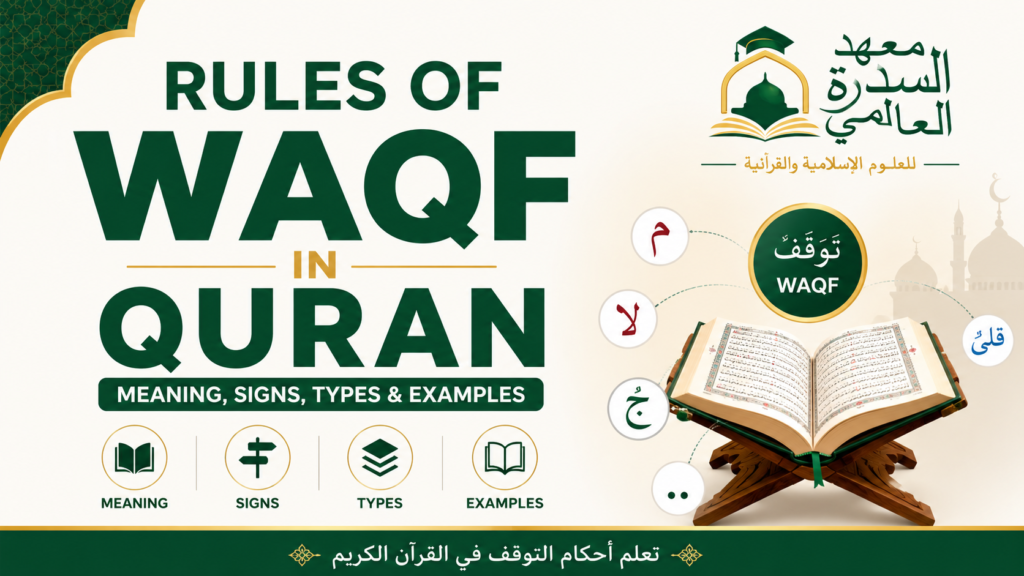
Learning the Quran is not only about pronouncing Arabic letters correctly. It also involves knowing where to stop, pause, and resume recitation. These stopping rules are known as Waqf. Understanding the rules of Waqf in Quran helps preserve the meaning of Allah’s words, improves fluency in recitation, and strengthens one’s connection with the Quran.
Whether you are a beginner studying Noorani Qaida, a student of Tajweed, or someone memorizing the Quran, learning Waqf signs is an essential step toward proper Quran recitation.
Quick Answer
Waqf in Quran refers to stopping or pausing during recitation at specific places indicated by Tajweed rules and Quranic symbols. These stopping signs guide readers on whether they should stop, may stop, should continue, or must not stop. Proper use of Waqf helps preserve the intended meaning of Quranic verses and prevents misunderstandings during recitation.
What Is Waqf in Quran?
The Arabic word Waqf (وقف) literally means “to stop,” “to pause,” or “to halt.”
In the science of Tajweed, Waqf refers to stopping the recitation of the Quran at a particular word for a short period, usually to take a breath, while intending to continue reading afterward.
Waqf is not a random pause. It follows established rules developed by Quran scholars to ensure that the meaning of the Quran remains clear and accurate.
Definition of Waqf in Tajweed
Waqf is the act of temporarily stopping during Quran recitation at a place where the meaning remains complete or where stopping is recommended according to Tajweed principles.
Why Is Waqf Important in Quran Recitation?
Many people focus on pronunciation but overlook the importance of stopping correctly. However, stopping at the wrong place can alter or confuse the meaning of a verse.
1. Preserves the Meaning of the Quran
The Quran was revealed with precise wording and meaning. Correct pauses help convey the intended message without distortion.
2. Improves Recitation Quality
Knowing where to stop and continue creates a smoother and more beautiful recitation.
3. Helps Quran Memorization
Students of Hifz often use Waqf points as natural memory markers, making revision easier.
4. Strengthens Understanding
Proper stopping points allow readers to reflect on meanings and understand the flow of Quranic verses.
What Is Ibtida and How Is It Related to Waqf?
Waqf and Ibtida are closely connected concepts in Tajweed.
What Is Ibtida?
Ibtida (ابتداء) means “to begin” or “to start.”
It refers to resuming recitation after stopping.
Difference Between Waqf and Ibtida
| Waqf | Ibtida |
| Stopping during recitation | Starting recitation after a stop |
| Concerned with pause points | Concerned with restart points |
| Prevents incorrect stopping | Prevents incorrect restarting |
A person may stop correctly but restart incorrectly, which can also affect meaning. Therefore, scholars traditionally teach Waqf and Ibtida together.
Types of Waqf in Tajweed
Islamic scholars classify Waqf into several categories based on meaning and context.
1. Waqf Lazim (Necessary Stop)
This is a mandatory stop.
If the reader continues without stopping, the meaning may become confusing or incorrect.
Symbol:
م
Rule:
Stop here.
2. Waqf Jaiz (Permissible Stop)
The reader may stop or continue.
Both options are acceptable.
Symbol:
ج
Rule:
Stopping is allowed.
3. Waqf Mamnu (Prohibited Stop)
Stopping here is not recommended because the meaning remains incomplete.
Symbol:
لا
Rule:
Do not stop unless absolutely necessary.
4. Waqf Mutlaq (Preferred Stop)
A complete thought has ended.
Symbol:
ط
Rule:
Stopping is preferred.
5. Waqf Kafi (Sufficient Stop)
The meaning is complete, although it remains connected to what follows.
Rule:
Stopping is permissible and often beneficial.
6. Waqf Hasan (Good Stop)
The sentence is understandable, but the next portion remains related.
Rule:
Stopping is allowed, but continuation may be better.
7. Waqf Qabih (Bad Stop)
Stopping causes an incomplete or misleading meaning.
Rule:
Avoid stopping here.
Complete Table of Waqf Signs in Quran
The following chart summarizes the most common Waqf symbols found in many Mushafs.
| Symbol | Name | Meaning | Rule |
| م | Waqf Lazim | Necessary stop | Must stop |
| ج | Waqf Jaiz | Permissible stop | May stop |
| لا | Waqf Mamnu | No stop | Continue |
| ط | Waqf Mutlaq | Complete stop | Better to stop |
| قلى | Better to stop | Preferred stop | Stop recommended |
| صلى | Better to continue | Continue preferred | Continue recommended |
| ∴ | Mu’anaqah | Paired stopping signs | Stop at one, not both |
This table serves as a quick reference for beginners learning Quran stopping rules.
Common Waqf Symbols Explained With Examples
م (Waqf Lazim)
This sign indicates that stopping is necessary to preserve the intended meaning.
Example
When a sentence reaches a complete meaning and continuing could create confusion, the Mushaf places the symbol م.
Practical Rule
Always stop here before continuing.
لا (No Stop Sign)
This sign indicates that stopping is not appropriate because the thought is incomplete.
Practical Rule
Continue reading without pausing if possible.
Common Beginner Mistake
Stopping at لا simply because a breath is needed.
If breathing becomes necessary, stop and then restart carefully from an appropriate place.
ج (Permissible Stop)
The symbol ج indicates flexibility.
Practical Rule
You may stop or continue based on your breath and reading pace.
ط (Complete Stop)
This sign indicates that the meaning has reached completion.
Practical Rule
Stopping is generally better than continuing.
قلى (Stopping Preferred)
The meaning is complete and stopping helps clarity.
Practical Rule
Stopping is recommended.
صلى (Continuing Preferred)
The meaning is connected to the next phrase.
Practical Rule
Continuing is better than stopping.
Mu’anaqah Signs (Paired Dots)
Sometimes two sets of three dots appear close together.
Rule
Stop at one of them but not both.
This ensures the meaning remains connected properly.
Rules of Stopping (Waqf) and Starting (Ibtida)
Understanding symbols alone is not enough. A reader must also know how to stop and restart correctly.
When Stopping
- Complete the word before pausing.
- Do not cut a word in the middle.
- Observe the Waqf symbol whenever possible.
- Maintain proper pronunciation.
When Restarting
- Begin from a meaningful point.
- Avoid restarting from a phrase that changes the intended meaning.
- Review the surrounding verse if unsure.
What Happens When You Stop in Quran Recitation?
When making Waqf, several pronunciation changes may occur.
For example:
- Final vowels are often dropped when stopping.
- Certain ending sounds become sukoon.
- Pronunciation may differ slightly compared to continuous recitation.
These rules are studied in advanced Tajweed lessons and help maintain accurate recitation.
Can You Stop at Every Verse in the Quran?
This is a common question among beginners.
In general, stopping at the end of a verse is permissible, even when a specific Waqf sign is not present.
However, understanding the meaning remains important.
Some verses continue a thought into the next verse, so advanced students should learn both verse endings and Waqf rules to achieve the best recitation.
Importance of Waqf for Quran Memorization
Students memorizing the Quran benefit greatly from learning Waqf signs.
Better Revision
Natural stopping points make memorized passages easier to review.
Improved Retention
Breaking verses into meaningful sections helps memory.
Stronger Understanding
Memorization becomes more meaningful when connected to the verse’s message.
More Confident Recitation
Knowing where to pause reduces hesitation during recitation.
Common Mistakes Beginners Make
Many new learners struggle with Waqf because they focus only on reading Arabic words.
1. Ignoring Waqf Signs
Some readers overlook the symbols entirely.
Solution
Practice identifying signs before starting recitation.
2. Stopping Because of Breath Alone
Taking a breath is important, but stopping should also respect meaning whenever possible.
Solution
Develop breath control and become familiar with common Waqf signs.
3. Stopping at Incorrect Places
Incorrect pauses may alter meaning.
Solution
Study with a qualified Quran teacher.
4. Restarting Incorrectly
A wrong restart point may create confusion even if the stop was correct.
Solution
Learn Waqf and Ibtida together.
Practical Tips to Learn Waqf Faster
Study Tajweed Systematically
Waqf is one chapter within Tajweed. Learning it as part of a complete Tajweed curriculum helps build understanding.
Use a Mushaf That Clearly Displays Symbols
Many modern Mushafs print Waqf signs clearly, making them easier to recognize.
Practice Daily
Even ten to fifteen minutes of focused recitation can improve recognition of stopping signs.
Listen to Skilled Qaris
Pay attention to how experienced reciters stop and resume during Tilawah.
Learn With a Teacher
Personal feedback helps correct mistakes quickly and builds confidence.
Waqf Signs Quick Reference Chart
| Symbol | Meaning |
| م | Mandatory stop |
| ج | Permissible stop |
| لا | Do not stop |
| ط | Complete stop |
| قلى | Better to stop |
| صلى | Better to continue |
| ∴ | Stop at one sign only |
Keeping this chart nearby can help beginners learn Waqf symbols more quickly.
Common Misconceptions About Waqf
Misconception 1: Waqf Signs Are Part of the Quran
The symbols are not Quranic words. They were added by scholars to help readers recite correctly.
Misconception 2: Every Stop Is Equal
Different stopping points carry different rulings and recommendations.
Misconception 3: Beginners Do Not Need Waqf
Even beginners benefit greatly from learning basic Waqf signs early.
Misconception 4: Waqf Is Only for Advanced Students
Basic Waqf signs are important for every Muslim who recites the Quran.
Key Takeaways
- Waqf means stopping or pausing during Quran recitation.
- Waqf signs guide readers on where to stop and continue.
- Proper Waqf preserves the meaning of Quranic verses.
- Waqf and Ibtida should be learned together.
- Common symbols include م, ج, لا, ط, قلى, and صلى.
- Learning Waqf improves Tajweed, fluency, understanding, and memorization.
- Every Quran student should understand the basic rules of Waqf.
Frequently Asked Questions
What is Waqf in the Quran?
Waqf is the act of stopping or pausing during Quran recitation according to established Tajweed rules and stopping signs.
What are Waqf signs in Quran?
Waqf signs are symbols placed in the Mushaf to guide readers on where stopping is mandatory, permissible, preferred, or discouraged.
How many Waqf signs are there in the Quran?
Different Mushafs may include slightly different systems, but the most commonly taught signs include م, ج, لا, ط, قلى, صلى, and Mu’anaqah symbols.
What does م mean in Quran stopping signs?
The symbol م represents Waqf Lazim, which indicates a necessary stop.
What is the meaning of لا in Quran?
The symbol لا means “do not stop” because stopping there may leave the meaning incomplete.
What is Waqf Lazim?
Waqf Lazim is a mandatory stopping point where continuing without a pause may affect the meaning.
What is Waqf Jaiz?
Waqf Jaiz indicates a permissible stopping point where both stopping and continuing are acceptable.
Why are Waqf signs important?
They help preserve the correct meaning of the Quran and improve the quality of recitation.
What is the difference between Waqf and Ibtida?
Waqf refers to stopping during recitation, while Ibtida refers to restarting after a stop.
Can you stop at every verse in the Quran?
Generally, stopping at verse endings is permissible, but understanding the meaning remains important for optimal recitation.
Conclusion
The rules of Waqf in Quran are an essential part of Tajweed and proper Quran recitation. These signs guide readers to pause at appropriate places, preserve the meaning of Allah’s words, and recite with clarity and confidence. By learning common Waqf symbols, understanding the relationship between Waqf and Ibtida, and practicing regularly, Muslims can improve both their recitation and their understanding of the Quran.
Mastering Waqf is not merely a technical skill—it is a means of honoring the words of Allah and reciting the Quran as accurately and beautifully as possible.
For structured learning, beginners can follow:
To continue your Islamic learning journey, you may also like our guides on [Top Quran Surahs Every Muslim Should Memorize and Benefits], [Benefits of Surah Mulk: Every Muslim Should Recite It Regularly], and [Can You Chew Gum While Fasting? Islamic Ruling Explained]. Exploring related topics can help you build a stronger understanding of Islam, the Quran, and everyday Islamic practices.