
The Quran is the most important source of guidance for Muslims. Because it is the final revelation from Allah, many people ask an important historical question: Who compiled the Quran into a book?
Understanding how the Quran was collected, preserved, and transmitted helps Muslims appreciate the remarkable efforts made to protect Allah’s words. It also answers common questions about whether the Quran was written during the Prophet Muhammad’s ﷺ lifetime and how the Quran we read today has remained unchanged for more than fourteen centuries.
In this article, you will learn the complete history of Quran compilation, the role of key companions, and the process that ensured the preservation of the Quran from revelation until today.
Quick Answer: Who Compiled the Quran Into a Book?
The Quran was first compiled into a single manuscript during the caliphate of Abu Bakr As-Siddiq (RA) after the death of Prophet Muhammad ﷺ. The project was suggested by Umar ibn Al-Khattab (RA) following the Battle of Yamama, where many memorizers of the Quran were martyred.
Abu Bakr (RA) appointed Zayd ibn Thabit (RA), one of the Prophet’s trusted scribes, to collect and verify the Quranic verses from written materials and memorization. Later, Uthman ibn Affan (RA) standardized official copies of the Quran to preserve a unified text throughout the growing Muslim world.
Featured Snippet Answer
Who compiled the Quran into a book?
The Quran was compiled into a single manuscript during the caliphate of Abu Bakr (RA). After the Battle of Yamama, Umar ibn Al-Khattab (RA) recommended collecting the Quran into one book. Zayd ibn Thabit (RA) led the compilation process by verifying verses from written records and reliable memorizers. Later, Uthman ibn Affan (RA) standardized copies of the Quran across the Muslim world.
What Does “Compiling the Quran” Mean?
When discussing Quran compilation, it is important to understand what the term means.
Compiling the Quran did not mean creating, editing, or changing its contents. Rather, it refers to:
- Collecting all revealed verses into one manuscript.
- Verifying every verse through multiple sources.
- Preserving the exact wording revealed to Prophet Muhammad ﷺ.
- Arranging the Quran according to the order taught by the Prophet ﷺ.
The Quran was already complete before the Prophet’s death. The compilation process simply gathered the preserved revelation into a unified written manuscript known as a Mushaf.
How Was the Quran Preserved During the Prophet Muhammad’s Lifetime?
Before the Quran was collected into a single book, it was preserved through two primary methods:
Revelation and Memorization
The Quran was revealed gradually to Prophet Muhammad ﷺ over approximately 23 years.
Whenever verses were revealed:
- The Prophet ﷺ memorized them immediately.
- His companions memorized them.
- The verses were regularly recited in prayers.
- Muslims taught the Quran to one another.
Arab society had a strong oral tradition, and many companions became expert memorizers of the entire Quran.
This method of memorization played a crucial role in preserving the Quran accurately.
Quran Scribes and Written Records
The Prophet ﷺ also appointed scribes to write down revelations as they were revealed.
Among the most famous scribes was Zayd ibn Thabit (RA).
Verses were written on:
- Parchment
- Leather
- Animal shoulder bones
- Palm stalks
- Stones
- Wooden tablets
Whenever revelation came, the Prophet ﷺ instructed where each verse belonged within its chapter.
As a result, the Quran was both memorized and written during his lifetime.
Was the Quran Written During the Prophet’s Lifetime?
Yes.
A common misconception is that the Quran existed only in people’s memories before Abu Bakr (RA).
In reality:
- The Quran was written throughout the Prophet’s life.
- Hundreds of companions memorized it.
- Numerous written records existed.
- The Prophet ﷺ personally supervised the recording of revelations.
However, these writings were not yet collected into a single bound manuscript.
Therefore, while the Quran was written during the Prophet’s lifetime, it had not yet been compiled into one complete book.
Why Was the Quran Compiled After the Prophet’s Death?
After Prophet Muhammad ﷺ passed away in 632 CE, Islam spread rapidly across Arabia.
During this period, a major event highlighted the need for a formal compilation.
The Battle of Yamama
The Battle of Yamama took place during the caliphate of Abu Bakr (RA).
Many companions who had memorized the Quran were martyred during the battle.
This alarmed Umar ibn Al-Khattab (RA).
He feared that if more memorizers passed away in future battles, valuable knowledge could be lost.
Umar’s Concern
Umar (RA) approached Abu Bakr (RA) and suggested collecting the Quran into a single manuscript.
Initially, Abu Bakr (RA) hesitated because the Prophet ﷺ had not personally ordered such a compilation.
After careful consideration, he recognized the importance of preserving the Quran for future generations and agreed to proceed.
Who Ordered the First Compilation of the Quran?
The first official compilation was ordered by Caliph Abu Bakr As-Siddiq (RA).
After accepting Umar’s recommendation, Abu Bakr (RA) appointed a qualified leader for the project.
Why Was Zayd ibn Thabit Chosen?
Zayd ibn Thabit (RA) was selected because he:
- Served as one of the Prophet’s scribes.
- Was known for his intelligence.
- Had memorized the Quran.
- Was trusted by the companions.
- Had firsthand experience recording revelation.
His combination of knowledge, integrity, and experience made him the ideal person for this responsibility.
How Did Zayd ibn Thabit Compile the Quran?
The compilation process was extremely careful and methodical.
Zayd (RA) did not rely solely on memory.
Instead, he established a rigorous verification system.
Sources Used for Verification
The Quran was collected from:
- Written manuscripts recorded during the Prophet’s life.
- Memorization of companions.
- Multiple witnesses who could verify authenticity.
Each verse underwent careful examination before being included.
This ensured complete accuracy.
A Remarkable Standard of Verification
Zayd ibn Thabit (RA) later described the task as one of the most difficult responsibilities he had ever undertaken.
Every verse had to be verified according to strict standards.
The objective was clear:
To preserve Allah’s revelation exactly as it had been received and taught by Prophet Muhammad ﷺ.
What Happened to the First Quran Manuscript?
After the compilation was completed, the manuscript remained in trusted custody.
During Abu Bakr’s Caliphate
The compiled Quran stayed with Abu Bakr (RA).
During Umar’s Caliphate
After Abu Bakr’s death, the manuscript passed to Umar ibn Al-Khattab (RA).
With Hafsa bint Umar (RA)
Following Umar’s death, the manuscript was entrusted to his daughter, Hafsa bint Umar (RA), one of the Mothers of the Believers.
This manuscript later played a crucial role during Uthman’s standardization effort.
How Did Uthman ibn Affan Standardize the Quran?
As Islam expanded beyond Arabia, Muslims from different regions began reciting the Quran according to various recognized dialects and modes taught by the Prophet ﷺ.
While these recitations were authentic, differences in pronunciation occasionally caused confusion among new Muslims.
Why Was Standardization Needed?
Reports reached Uthman ibn Affan (RA) that disagreements were beginning to arise among Muslims regarding recitation.
To prevent division, he decided to produce official copies based on the manuscript preserved with Hafsa (RA).
Formation of the Committee
Uthman (RA) appointed a committee that included:
- Zayd ibn Thabit (RA)
- Abdullah ibn Zubayr (RA)
- Sa’id ibn Al-As (RA)
- Abdur Rahman ibn Al-Harith (RA)
Their task was to prepare standardized copies of the Quran.
Distribution of Official Copies
After completion:
- Multiple copies were produced.
- Copies were sent to major Islamic centers.
- Qualified teachers accompanied the manuscripts.
- Muslims were encouraged to follow these authenticated copies.
These copies became known as the Uthmanic Mushaf.
What Is the Uthmanic Mushaf?
The Uthmanic Mushaf refers to the standardized Quran manuscripts produced during the caliphate of Uthman ibn Affan (RA).
Its purpose was not to change the Quran.
Instead, it ensured:
- Uniformity of the written text.
- Preservation of authentic recitations.
- Unity among Muslims.
The Uthmanic Mushaf remains the foundation of modern Quran copies used throughout the world today.
Timeline of Quran Compilation and Preservation
| Event | Approximate Year |
| First Revelation to Prophet Muhammad ﷺ | 610 CE |
| Completion of Revelation | 632 CE |
| Passing of Prophet Muhammad ﷺ | 632 CE |
| Battle of Yamama | 632 CE |
| Compilation Under Abu Bakr (RA) | 632–634 CE |
| Manuscript Preserved by Hafsa (RA) | After Umar’s Caliphate |
| Standardization Under Uthman (RA) | Around 650 CE |
Abu Bakr’s Compilation vs Uthman’s Standardization
| Abu Bakr (RA) | Uthman (RA) |
| Ordered first compilation | Ordered standardization |
| Collected Quran into one manuscript | Produced official copies |
| Motivated by loss of memorizers | Motivated by preserving unity |
| Led by Zayd ibn Thabit (RA) | Led by a committee including Zayd |
| Focused on preservation | Focused on consistency and distribution |
Understanding this distinction helps answer many misconceptions about Quran history.
How Was the Quran Preserved Before Becoming a Book?
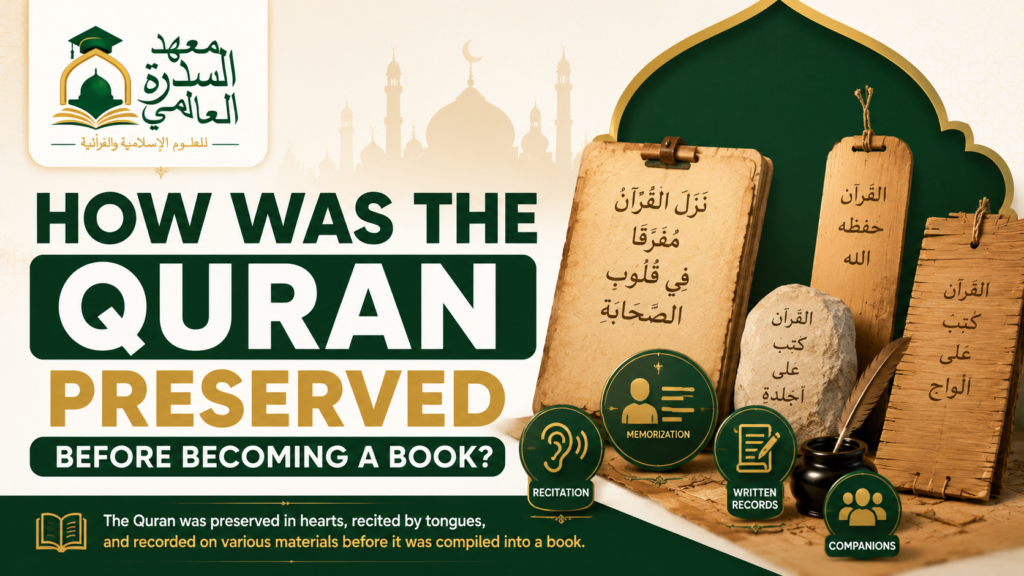
Many people ask how the Quran remained protected before it was compiled into a single manuscript.
The answer lies in multiple layers of preservation:
Memorization
Thousands of companions memorized portions or all of the Quran.
Written Documentation
Verses were recorded immediately after revelation.
Public Recitation
The Quran was recited daily in prayers and gatherings.
Continuous Teaching
Companions taught the Quran directly to students, creating an uninterrupted chain of transmission.
These methods worked together to safeguard the Quran even before its formal compilation.
Common Misconceptions About Quran Compilation
Misconception 1: Abu Bakr Wrote the Quran
Reality:
Abu Bakr (RA) did not write the Quran. He ordered its compilation from already existing revelation.
Misconception 2: Uthman Changed the Quran
Reality:
Uthman (RA) did not alter the Quran. He standardized official copies to prevent disputes and preserve unity.
Misconception 3: Parts of the Quran Were Lost
Reality:
The compilation process involved written records and widespread memorization, ensuring preservation of the complete Quran.
Misconception 4: The Prophet Never Had the Quran Written Down
Reality:
The Quran was written throughout the Prophet’s lifetime by designated scribes under his supervision.
What Does Quran Compilation Teach Muslims Today?
The history of Quran compilation demonstrates several important lessons:
- Preservation requires responsibility.
- Knowledge should be documented carefully.
- Scholars and leaders worked together to protect revelation.
- The Muslim community valued accuracy above convenience.
- Allah’s promise to preserve the Quran continues to be evident through its transmission.
For students learning Quran today, this history highlights the importance of memorization, proper recitation, and authentic learning from qualified teachers.
Frequently Asked Questions
Who compiled the Quran after the Prophet died?
The Quran was compiled during the caliphate of Abu Bakr (RA), with Zayd ibn Thabit (RA) leading the project after a recommendation from Umar ibn Al-Khattab (RA).
When was the Quran first compiled into a book?
The first compilation occurred shortly after the Prophet’s death, around 632–634 CE during Abu Bakr’s caliphate.
Why was the Quran compiled?
It was compiled to preserve the Quran after many memorizers were martyred during the Battle of Yamama.
Who was Zayd ibn Thabit?
Zayd ibn Thabit (RA) was a companion of the Prophet ﷺ, a Quran scribe, and the leader of the first Quran compilation effort.
Did Prophet Muhammad compile the Quran himself?
The Prophet ﷺ supervised the writing and arrangement of Quranic verses, but the complete manuscript was formally compiled after his death.
Who preserved the Quran after Prophet Muhammad?
Allah preserved the Quran through memorization, written records, and the efforts of companions such as Abu Bakr, Umar, Uthman, Zayd ibn Thabit, and many other scholars and memorizers.
What is the Uthmanic Mushaf?
The Uthmanic Mushaf is the standardized Quran manuscript produced under Uthman ibn Affan (RA) and distributed throughout the Muslim world.
Was the Quran written during the Prophet’s lifetime?
Yes. The Quran was written by scribes during the Prophet’s lifetime, though it was not yet gathered into a single bound manuscript.
Key Takeaways
- The Quran was revealed over 23 years to Prophet Muhammad ﷺ.
- It was preserved through memorization and written records.
- Abu Bakr (RA) ordered the first compilation after the Battle of Yamama.
- Umar (RA) proposed the idea due to concerns about preservation.
- Zayd ibn Thabit (RA) led the compilation process.
- Hafsa (RA) safeguarded the manuscript.
- Uthman (RA) standardized official copies to preserve unity.
- The Quran used today traces back to this carefully preserved tradition.
Conclusion
The answer to “Who compiled the Quran into a book?” is rooted in one of the most significant preservation efforts in Islamic history. While Prophet Muhammad ﷺ oversaw the recording and teaching of the Quran during his lifetime, the first complete manuscript was compiled under Abu Bakr As-Siddiq (RA), following a recommendation from Umar ibn Al-Khattab (RA) and the dedicated work of Zayd ibn Thabit (RA).
Later, Uthman ibn Affan (RA) standardized official copies to ensure unity across the expanding Muslim world. Together, these efforts helped preserve the Quran exactly as it was revealed, allowing Muslims today to recite and study the same divine message that was taught by Prophet Muhammad ﷺ more than fourteen centuries ago.
For structured learning, beginners can follow:
To continue your Islamic learning journey, you may also like our guides on [Rules of Waqf in Quran: Meaning, Signs, Types and Examples], [Top Quran Surahs Every Muslim Should Memorize and Benefits], and [Benefits of Surah Mulk: Every Muslim Should Recite It Regularly]. Exploring related topics can help you build a stronger understanding of Islam, the Quran, and everyday Islamic practices.