
Introduction
The Quran is the most sacred book in Islam and the primary source of guidance for Muslims around the world. While many people know that the Quran contains Allah’s revelation to Prophet Muhammad ﷺ, fewer understand the deeper meaning behind the word “Quran” itself.
Understanding the meaning of the word Quran helps Muslims appreciate not only its linguistic beauty but also its purpose as a divine message meant to be read, recited, understood, and followed. The name “Quran” is not random; it reflects the unique nature of Allah’s final revelation and its central role in Muslim life.
In this article, we will explore the Arabic meaning of the word Quran, its linguistic roots, its significance in Islam, scholarly explanations, and why Allah chose this name for His final revealed book.
Quick Answer
The word Quran comes from the Arabic root qara’a (قرأ), which means “to read” or “to recite.” The term Quran (القرآن) literally means “the recitation” or “that which is recited.” In Islam, the Quran is the final divine revelation sent by Allah to Prophet Muhammad ﷺ through Angel Jibreel (Gabriel), serving as the ultimate source of guidance for humanity.
Featured Snippet Answer
The word Quran means “the recitation” and is derived from the Arabic root qara’a, meaning “to read” or “to recite.” In Islam, the Quran refers to Allah’s final revelation sent to Prophet Muhammad ﷺ, preserved in its original Arabic language and recited by Muslims worldwide as an act of worship.
Definition of the Word Quran
The meaning of the word Quran can be understood from several perspectives: literal, linguistic, and Islamic.
Literal Meaning
Literally, the word Quran means:
“Recitation” or “reading aloud.”
This meaning reflects the way the Quran was first delivered and transmitted—through recitation rather than written texts.
Linguistic Meaning
From a linguistic perspective, Quran comes from the Arabic root:
Qara’a (قرأ)
This root carries meanings such as:
- To read
- To recite
- To proclaim
- To gather words together through recitation
Because the Quran was revealed to be recited repeatedly, the name perfectly describes its nature.
Islamic Meaning
In Islamic terminology, the Quran refers to:
The exact words of Allah revealed to Prophet Muhammad ﷺ through Angel Jibreel, preserved in Arabic, and transmitted through continuous generations.
Thus, while the literal meaning is “recitation,” the Islamic meaning is much broader and refers to Allah’s final revelation for mankind.
The Arabic Root of the Word Quran
To fully understand the meaning of Al-Quran, we must examine its Arabic origin.
Meaning of Qara’a
The root qara’a (قرأ) appears throughout classical Arabic and generally means:
- To read
- To recite
- To proclaim verbally
This root emphasizes spoken transmission and vocal delivery.
Interestingly, the first revelation received by Prophet Muhammad ﷺ began with the command:
“Read!” or “Recite!”
This highlights the close connection between revelation and recitation in Islam.
How Quran Is Derived From the Root
Many classical scholars explain that Quran is derived from the root qara’a, making it a verbal noun that means:
“The Recitation.”
Unlike ordinary books that are primarily read silently, the Quran was revealed to be recited aloud, memorized, and heard.
This unique characteristic distinguishes it from all other scriptures.
What Does Quran Mean in Arabic?
In Arabic, the term Al-Quran (القرآن) is generally understood as:
“The Recitation”
The definite article “Al” means “The.”
Therefore:
- Quran = Recitation
- Al-Quran = The Recitation
This title reflects the Quran’s special status as the divinely revealed recitation from Allah.
The Quran itself refers to its recited nature in several places, emphasizing listening, reciting, and reflecting upon its verses.
Why Is It Called Al-Quran?
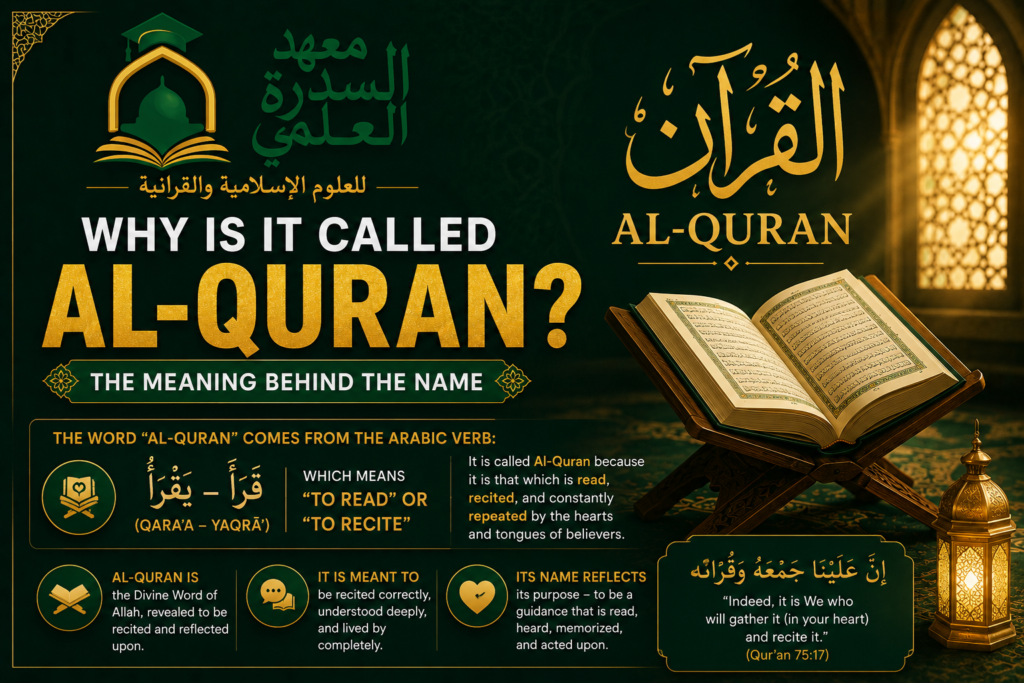
Allah chose the name “Al-Quran” because recitation is one of the defining features of His final revelation.
Unlike many books that are mainly studied through reading, the Quran is:
- Recited in prayer
- Memorized by millions
- Taught orally
- Preserved through both writing and memorization
The name itself reminds believers that the Quran is meant to be actively engaged with rather than simply stored on a shelf.
Its recitation is considered an act of worship, and every letter recited brings reward according to authentic Islamic teachings.
The Quran as Divine Revelation
Understanding the meaning of Quran requires understanding its role as revelation.
Revelation to Prophet Muhammad ﷺ
The Quran was revealed by Allah over approximately 23 years through Angel Jibreel (Gabriel).
It addressed:
- Belief in Allah
- Worship
- Morality
- Family life
- Justice
- Spiritual development
- Guidance for humanity
Each verse was revealed with divine wisdom and purpose.
Connection Between Recitation and Revelation
The Quran was initially preserved through oral transmission.
The Prophet ﷺ would recite the revealed verses to his companions, who would:
- Memorize them
- Recite them back
- Teach them to others
- Record them in writing
This method ensured extraordinary preservation.
Because revelation was delivered through recitation, the name “Quran” perfectly reflects its method of transmission.
Meaning of Quran According to Islamic Scholars
Islamic scholars have discussed the meaning of the word Quran for centuries.
Classical Scholarly Explanations
Many scholars explain that Quran refers to:
That which is recited repeatedly by believers.
Others emphasize that the word highlights the Quran’s role as a divine message intended for continual recitation and reflection.
Classical Islamic scholarship consistently links the name Quran to the concepts of:
- Reading
- Recitation
- Preservation
- Divine revelation
Linguistic Perspectives
Arabic linguists note that the word Quran carries meanings beyond simple reading.
It also conveys the idea of:
- Collecting words together
- Conveying a message
- Delivering knowledge through recitation
This broader meaning aligns perfectly with the Quran’s role as a comprehensive source of guidance.
Quran vs Hadith: What Is the Difference?
Many beginners confuse the Quran and Hadith. Although both are important in Islam, they are not the same.
| Quran | Hadith |
| Direct words of Allah | Words, actions, and approvals of Prophet Muhammad ﷺ |
| Revealed through Jibreel | Reported by companions |
| Recitation is worship | Reading is beneficial but not an act of worship in the same way |
| Preserved verbatim | Preserved through chains of narration |
| Highest source of Islamic law | Secondary source after the Quran |
| Cannot be altered | Evaluated according to authenticity classifications |
Understanding this distinction helps clarify the unique status of the Quran in Islam.
The Importance of the Quran in Islam
The meaning of Quran is closely connected to its purpose.
Source of Guidance
The Quran provides guidance regarding:
- Faith
- Worship
- Character
- Family life
- Social conduct
Muslims turn to the Quran for direction in both spiritual and practical matters.
Source of Worship
Reciting the Quran is itself an act of worship.
Muslims recite Quran:
- During Salah
- During Ramadan
- During personal worship
- For spiritual growth
This is one reason why the meaning “The Recitation” is so significant.
Source of Knowledge
The Quran teaches believers about:
- Allah
- Previous prophets
- The Hereafter
- Moral principles
- Human responsibility
Its teachings continue to guide Muslims across generations.
Common Misconceptions About the Meaning of Quran
Misconception 1: Quran Simply Means “Book”
While the Quran exists in written form, the word itself does not primarily mean “book.”
Its literal meaning is “recitation.”
The written copy is often referred to as a Mushaf.
Misconception 2: Quran and Mushaf Mean the Same Thing
They are closely related but not identical.
- Quran refers to Allah’s revealed words.
- Mushaf refers to the physical written manuscript.
Misconception 3: The Name Quran Has No Special Significance
In reality, the name reflects:
- Divine revelation
- Oral transmission
- Memorization
- Worship through recitation
The title itself teaches an important lesson about engaging with Allah’s message.
Key Lessons Muslims Can Learn From the Name Quran
The name “Quran” teaches several valuable lessons:
1. Islam Encourages Learning
The root of the word is connected to reading and recitation, highlighting the importance of knowledge.
2. The Quran Should Be Recited Regularly
It is not merely a reference book but a living guide that should be recited frequently.
3. Understanding Matters
Recitation should be accompanied by reflection and understanding.
4. Preservation Is Part of Its Nature
The Quran has been preserved through both memorization and written transmission.
5. The Quran Connects Believers to Allah
Through recitation, Muslims strengthen their relationship with their Creator.
Frequently Asked Questions
What does the word Quran literally mean?
The word Quran literally means “the recitation” or “that which is recited.”
What is the Arabic meaning of Quran?
The Arabic meaning of Quran comes from the root qara’a, meaning “to read” or “to recite.”
Why is it called Al-Quran?
It is called Al-Quran because it was revealed to be recited, memorized, and transmitted through recitation.
What does Al-Quran mean in Arabic?
Al-Quran means “The Recitation.” The word “Al” means “The,” making it a specific and unique title.
Is Quran a proper noun?
Yes. While the word has a linguistic meaning, Al-Quran is also used as the proper name of Allah’s final revelation.
What is the difference between Quran and Hadith?
The Quran is the direct word of Allah, while Hadith consists of the sayings, actions, and approvals of Prophet Muhammad ﷺ.
How did the Quran get its name?
The name comes from the Arabic root qara’a, emphasizing reading and recitation, which are central features of the revelation.
Why is recitation so important in Islam?
Recitation allows Muslims to worship Allah, preserve revelation, strengthen faith, and reflect upon divine guidance.
Conclusion
The meaning of the word Quran goes far beyond the idea of a written book. Derived from the Arabic root qara’a, the Quran literally means “the recitation.” This name reflects the unique nature of Allah’s final revelation—one that is read, recited, memorized, preserved, and lived by Muslims around the world.
Understanding the meaning of Al-Quran helps believers appreciate its divine origin and its central role in Islamic life. The Quran is not merely a text to be stored on a shelf; it is a living source of guidance, wisdom, worship, and spiritual transformation. By reciting, studying, and reflecting upon the Quran, Muslims connect with the words of Allah and deepen their understanding of Islam.
For structured learning, beginners can follow:
To continue your Islamic learning journey, you may also like our guides on [How to Make Istighfar Within the Salah Correctly: Islamic Guide], [How Many Versions of the Quran Are There? Full Explanation], and [What Is Sirat al-Mustaqeem? Meaning, Tafsir & Importance in Islam]. Exploring related topics can help you build a stronger understanding of Islam, the Quran, and everyday Islamic practices.