
Many people ask whether the Bible or the Quran is more accurate. This question often arises when discussing the preservation of religious scriptures, historical reliability, manuscript evidence, and the authenticity of sacred texts.
For Muslims, the Quran is the final revelation from Allah and has been preserved exactly as it was revealed to Prophet Muhammad ﷺ. Christians regard the Bible as the inspired Word of God and rely on its manuscript tradition and historical transmission. Understanding the differences between these scriptures requires examining their preservation, compilation, manuscript evidence, and historical background.
This article explains Bible vs Quran accuracy from an educational and Islamic perspective while also considering historical evidence and scholarly discussions.
Quick Answer
From an Islamic perspective, the Quran has been preserved in its original form since its revelation through a combination of memorization, written records, and continuous transmission. Muslims believe this fulfills Allah’s promise to preserve His revelation.
The Bible, while revered by Christians, was written by multiple authors over centuries and transmitted through numerous manuscripts, copies, and translations. As a result, discussions about Bible vs Quran accuracy often focus on differences in preservation methods, textual transmission, and manuscript history.
Featured Snippet Answer
When comparing Bible vs Quran accuracy, Muslims believe the Quran has been perfectly preserved since revelation through memorization and written manuscripts. The Bible has a longer and more complex transmission history involving multiple authors, manuscripts, and translations. Historical discussions therefore focus on preservation methods, manuscript evidence, and textual reliability.
What Does Bible vs Quran Accuracy Mean?
Bible vs Quran accuracy refers to comparing the reliability, preservation, authenticity, and historical transmission of the two scriptures.
This comparison typically examines:
- Original sources
- Manuscript evidence
- Compilation history
- Preservation methods
- Historical references
- Consistency of transmission
It is important to distinguish between faith-based beliefs and historical analysis. Religious believers often approach scripture from a theological perspective, while historians study manuscripts and textual evidence.
Why Do People Compare the Bible and the Quran?
Religious Reasons
Many Muslims and Christians wish to understand how their scriptures were preserved and transmitted through history.
Questions often include:
- Is the Quran unchanged?
- Has the Bible been altered?
- Which scripture has stronger manuscript evidence?
- How were these texts compiled?
Historical Reasons
Students, researchers, and those interested in comparative religion examine historical records to understand how sacred texts reached modern readers.
The comparison is not merely about religion; it also involves history, linguistics, manuscript studies, and textual transmission.
How Was the Quran Preserved?
One of the strongest arguments regarding Quran preservation is the unique combination of oral and written transmission.
Revelation During the Prophet’s Lifetime
The Quran was revealed to Prophet Muhammad ﷺ over approximately 23 years.
Whenever revelation descended:
- The Prophet ﷺ memorized it.
- Companions memorized it.
- Designated scribes recorded it.
Thousands of companions learned portions of the Quran directly from the Prophet ﷺ.
Compilation Under Abu Bakr (RA)
After the Battle of Yamamah, many Quran memorizers were martyred.
Concerned about preserving the Quran, Caliph Abu Bakr (RA) commissioned the collection of Quranic materials into a single compilation.
This effort ensured that the revealed text remained preserved in written form.
Standardization Under Uthman (RA)
During the caliphate of Uthman ibn Affan (RA), copies of the Quran were produced and distributed to major Muslim regions.
This standardization helped maintain uniform recitation and prevent regional variations from causing confusion.
The Uthmanic text remains the foundation of Quranic copies used worldwide today.
Early Quran Manuscripts
Several early Quran manuscripts support the historical preservation of the Quran.
Examples include:
- Birmingham Quran Manuscript
- Sana’a Manuscript
- Topkapi Manuscript
- Samarkand Manuscript
These manuscripts are frequently cited in discussions about Quran preservation evidence.
How Was the Bible Preserved?
The Bible consists of multiple books written over many centuries.
Unlike the Quran, which Muslims believe was revealed to one prophet, the Bible includes writings attributed to numerous authors.
Old Testament Formation
The Old Testament developed over a long historical period.
Its books were written, copied, preserved, and transmitted within Jewish communities before the emergence of Christianity.
New Testament Formation
The New Testament contains writings associated with the life and teachings of Jesus and the early Christian community.
These texts circulated among different Christian communities before eventually being recognized as part of the biblical canon.
Bible Canon Development
One major difference in Bible vs Quran comparison is canon formation.
The biblical canon developed over time as religious communities identified which books should be considered authoritative scripture.
Different Christian traditions recognize slightly different collections of biblical books.
Major Biblical Manuscripts
Important biblical manuscripts include:
- Codex Sinaiticus
- Codex Vaticanus
- Codex Alexandrinus
- Dead Sea Scrolls
These manuscripts play a central role in discussions about Bible preservation and textual transmission.
Quran vs Bible Preservation Comparison
| Feature | Quran | Bible |
| Original Language | Arabic | Hebrew, Aramaic, Greek |
| Revelation Period | 23 Years | Many Centuries |
| Main Source | Prophet Muhammad ﷺ | Multiple Authors |
| Memorization Tradition | Extensive | Limited |
| Standardized Text | Early | More Complex History |
| Manuscript Families | Relatively Unified | Multiple Textual Traditions |
| Global Recitation Consistency | Very High | Varies By Translation |
Historical Accuracy of the Quran
When discussing Quran accuracy compared to the Bible, Muslims often point to several factors.
Preservation Evidence
The Quran has been transmitted through:
- Written manuscripts
- Oral memorization
- Continuous recitation
- Scholarly verification
Millions of Muslims continue to memorize the entire Quran today, creating a unique preservation system that spans generations.
Historical References
The Quran contains references to:
- Ancient nations
- Prophets
- Historical communities
- Geographical locations
Muslim scholars argue that these references support the Quran’s authenticity and reliability.
Historical Accuracy of the Bible
The Bible also contains many historical references that have been studied by historians and archaeologists.
Historical References
The Bible discusses:
- Ancient kingdoms
- Historical rulers
- Religious communities
- Significant historical events
Many biblical locations and figures have been subjects of extensive historical research.
Manuscript Evidence
One frequently cited strength of the Bible is the large number of surviving manuscripts.
These manuscripts allow scholars to compare textual variations and reconstruct earlier readings.
However, the existence of multiple manuscript traditions also leads to discussions about textual differences and transmission history.
Quranic Manuscripts and Biblical Manuscripts Compared
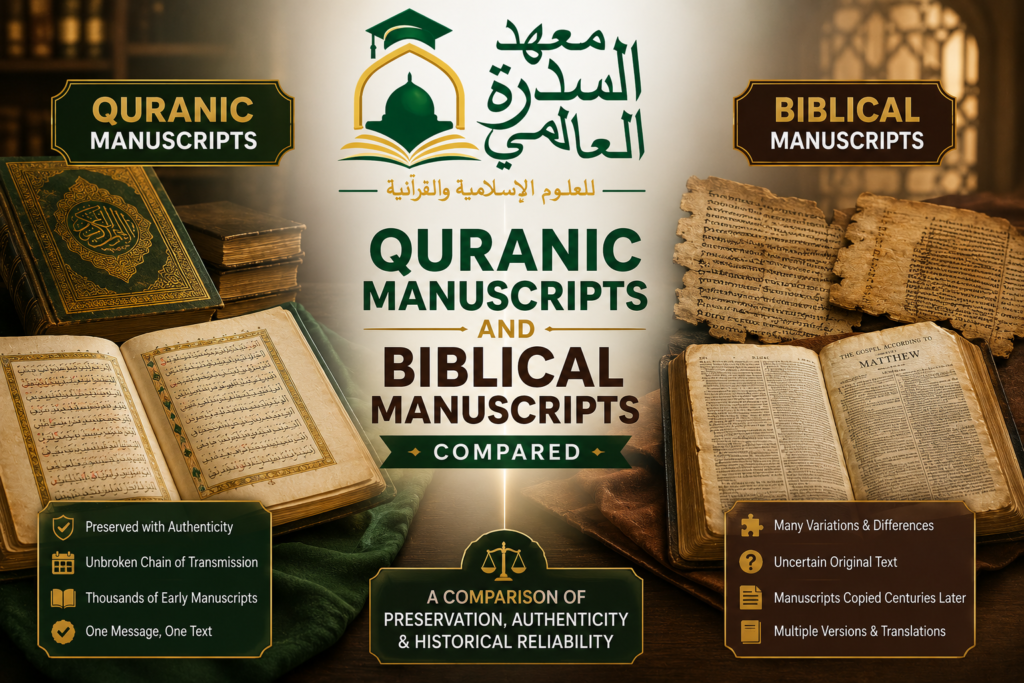
Birmingham Quran Manuscript
This manuscript is often highlighted because radiocarbon dating places it very close to the lifetime of Prophet Muhammad ﷺ.
Its significance lies in demonstrating the early existence of Quranic text.
Sana’a Manuscript
The Sana’a Manuscript provides valuable insight into early Quranic transmission and manuscript development.
Researchers continue studying its historical significance.
Codex Sinaiticus
Dating back to the fourth century, Codex Sinaiticus is one of the oldest surviving biblical manuscripts. It remains a valuable resource for scholars studying the history and transmission of the Bible.
Codex Vaticanus
Also dating to the fourth century, Codex Vaticanus is considered one of the most important biblical manuscripts ever discovered. Researchers frequently use it when analyzing textual preservation and comparing ancient biblical copies.
Islamic Perspective on Bible vs Quran Accuracy
Islam teaches that Allah revealed scriptures before the Quran, including:
- Tawrah (Torah)
- Zabur (Psalms)
- Injil (Gospel)
Muslims respect these revelations as originally divine.
However, Islamic belief holds that the Quran is the final revelation and that Allah specifically preserved it.
Allah says:
“Indeed, it is We who sent down the Reminder, and indeed, We will be its guardian.” (Quran 15:9)
For this reason, Muslims view the Quran as the most reliably preserved scripture.
Christian Perspective on Bible vs Quran Accuracy
Christians generally believe the Bible faithfully preserves God’s message through the guidance of divine inspiration and manuscript transmission.
Many Christian scholars argue that the large number of manuscripts helps scholars identify and preserve the original message of the biblical texts.
Understanding this perspective helps create respectful and informed dialogue.
Common Misconceptions About Quran and Bible Preservation
Misconception 1: The Quran Has No Manuscript Evidence
Incorrect.
Multiple early manuscripts exist and continue to be studied by historians and researchers.
Misconception 2: The Bible Has Only One Version
Incorrect.
There are many translations and manuscript traditions within biblical history.
Misconception 3: Translation Equals the Original Text
Not exactly.
Translations help readers understand scripture, but they are distinct from the original language texts.
Misconception 4: Preservation Means the Same Thing in Every Religion
Different faith traditions define preservation differently.
Understanding these differences is essential for fair comparison.
What Can Muslims Learn From This Discussion?
Studying scripture preservation should strengthen knowledge rather than encourage hostility.
Muslims can benefit from:
- Learning how the Quran was preserved
- Understanding Islamic history
- Appreciating the role of memorization
- Developing respectful interfaith understanding
- Strengthening confidence in Quranic transmission
Those interested in deeper study may also explore What is the Meaning of the Word Quran, How Many Versions of the Quran Are There, and Tips for Memorizing Quran Easily.
Key Differences Between the Bible and the Quran
| Aspect | Quran | Bible |
| Revealed To | Prophet Muhammad ﷺ | Multiple Prophets and Authors |
| Language | Arabic | Hebrew, Aramaic, Greek |
| Preservation Method | Oral + Written | Manuscript Tradition |
| Canon Formation | Unified Text | Multiple Books |
| Memorization Culture | Global and Extensive | Less Central |
| Islamic Status | Final Revelation | Earlier Revelation |
Frequently Asked Questions
Is the Quran unchanged?
According to Islamic belief, the Quran has remained unchanged since its revelation and has been preserved through memorization and written transmission.
Has the Bible been altered?
This depends on perspective. Muslims generally believe earlier scriptures experienced changes in transmission, while Christians believe the Bible faithfully preserves God’s message.
Which scripture has better manuscript preservation?
Muslims typically argue that the Quran demonstrates stronger preservation through memorization and standardization. Scholars examine manuscript evidence from both traditions when discussing this topic.
What is the oldest Quran manuscript?
Among the most discussed early manuscripts are the Birmingham Quran Manuscript and the Sana’a Manuscript.
What is the oldest Bible manuscript?
Important ancient biblical manuscripts include Codex Sinaiticus and Codex Vaticanus.
Why do Muslims believe the Quran is preserved?
Muslims believe Allah promised to protect the Quran and that its preservation is demonstrated through memorization, manuscripts, and continuous transmission.
Are the Bible and Quran completely different?
No. Both discuss prophets, moral teachings, worship, and belief in God, although they differ significantly in theology, narrative details, and religious teachings.
Conclusion
The discussion of Bible vs Quran accuracy involves faith, history, manuscripts, and preservation methods. From an Islamic perspective, the Quran stands apart because Muslims believe it has been preserved exactly as revealed through a unique combination of memorization, written documentation, and scholarly transmission.
The Bible and the Quran remain among the most influential religious texts in human history. Understanding how each scripture was preserved allows readers to make informed comparisons based on evidence, historical research, and religious belief.
For Muslims, studying Quran preservation deepens appreciation for Allah’s final revelation and encourages a stronger connection with the Quran through reading, memorization, and understanding.
For structured learning, beginners can follow:
To continue your Islamic learning journey, you may also like our guides on [What Is the Meaning of the Word Quran? Meaning Explained], [How to Make Istighfar Within the Salah Correctly: Islamic Guide], and [How Many Versions of the Quran Are There? Full Explanation]. Exploring related topics can help you build a stronger understanding of Islam, the Quran, and everyday Islamic practices.