
Introduction
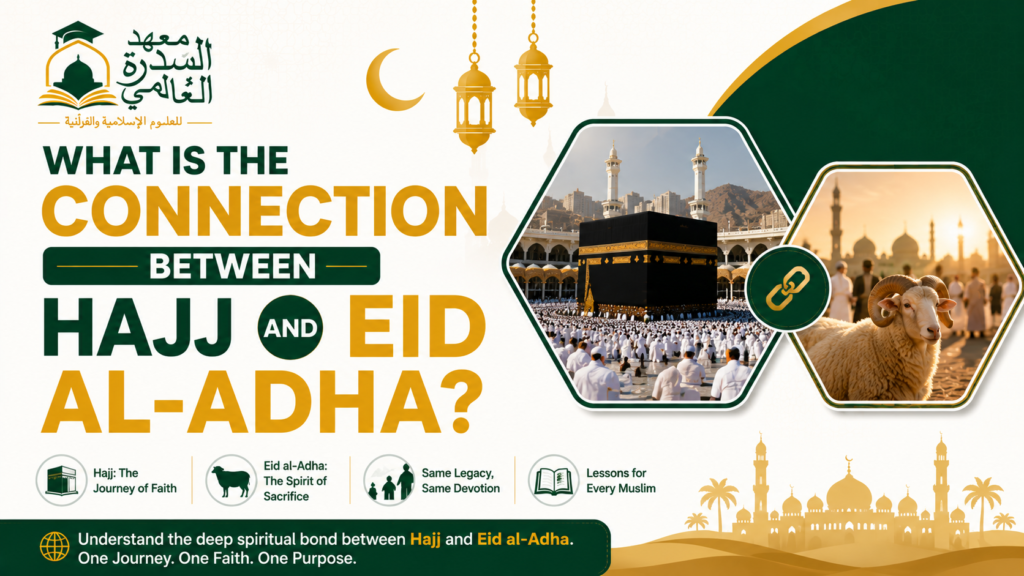
Every year, millions of Muslims gather in Makkah to perform Hajj, while Muslims around the world celebrate Eid al-Adha. Because these two important Islamic events occur during the same period of Dhul Hijjah, many people wonder: What is the connection between Hajj and Eid al-Adha?
The connection goes far beyond timing. Both Hajj and Eid al-Adha commemorate the faith, obedience, and sacrifice of Prophet Ibrahim (AS) and his family. They remind Muslims of complete submission to Allah, gratitude for His blessings, and unity among believers worldwide.
Understanding this relationship helps Muslims appreciate the deeper spiritual meaning of both the Hajj pilgrimage and the celebration of Eid al-Adha.
Quick Answer
The connection between Hajj and Eid al-Adha is that both occur during the month of Dhul Hijjah and commemorate the devotion of Prophet Ibrahim (AS), Prophet Ismail (AS), and their willingness to obey Allah’s command. During Hajj, pilgrims perform rituals connected to Ibrahim’s legacy, while Muslims worldwide celebrate Eid al-Adha by offering Qurbani (sacrifice). Together, they symbolize faith, obedience, sacrifice, and unity in Islam.
Featured Snippet Answer
Hajj and Eid al-Adha are connected through their timing, history, and spiritual purpose. Both occur during Dhul Hijjah and honor the legacy of Prophet Ibrahim (AS). Hajj pilgrims perform rituals associated with his life, while Muslims worldwide observe Eid al-Adha and offer Qurbani to remember his willingness to sacrifice his son in obedience to Allah.
Understanding the Connection Between Hajj and Eid al-Adha
Short Definition
Hajj and Eid al-Adha are two distinct acts of worship, but they are closely linked through the events of Dhul Hijjah, the story of Prophet Ibrahim (AS), and the concept of sacrifice and submission to Allah.
Hajj is the fifth pillar of Islam and is obligatory for eligible Muslims once in their lifetime. Eid al-Adha is one of the two major Islamic festivals celebrated annually by Muslims around the world.
Although not every Muslim performs Hajj, all Muslims can participate in the spiritual lessons of Eid al-Adha.
What Is Hajj?
Hajj is the annual Islamic pilgrimage to Makkah that takes place during specific days of Dhul Hijjah. It is one of the Five Pillars of Islam and is required once in a lifetime for every Muslim who is physically and financially able.
Hajj is a journey of worship, repentance, humility, and devotion. It brings together Muslims from every race, language, and nationality in a powerful demonstration of unity.
Purpose of Hajj
The purpose of Hajj is to:
- Obey Allah’s command
- Strengthen faith
- Seek forgiveness
- Purify the soul
- Follow the example of Prophet Ibrahim (AS)
- Experience the unity of the Muslim Ummah
Main Rituals of Hajj
Some of the major rituals include:
- Entering the state of Ihram
- Performing Tawaf around the Kaaba
- Walking between Safa and Marwah (Sa’i)
- Standing at Mount Arafat
- Spending the night in Muzdalifah
- Stoning the Jamarat in Mina
- Offering sacrifice
- Completing Tawaf al-Ifadah
Each ritual carries deep spiritual significance and reflects important moments in Islamic history.
What Is Eid al-Adha?
Eid al-Adha, often called the “Festival of Sacrifice,” is celebrated on the 10th day of Dhul Hijjah.
It commemorates Prophet Ibrahim’s (AS) willingness to sacrifice his son after receiving Allah’s command in a dream. Before the sacrifice could take place, Allah replaced Prophet Ismail (AS) with a ram, demonstrating that Ibrahim had fulfilled the test of obedience.
Meaning of Eid al-Adha
Eid al-Adha teaches Muslims:
- Obedience to Allah
- Trust in Allah’s wisdom
- Gratitude for blessings
- Generosity toward others
- Compassion for those in need
Why Muslims Celebrate It
Muslims celebrate Eid al-Adha by:
- Performing Eid prayer
- Remembering Allah
- Offering Qurbani
- Sharing meat with family, friends, and the needy
- Strengthening community bonds
The festival serves as an annual reminder of sincere devotion and sacrifice for the sake of Allah.
Why Are Hajj and Eid al-Adha Connected?
Shared Timing in Dhul Hijjah
One of the clearest connections is timing.
Both Hajj and Eid al-Adha occur during the first ten days of Dhul Hijjah, which are among the most blessed days in the Islamic calendar.
Pilgrims perform the major rites of Hajj during these days, while Muslims worldwide increase worship and prepare for Eid al-Adha.
The Day of Arafah
The 9th of Dhul Hijjah is known as the Day of Arafah.
For pilgrims, standing at Arafah is the most important pillar of Hajj. It is a day of prayer, repentance, and seeking Allah’s mercy.
For non-pilgrims, fasting on the Day of Arafah is highly recommended and carries great spiritual reward.
Eid al-Adha follows immediately after this sacred day, creating a powerful spiritual connection between the pilgrimage and the festival.
The Legacy of Prophet Ibrahim (AS)
Both Hajj and Eid al-Adha are deeply rooted in the life of Prophet Ibrahim (AS).
Many rituals of Hajj trace back to his actions and sacrifices:
- Building the Kaaba with Prophet Ismail (AS)
- Calling people to pilgrimage
- Demonstrating complete obedience to Allah
Likewise, Eid al-Adha commemorates Ibrahim’s willingness to sacrifice his beloved son in obedience to Allah’s command.
Prophet Ismail (AS) and the Test of Faith
The story of Prophet Ismail (AS) is central to understanding the connection.
When Prophet Ibrahim (AS) informed his son about the command from Allah, Ismail responded with patience and submission.
This event demonstrates:
- Faith in Allah
- Patience during trials
- Family devotion to worship
- Trust in divine wisdom
Muslims remember this example every year during Eid al-Adha.
Qurbani as a Symbol of Sacrifice
Qurbani forms one of the strongest links between Hajj and Eid al-Adha.
Pilgrims performing certain types of Hajj offer a sacrifice during the pilgrimage. Muslims around the world also offer Qurbani during Eid al-Adha.
The sacrifice is not merely about slaughtering an animal. It symbolizes:
- Obedience to Allah
- Gratitude
- Charity
- Willingness to give up what we love for Allah’s sake
Why Is Eid al-Adha Celebrated During Hajj?
Eid al-Adha occurs during Hajj because both acts of worship commemorate the same spiritual legacy.
The timing highlights:
- The obedience of Prophet Ibrahim (AS)
- The completion of major Hajj rituals
- The importance of sacrifice in Islam
- The unity of Muslims worldwide
While pilgrims complete important rites in Mina, Muslims everywhere join in remembrance through prayer, Qurbani, and acts of charity.
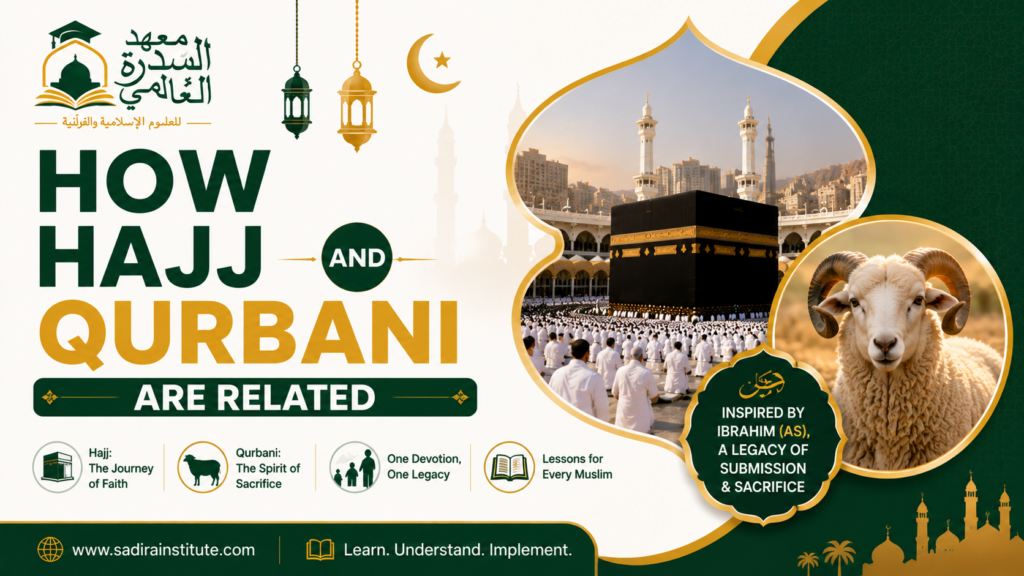
How Hajj and Qurbani Are Related
For Pilgrims
Pilgrims may offer a sacrifice as part of their Hajj rites. This sacrifice is connected to the traditions established by Prophet Ibrahim (AS).
The act reinforces themes of devotion and submission.
For Non-Pilgrims
Muslims who are not performing Hajj can still participate in the spirit of sacrifice through Qurbani.
This allows believers around the world to share in the lessons of Eid al-Adha even if they are not physically present in Makkah.
Timeline of Hajj and Eid al-Adha in Dhul Hijjah
| Date | Major Event | Significance |
| 8 Dhul Hijjah | Pilgrims travel to Mina | Beginning of major Hajj rites |
| 9 Dhul Hijjah | Day of Arafah | Most important day of Hajj |
| Night of 9th | Stay in Muzdalifah | Worship and preparation |
| 10 Dhul Hijjah | Eid al-Adha begins | Sacrifice and celebration |
| 10–13 Dhul Hijjah | Stoning of Jamarat | Following Ibrahim’s example |
Hajj vs Eid al-Adha
| Aspect | Hajj | Eid al-Adha |
| Type | Pilgrimage | Islamic festival |
| Obligation | Once in a lifetime if able | Annual celebration |
| Location | Makkah and surrounding sites | Worldwide |
| Main Purpose | Fulfill a pillar of Islam | Commemorate sacrifice and obedience |
| Key Rituals | Tawaf, Arafah, Mina, Jamarat | Prayer and Qurbani |
| Participants | Eligible pilgrims | Muslims worldwide |
Spiritual Lessons Muslims Learn
Obedience to Allah
Both Hajj and Eid al-Adha teach that true faith requires obedience to Allah even when challenges arise.
Prophet Ibrahim (AS) serves as the perfect example of submission.
Sacrifice for Faith
Sacrifice is not limited to animals.
Muslims are encouraged to sacrifice:
- Time for worship
- Wealth for charity
- Personal desires that conflict with faith
Gratitude
The blessings of health, family, and provision should inspire gratitude toward Allah.
Eid al-Adha encourages believers to recognize and appreciate these blessings.
Unity of the Muslim Ummah
Hajj gathers Muslims from every corner of the world.
Eid al-Adha is celebrated globally on the same occasion, reinforcing the sense of belonging to one Ummah.
Generosity and Charity
Sharing Qurbani meat reminds Muslims to care for the less fortunate.
The festival promotes kindness, compassion, and social responsibility.
Common Misconceptions About Hajj and Eid al-Adha
Is Eid al-Adha Part of Hajj?
No.
Eid al-Adha is not part of Hajj itself. However, it occurs during the Hajj season and is closely connected through history and meaning.
Is Qurbani Only for Pilgrims?
No.
Muslims worldwide can offer Qurbani during Eid al-Adha, not just pilgrims.
Must Every Muslim Perform Hajj?
No.
Hajj is obligatory only for Muslims who are physically and financially capable.
Can Someone Celebrate Eid al-Adha Without Performing Hajj?
Yes.
The vast majority of Muslims celebrate Eid al-Adha without performing Hajj. The blessings and lessons of Eid are available to all believers.
How Muslims Can Benefit During the First 10 Days of Dhul Hijjah
These blessed days provide opportunities for increased worship.
Muslims can:
- Perform extra prayers
- Recite the Quran regularly
- Make abundant dhikr
- Give charity
- Fast, especially on the Day of Arafah
- Strengthen family ties
- Prepare for Qurbani
- Seek forgiveness from Allah
These actions help believers maximize the spiritual benefits of the season.
Key Takeaways
- Hajj and Eid al-Adha are connected through Dhul Hijjah, Prophet Ibrahim (AS), and the concept of sacrifice.
- Both commemorate faith, obedience, and submission to Allah.
- The Day of Arafah links the pilgrimage directly to Eid al-Adha.
- Qurbani symbolizes devotion and generosity.
- Hajj is a pillar of Islam, while Eid al-Adha is a global Islamic festival.
- Muslims can benefit spiritually from Eid al-Adha even if they do not perform Hajj.
Frequently Asked Questions
What is the connection between Hajj and Eid al-Adha?
Both occur during Dhul Hijjah and commemorate the faith, obedience, and sacrifice of Prophet Ibrahim (AS).
Why is Eid al-Adha celebrated during Hajj?
It coincides with the completion of major Hajj rites and honors the legacy of Prophet Ibrahim (AS).
How are Hajj and Eid al-Adha related?
They share common historical origins, spiritual lessons, and acts of worship connected to sacrifice and submission.
Why do Muslims perform Qurbani during Eid al-Adha?
Qurbani commemorates Prophet Ibrahim’s willingness to sacrifice his son in obedience to Allah.
What is the significance of the Day of Arafah?
It is the most important day of Hajj and a day of immense mercy, forgiveness, and supplication.
What role does Prophet Ibrahim (AS) play in Hajj and Eid al-Adha?
His life, sacrifices, and devotion form the foundation of many Hajj rituals and the celebration of Eid al-Adha.
Is Eid al-Adha part of Hajj?
No. It is a separate act of worship, though it occurs during the Hajj season.
What happens during Hajj before Eid al-Adha?
Pilgrims travel to Mina, stand at Arafah, and spend time in Muzdalifah before the arrival of Eid al-Adha.
Can Muslims celebrate Eid al-Adha without performing Hajj?
Yes. Most Muslims celebrate Eid al-Adha from their local communities around the world.
Why is Dhul Hijjah important?
Dhul Hijjah contains the days of Hajj, the Day of Arafah, and Eid al-Adha, making it one of the most sacred months in Islam.
Conclusion
The connection between Hajj and Eid al-Adha reflects some of the most important values in Islam: faith, obedience, sacrifice, gratitude, and unity. Both are rooted in the remarkable story of Prophet Ibrahim (AS) and his family’s unwavering devotion to Allah.
While only a portion of Muslims perform the pilgrimage to Makkah, every Muslim can participate in the spiritual lessons of Eid al-Adha. Through worship, charity, remembrance of Allah, and acts of sacrifice, believers around the world renew their commitment to the same principles that inspired Prophet Ibrahim (AS) centuries ago.
By understanding how Hajj and Eid al-Adha are connected, Muslims can appreciate the deeper meaning of these sacred occasions and strengthen their relationship with Allah throughout the blessed days of Dhul Hijjah.
For structured learning, beginners can follow:
To continue your Islamic learning journey, you may also like our guides on [Who Compiled the Quran Into a Book? Complete History], [What Is Surah Al-Fatiha? Meaning, Translation & Importance], and [Al Halq in Tajweed: Meaning, Six Throat Letters, Makharij & Guide]. Exploring related topics can help you build a stronger understanding of Islam, the Quran, and everyday Islamic practices.