
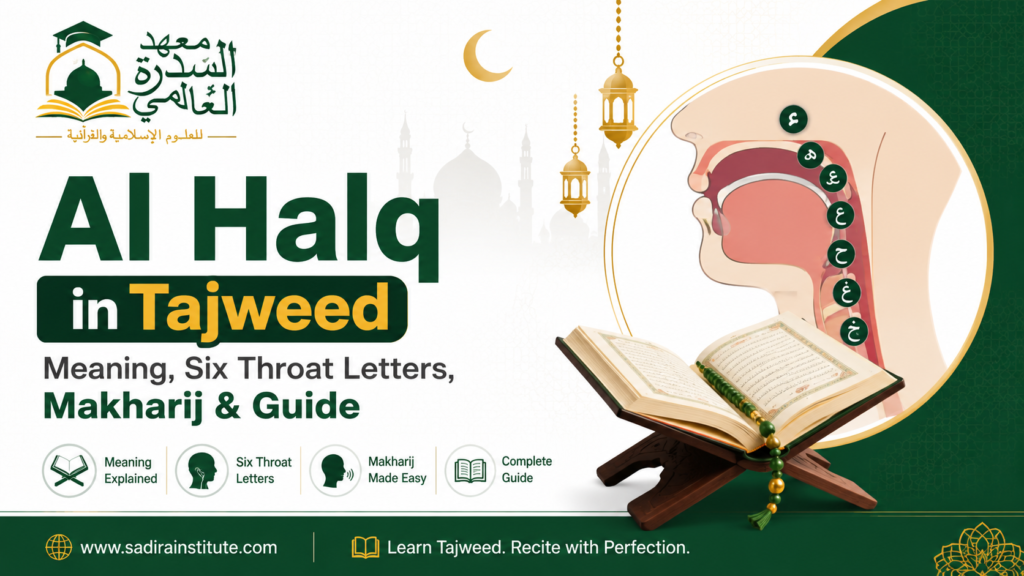
Learning the Quran correctly requires more than recognizing Arabic letters. Every letter has a specific point of articulation (Makhraj), and pronouncing it from the correct place is essential for proper Quran recitation. One of the most important articulation areas in Tajweed is Al Halq (الحلق), which means the throat.
Several Arabic letters are produced from different parts of the throat. These letters are known as Huroof Al Halqiyah (Throat Letters). Understanding Al Halq helps Quran learners improve pronunciation, avoid common recitation mistakes, and recite the Quran according to the rules of Tajweed.
Whether you are a beginner learning Noorani Qaida, a student studying Tajweed, or someone seeking to improve Quran recitation, understanding Al Halq is a fundamental step in your learning journey.
Quick Answer: What Is Al Halq in Tajweed?
Al Halq in Tajweed refers to the throat, which serves as the articulation point (Makhraj) for six Arabic letters: ء (Hamzah), ه (Haa), ع (Ain), ح (Haa), غ (Ghain), and خ (Khaa). These letters are divided into three sections of the throat known as Aqsa Al Halq (deepest throat), Wasat Al Halq (middle throat), and Adna Al Halq (upper throat). Proper understanding of Al Halq helps Muslims pronounce Quranic letters correctly and recite the Quran with accurate Tajweed.
Featured Snippet Answer
Al Halq in Tajweed means the throat, which is the articulation area for six Arabic letters: ء, ه, ع, ح, غ, and خ. These letters originate from three different sections of the throat—Aqsa Al Halq, Wasat Al Halq, and Adna Al Halq—and play an important role in correct Quran pronunciation and recitation.
What Does Al Halq Mean?
The Arabic word “Al Halq” (الحلق) literally means the throat.
In the science of Tajweed, Al Halq refers to one of the major articulation regions from which specific Arabic letters are pronounced. Scholars of Tajweed carefully identified the exact places where sounds originate to preserve the correct recitation of the Quran as it was taught by Prophet Muhammad ﷺ.
Because the throat contains several distinct articulation points, it is divided into different sections for Tajweed study.
What Are Makharij Al Huruf?
Before studying Al Halq in detail, it is important to understand Makharij Al Huruf.
Makharij Al Huruf means the articulation points of Arabic letters. A Makhraj is the place from which a letter’s sound emerges.
When a letter is pronounced from the wrong place:
- The sound changes.
- The meaning may change.
- Quran recitation becomes incorrect.
- Tajweed rules are not properly applied.
For this reason, learning Makharij is considered one of the foundations of Tajweed.
Relationship Between Al Halq and Makharij
Al Halq is one of the primary articulation regions within Makharij Al Huruf.
The six throat letters originate from three locations inside the throat, making Al Halq one of the most important areas for Quran learners to master.
The Six Letters of Al Halq
The throat contains six letters known as Huroof Al Halqiyah (Throat Letters).
| Letter | Name | Throat Section |
| ء | Hamzah | Aqsa Al Halq |
| ه | Haa | Aqsa Al Halq |
| ع | Ain | Wasat Al Halq |
| ح | Haa | Wasat Al Halq |
| غ | Ghain | Adna Al Halq |
| خ | Khaa | Adna Al Halq |
These six letters are divided equally among the three parts of the throat.
The Three Sections of Al Halq
Tajweed scholars divide the throat into three sections:
| Section | Location |
| Aqsa Al Halq | Deepest part of the throat |
| Wasat Al Halq | Middle part of the throat |
| Adna Al Halq | Upper part of the throat near the mouth |
Each section produces two letters.
Aqsa Al Halq (أقصى الحلق) – The Deepest Part of the Throat
Aqsa Al Halq refers to the deepest area of the throat, closest to the chest.
The following letters originate from this area:
Hamzah (ء)
Hamzah is produced by a brief closure and release of airflow deep within the throat.
Examples:
- أَنْعَمْتَ
- إِيَّاكَ
- أَحَدٌ
Pronunciation Tip
Avoid turning Hamzah into a weak vowel sound. It should have a clear and distinct articulation.
Haa (ه)
The letter ه is pronounced from the deepest part of the throat with a soft flow of breath.
Examples:
- هُدًى
- هَذَا
- لَهُ
Pronunciation Tip
Keep the sound light and gentle without excessive force.
Wasat Al Halq (وسط الحلق) – The Middle of the Throat
Wasat Al Halq refers to the middle section of the throat.
The letters produced here are often challenging for non-Arabic speakers.
Ain (ع)
Ain is one of the most unique Arabic letters.
It does not exist in English and therefore requires practice.
Examples:
- الْعَالَمِينَ
- نَعْبُدُ
- عَلِيمٌ
Pronunciation Tip
The sound should emerge from the middle throat with slight compression. Avoid replacing it with a simple “A” sound.
Common Mistake
Many beginners pronounce:
- عَلِيم as “Aleem”
instead of producing the proper Ain sound.
Haa (ح)
This letter differs from ه.
It is produced from the middle throat with stronger breath flow.
Examples:
- الْحَمْدُ
- رَحْمَة
- حَكِيم
Pronunciation Tip
Allow more air to pass through the throat compared to ه.
Adna Al Halq (أدنى الحلق) – The Upper Part of the Throat
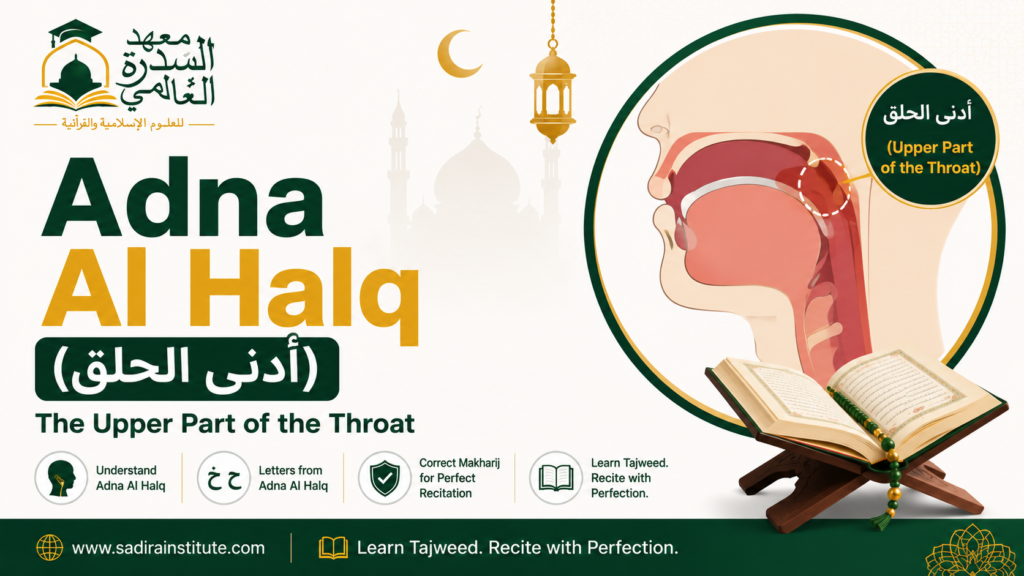
Adna Al Halq is the upper throat closest to the mouth.
Two heavy letters originate here.
Ghain (غ)
Ghain is produced from the upper throat with vibration and resonance.
Examples:
- غَفُور
- غَنِيٌّ
- غَيْب
Pronunciation Tip
The sound should remain distinct and not resemble the English letter “G.”
Khaa (خ)
Khaa is produced from the same area as Ghain but without vocal vibration.
Examples:
- خَالِق
- خَيْر
- خَاشِعِين
Pronunciation Tip
Maintain a rough, friction-based sound while keeping articulation controlled.
Al Halq Letters Chart
The following chart summarizes the six throat letters:
| Throat Section | Letters |
| Aqsa Al Halq | ء ، ه |
| Wasat Al Halq | ع ، ح |
| Adna Al Halq | غ ، خ |
This chart is often taught in Noorani Qaida and introductory Tajweed courses.
How to Pronounce Throat Letters Correctly
Correct pronunciation requires listening, practice, and guidance.
Step 1: Learn the Correct Makhraj
Understand exactly where the letter originates.
Step 2: Listen to Qualified Reciters
Listening repeatedly helps train the ear to recognize correct sounds.
Step 3: Practice Slowly
Read individual letters before combining them into words and verses.
Step 4: Record Your Recitation
Compare your pronunciation with qualified reciters.
Step 5: Learn With a Teacher
A Tajweed teacher can identify subtle pronunciation mistakes that learners may not notice themselves.
Examples of Al Halq Letters in the Quran
The Quran contains numerous examples of throat letters.
| Letter | Example |
| ء | أَحَد |
| ه | هُدًى |
| ع | الْعَالَمِينَ |
| ح | الْحَمْدُ |
| غ | غَفُور |
| خ | خَالِق |
Reading these examples repeatedly helps strengthen articulation.
Why Is Al Halq Important in Tajweed?
Al Halq plays a crucial role in preserving correct Quran recitation.
Its importance includes:
- Ensuring accurate pronunciation
- Preserving the meanings of Quranic words
- Improving recitation quality
- Strengthening Tajweed skills
- Developing confidence during Quran reading
- Following the traditional method of Quran recitation
Even small pronunciation errors can alter sounds significantly.
Common Mistakes When Pronouncing Al Halq Letters
Many beginners encounter similar challenges.
| Letter | Common Mistake | Correct Approach |
| ع | Pronounced as A | Use middle throat compression |
| ح | Pronounced as ه | Increase breath flow |
| ه | Pronounced like ح | Keep sound softer |
| غ | Pronounced as G | Use upper throat resonance |
| خ | Pronounced too softly | Maintain friction sound |
Recognizing these mistakes early helps learners progress faster.
Al Halq and Makharij Al Huruf: What Is the Difference?
Many students confuse these two terms.
| Term | Meaning |
| Makharij Al Huruf | All articulation points of Arabic letters |
| Al Halq | One specific articulation region within Makharij |
In simple words:
Every Al Halq letter belongs to Makharij Al Huruf, but Makharij Al Huruf includes many articulation points besides Al Halq.
Practical Tips for Mastering Throat Letters
Practice Daily
Even five to ten minutes of focused practice can improve pronunciation.
Focus on Difficult Letters
Spend extra time on:
- ع (Ain)
- ح (Haa)
- غ (Ghain)
- خ (Khaa)
Read With Tajweed
Consistent Quran reading strengthens articulation naturally.
Learn Through Noorani Qaida
Noorani Qaida introduces Makharij gradually and systematically.
Seek Teacher Feedback
Direct correction remains one of the fastest ways to improve.
Common Misconceptions About Al Halq
Misconception 1: All Throat Letters Sound Similar
While they originate from the throat, each letter has a unique sound and articulation point.
Misconception 2: Ain Can Be Replaced With a Vowel
The letter Ain has its own distinct sound and should not be replaced with a simple vowel.
Misconception 3: Makharij Are Optional
Correct Makharij are an essential part of proper Tajweed and accurate Quran recitation.
Misconception 4: Throat Letters Can Be Learned Through Reading Alone
Most learners benefit from listening and receiving correction from a qualified teacher.
Frequently Asked Questions About Al Halq in Tajweed
What is Al Halq in Tajweed?
Al Halq means the throat and refers to the articulation area from which six Arabic letters are pronounced.
How many Al Halq letters are there?
There are six throat letters:
ء، ه، ع، ح، غ، خ
What are the three sections of Al Halq?
The three sections are:
- Aqsa Al Halq
- Wasat Al Halq
- Adna Al Halq
What is Aqsa Al Halq?
Aqsa Al Halq is the deepest part of the throat and produces Hamzah (ء) and Haa (ه).
Why is Ain difficult to pronounce?
Ain is unique to Arabic and does not have a direct equivalent in English, making it challenging for many learners.
What is the difference between ح and ه?
Both are throat letters, but ح is produced from the middle throat with stronger breath flow, while ه comes from the deepest throat with a softer sound.
How can beginners improve throat letter pronunciation?
Beginners can improve by studying Makharij, listening to qualified reciters, practicing regularly, and learning under a Tajweed teacher.
Key Takeaways
- Al Halq means the throat in Tajweed.
- Six Arabic letters originate from the throat.
- The letters are ء، ه، ع، ح، غ، خ.
- Al Halq is divided into Aqsa Al Halq, Wasat Al Halq, and Adna Al Halq.
- Correct pronunciation of throat letters is essential for proper Quran recitation.
- Learning Makharij Al Huruf helps preserve the accuracy and beauty of Quran reading.
- Regular practice and qualified guidance are the best ways to master throat letters.
Conclusion
Al Halq is one of the most important concepts in Tajweed because it teaches learners where and how six essential Arabic letters are pronounced. By understanding the three sections of the throat—Aqsa Al Halq, Wasat Al Halq, and Adna Al Halq—students can improve their Quran recitation and develop stronger pronunciation skills.
Mastering throat letters may take time, especially for sounds such as Ain (ع) and Ghain (غ), but consistent practice, proper guidance, and attention to Makharij will gradually lead to more accurate and confident Quran recitation. As you continue your Tajweed journey, strengthening your understanding of Al Halq will help you recite the Quran with greater precision, clarity, and respect for its sacred words.
For structured learning, beginners can follow:
To continue your Islamic learning journey, you may also like our guides on [What Is Surah Al-Fatiha? Meaning, Translation & Importance], [Who Compiled the Quran Into a Book? Complete History], and [Rules of Waqf in Quran: Meaning, Signs, Types and Examples]. Exploring related topics can help you build a stronger understanding of Islam, the Quran, and everyday Islamic practices.