
Introduction
The first 10 verses of Surah Al-Kahf hold a special place in the hearts of Muslims around the world. These verses are not only the opening of the 18th chapter of the Quran but are also connected to an authentic Prophetic teaching about protection from one of the greatest trials humanity will face—the trial of the Dajjal (False Messiah).
Many Muslims recite these verses every Friday, memorize them during their Hifz journey, and reflect on their meanings to strengthen their faith. However, simply reading the Arabic text without understanding its message means missing many of the profound lessons that Allah teaches through these verses.
In this guide, you will learn:
- The first 10 verses of Surah Al-Kahf in Arabic
- English translation
- Easy-to-read transliteration
- Brief tafsir (explanation) for every verse
- Authentic hadith regarding their virtues
- The connection between these verses and protection from Dajjal
- Practical lessons for everyday life
- Tips to memorize them more easily
Whether you are a beginner learning the Quran, a student of Islamic studies, or someone looking to deepen your understanding, this guide aims to present authentic information in a clear and easy-to-follow manner.
Quick Answer
The first 10 verses of Surah Al-Kahf emphasize Allah’s perfect guidance, warn against false beliefs, give glad tidings to sincere believers, and remind people that worldly life is a temporary test. According to authentic hadith, memorizing or preserving these verses is a means of protection from the trial of the Dajjal. Many Muslims also recite Surah Al-Kahf on Fridays following the Prophetic tradition.
Featured Snippet Answer
The first 10 verses of Surah Al-Kahf introduce the Quran as Allah’s flawless revelation, call people to sincere faith, warn against associating partners with Allah, and promise eternal reward for righteous believers. Authentic hadith also mention that memorizing these verses offers protection from the trial of the Dajjal.
What Are the First 10 Verses of Surah Al-Kahf?
The first 10 verses of Surah Al-Kahf (Chapter 18 of the Quran) begin by praising Allah for revealing the Quran to His Messenger ﷺ without any deviation. These verses establish the purpose of divine revelation, encourage belief in Allah, warn against false doctrines, and introduce the story of the People of the Cave, whose unwavering faith became a timeless lesson for believers.
These opening verses lay the foundation for the themes found throughout Surah Al-Kahf:
- The importance of sincere faith (Iman)
- Trust in Allah during hardship
- The temporary nature of worldly life
- The truthfulness of divine revelation
- Patience and steadfastness
- Protection from major trials
Because of these themes, Muslims throughout history have devoted special attention to learning, memorizing, and reflecting upon these verses.
Why Are the First 10 Verses of Surah Al-Kahf Important?
These verses are significant for several reasons.
1. They Begin with Praise of Allah
The Surah opens by praising Allah for revealing the Quran without any error, contradiction, or distortion. This reminds believers that the Quran is the ultimate source of guidance.
2. They Confirm the Truth of Revelation
The Quran was revealed to guide humanity toward the straight path, give glad tidings to believers, and warn those who reject the truth.
3. They Teach Pure Tawheed
The verses strongly reject the false claim that Allah has a son and emphasize His absolute perfection and uniqueness.
4. They Prepare Believers for Life’s Tests
The opening verses explain that worldly attractions are a temporary test. Wealth, beauty, status, and success are not permanent; rather, they are opportunities to demonstrate gratitude, patience, and obedience to Allah.
5. They Introduce the Story of the People of the Cave
The tenth verse begins the famous account of the righteous young believers who sought refuge in a cave to preserve their faith. Their story teaches courage, reliance upon Allah, and steadfastness in difficult circumstances.
Authentic Hadith About the First 10 Verses
Among the well-known virtues of these verses is an authentic narration concerning protection from the Dajjal.
The Prophet Muhammad ﷺ said:
“Whoever memorizes the first ten verses of Surah Al-Kahf will be protected from the Dajjal.”
This narration is recorded in Sahih Muslim, making it an authentic hadith.
Another authentic narration mentions the last ten verses of Surah Al-Kahf. Scholars explain these narrations together by noting that both the first and last ten verses carry great virtue, and Muslims may memorize either or both while reflecting upon their meanings.
What Does “Protection from Dajjal” Mean?
Scholars explain that this protection is by Allah’s permission. Memorizing these verses with faith, understanding, and acting upon their guidance strengthens a believer against deception and major trials.
It should not be understood as a magical formula or guarantee independent of sincere belief and obedience. Rather, these verses cultivate qualities—such as firm faith, trust in Allah, and discernment—that help believers remain steadfast.
The Virtues of Reciting Surah Al-Kahf on Friday
Reciting Surah Al-Kahf on Friday (Jumu’ah) is a well-known Sunnah supported by authentic and widely accepted narrations.
Among the reported virtues is that the person who recites Surah Al-Kahf on Friday is granted light (noor) extending until the following Friday, by Allah’s permission.
For this reason, many Muslims establish a weekly habit of reading the Surah every Friday.
Practical Friday Routine
A simple routine might include:
- Recite Surah Al-Kahf after Fajr or before Maghrib on Friday.
- Read the English translation if Arabic is still being learned.
- Reflect on a few verses instead of rushing through the recitation.
- Review the first 10 verses if you are memorizing them.
- Teach one lesson from the Surah to your family or children.
Even if you cannot complete the Surah at once, setting aside regular time every Friday helps build a lasting relationship with the Quran.
Before Reading the Verses
To benefit fully from the first ten verses:
- Read the Arabic carefully.
- Follow the transliteration if you are still learning pronunciation.
- Read the English translation to understand Allah’s message.
- Reflect on the tafsir rather than reading quickly.
- Ask yourself how each verse applies to your own life.
The purpose of the Quran is not only to be recited beautifully but also to be understood and acted upon.
Surah Al-Kahf First 10 Verses
Verse 1
Arabic
ٱلْحَمْدُ لِلَّهِ ٱلَّذِىٓ أَنزَلَ عَلَىٰ عَبْدِهِ ٱلْكِتَٰبَ وَلَمْ يَجْعَل لَّهُۥ عِوَجًا
Transliteration
Alhamdu lillahil-ladhi anzala ‘ala abdihil-kitaba wa lam yaj’al lahu ‘iwaja.
English Translation
“All praise is for Allah, Who has revealed the Book to His servant and has not placed in it any crookedness.”
Brief Tafsir
The Surah begins by praising Allah, acknowledging Him as the One who revealed the Quran to Prophet Muhammad ﷺ. The Quran is described as perfectly straight, free from contradiction, distortion, or falsehood. It is the ultimate source of guidance for humanity.
Key Lessons
- All praise belongs to Allah.
- The Quran is perfect guidance.
- The Prophet ﷺ is honored as Allah’s servant.
- Muslims should trust the Quran completely.
Surah Al-Kahf First 10 Verses
In this section, we continue with Verses 2–5 of Surah Al-Kahf. Each verse is presented with its Arabic text, transliteration, English translation, a concise tafsir based on classical Islamic scholarship, and practical lessons for daily life.
Note: The English translation below is a clear, meaning-based rendering. Different published translations may vary slightly in wording while conveying the same core meaning.
Verse 2
Arabic
قَيِّمًا لِّيُنذِرَ بَأْسًا شَدِيدًا مِّن لَّدُنْهُ وَيُبَشِّرَ ٱلْمُؤْمِنِينَ ٱلَّذِينَ يَعْمَلُونَ ٱلصَّٰلِحَٰتِ أَنَّ لَهُمْ أَجْرًا حَسَنًا
Transliteration
Qayyiman liyundhira ba’san shadīdan min ladunhu wa yubashshiral-mu’minīna alladhīna ya’malūnaṣ-ṣāliḥāti anna lahum ajran ḥasanā.
English Translation
“A perfectly upright Book, to warn of a severe punishment from Him and to give good news to the believers who do righteous deeds that they will have an excellent reward.”
Brief Tafsir
Allah describes the Quran as “Qayyim”—perfectly upright, correct, and reliable. It guides people without error or contradiction. The Quran serves two complementary purposes:
- It warns those who knowingly reject Allah’s guidance.
- It gives glad tidings to believers who combine faith with righteous actions.
Islam teaches that true faith is demonstrated through both belief and good deeds. The Quran therefore balances hope and accountability, encouraging believers while warning against persistent disbelief.
Key Lessons
- The Quran is the ultimate standard of truth.
- Faith should be accompanied by righteous actions.
- Allah’s mercy and justice are both reflected in His revelation.
- Believers should remain hopeful while taking accountability for their actions.
Verse 3
Arabic
مَّاكِثِينَ فِيهِ أَبَدًا
Transliteration
Mākithīna fīhi abadā.
English Translation
“They will remain therein forever.”
Brief Tafsir
This short verse continues the promise made in the previous verse. The “excellent reward” refers to Paradise, where righteous believers will enjoy everlasting happiness. Unlike worldly pleasures, which eventually end, the blessings of Jannah are permanent and free from hardship, sadness, or loss.
This verse reminds Muslims that the ultimate success is not measured by temporary achievements in this life but by attaining Allah’s pleasure and eternal reward in the Hereafter.
Key Lessons
- Paradise is eternal.
- The greatest reward is Allah’s pleasure.
- Worldly life is temporary.
- Good deeds have everlasting consequences.
Verse 4
Arabic
وَيُنذِرَ ٱلَّذِينَ قَالُوا ٱتَّخَذَ ٱللَّهُ وَلَدًا
Transliteration
Wa yundhira alladhīna qālū ittakhadha Allāhu waladā.
English Translation
“And to warn those who say, ‘Allah has taken a son.'”
Brief Tafsir
This verse rejects the claim that Allah has a child. Throughout the Quran, Allah repeatedly affirms His absolute oneness and perfection. He is unique and completely independent, unlike His creation.
This warning addresses false theological claims that existed among certain groups at the time of revelation. The verse emphasizes that beliefs about Allah must come from authentic revelation rather than assumptions or inherited traditions.
It also highlights one of the central principles of Islam: Tawheed, the belief that Allah alone deserves worship and possesses perfect attributes without partner, offspring, or equal.
Key Lessons
- Allah is One and uniquely perfect.
- Muslims should preserve the purity of Tawheed.
- Beliefs about Allah must be based on revelation.
- Respectful dialogue should always be rooted in truth and evidence.
Verse 5
Arabic
مَّا لَهُم بِهِۦ مِنْ عِلْمٍ وَلَا لِـَٔابَآئِهِمْ ۚ كَبُرَتْ كَلِمَةً تَخْرُجُ مِنْ أَفْوَٰهِهِمْ ۚ إِن يَقُولُونَ إِلَّا كَذِبًا
Transliteration
Mā lahum bihi min ‘ilmin wa lā li’ābā’ihim. Kaburat kalimatan takhruju min afwāhihim. In yaqūlūna illā kadhibā.
English Translation
“They have no knowledge of this, nor did their forefathers. Grave is the statement that comes from their mouths. They speak nothing but falsehood.”
Brief Tafsir
Allah declares that such claims are made without genuine knowledge or divine evidence. Instead, they are based on false assumptions passed down through generations.
This verse teaches an important principle for every Muslim: matters of faith must be established through authentic revelation from Allah and the teachings of His Messenger ﷺ—not through speculation, culture, or blind imitation.
It also encourages humility. A believer should avoid speaking about Allah without knowledge and should seek authentic understanding from the Quran and reliable Sunnah.
Key Lessons
- Religious beliefs require authentic evidence.
- Muslims should seek knowledge before making religious claims.
- Blindly following traditions without evidence can lead to error.
- Speaking truthfully about Allah is a serious responsibility.
Reflection on Verses 1–5
The opening verses of Surah Al-Kahf establish several foundational principles of Islam:
| Theme | What These Verses Teach |
| The Quran | Allah’s perfect and trustworthy revelation |
| Guidance | The Quran leads people to the straight path |
| Hope | Believers are promised an everlasting reward |
| Accountability | People are warned against rejecting divine guidance |
| Tawheed | Allah is One, without partner or offspring |
| Knowledge | Beliefs must be based on authentic revelation |
These verses prepare the reader for the rest of Surah Al-Kahf by emphasizing that success comes through sincere faith, righteous action, and steadfast adherence to Allah’s guidance.
Surah Al-Kahf First 10 Verses
In this section, we complete the first ten verses of Surah Al-Kahf with Verses 6–10. These verses transition from the Prophet Muhammad ﷺ’s concern for those who rejected the message to the beginning of the remarkable story of the People of the Cave (Ashab al-Kahf).
Note: The Arabic text is from the Quran. The transliteration is provided as a pronunciation aid only and should not replace learning correct Quranic recitation (Tajweed).
Verse 6
Arabic
فَلَعَلَّكَ بَٰخِعٌ نَّفْسَكَ عَلَىٰٓ ءَاثَٰرِهِمْ إِن لَّمْ يُؤْمِنُوا۟ بِهَٰذَا ٱلْحَدِيثِ أَسَفًا
Transliteration
Fala’allaka bākhi’un nafsaka ‘alā āthārihim illam yu’minū bihādhā al-ḥadīthi asafā.
English Translation
“Perhaps you would grieve yourself to death over them if they do not believe in this message, out of sorrow.”
Brief Tafsir
The Prophet Muhammad ﷺ deeply desired that people accept Allah’s guidance. Their rejection caused him great sadness. In this verse, Allah comforts His Messenger by reminding him that his duty is to convey the message faithfully—not to force people to believe.
Guidance ultimately comes from Allah. Believers should sincerely invite others to Islam with wisdom, patience, and kindness, while recognizing that every person is responsible for their own response.
Key Lessons
- Care for others’ guidance is a noble quality.
- A Muslim should share Islam with wisdom and compassion.
- Guidance is in Allah’s hands.
- We are responsible for sincere effort, not guaranteed results.
Verse 7
Arabic
إِنَّا جَعَلْنَا مَا عَلَى ٱلْأَرْضِ زِينَةً لَّهَا لِنَبْلُوَهُمْ أَيُّهُمْ أَحْسَنُ عَمَلًا
Transliteration
Innā ja’alnā mā ‘alā al-arḍi zīnatan lahā linabluwahum ayyuhum aḥsanu ‘amalā.
English Translation
“Indeed, We have made everything on the earth an adornment for it so that We may test which of them is best in deeds.”
Brief Tafsir
Allah explains that the beauty of the world—wealth, families, careers, possessions, and natural scenery—is a test. These blessings are not ends in themselves but opportunities to demonstrate gratitude, obedience, and righteousness.
Notice that the verse mentions “best in deeds” rather than “most deeds.” Classical scholars explain that Allah values deeds performed with sincerity and in accordance with His guidance over merely performing many actions.
Key Lessons
- Worldly blessings are tests as well as favors.
- Success is measured by the quality of good deeds.
- Sincerity is more important than showing off.
- Muslims should use worldly blessings to earn Allah’s pleasure.
Verse 8
Arabic
وَإِنَّا لَجَٰعِلُونَ مَا عَلَيْهَا صَعِيدًا جُرُزًا
Transliteration
Wa innā lajā’ilūna mā ‘alayhā ṣa’īdan juruzā.
English Translation
“And surely We will turn everything on it into barren, lifeless ground.”
Brief Tafsir
After mentioning the beauty of the earth, Allah reminds humanity that it is temporary. Every worldly possession, building, and landscape will eventually disappear by Allah’s command.
This verse encourages believers to maintain a balanced perspective. Islam does not prohibit enjoying lawful blessings, but it teaches that lasting success lies in preparing for the Hereafter.
Key Lessons
- This worldly life is temporary.
- Material possessions should not distract from worship.
- The Hereafter is everlasting.
- Gratitude and moderation are essential.
Verse 9
Arabic
أَمْ حَسِبْتَ أَنَّ أَصْحَٰبَ ٱلْكَهْفِ وَٱلرَّقِيمِ كَانُوا۟ مِنْ ءَايَٰتِنَا عَجَبًا
Transliteration
Am ḥasibta anna aṣḥāba al-kahfi war-raqīmi kānū min āyātinā ‘ajabā.
English Translation
“Or did you think that the People of the Cave and the Inscription were among the most remarkable of Our signs?”
Brief Tafsir
This verse introduces the famous story of the People of the Cave, a group of young believers who remained steadfast in their faith despite living in a society opposed to their beliefs.
The term “Ar-Raqim” has been explained by scholars in different ways. Many classical commentators held that it referred to an inscription or written record connected to the young men, while other interpretations have also been mentioned. Since the Quran does not explain it in detail, Muslims avoid making definitive claims beyond what authentic evidence establishes.
Allah also reminds readers that although the story is extraordinary, His signs throughout creation are even greater.
Key Lessons
- The stories of the Quran strengthen faith.
- Young people can become outstanding examples of righteousness.
- Allah’s power extends far beyond what people consider miraculous.
- Not every historical detail is necessary for guidance.
Verse 10
Arabic
إِذْ أَوَى ٱلْفِتْيَةُ إِلَى ٱلْكَهْفِ فَقَالُوا۟ رَبَّنَآ ءَاتِنَا مِن لَّدُنكَ رَحْمَةً وَهَيِّئْ لَنَا مِنْ أَمْرِنَا رَشَدًا
Transliteration
Idh awā al-fityatu ilā al-kahfi faqālū rabbanā ātinā min ladunka raḥmatan wa hayyi’ lanā min amrinā rashadā.
English Translation
“When the young men took refuge in the cave, they said, ‘Our Lord, grant us mercy from Yourself and guide us rightly in our affair.'”
Brief Tafsir
This verse begins the inspiring account of the People of the Cave. Faced with pressure to abandon their belief in Allah, these faithful young men chose to leave their homes and seek refuge rather than compromise their faith.
Instead of relying only on their own plans, they turned first to Allah with a heartfelt dua. They asked for two priceless gifts:
- Allah’s mercy, which encompasses protection, forgiveness, and care.
- Right guidance, so that every decision they made would lead them closer to Him.
Their example teaches Muslims that sincere supplication should accompany every difficult decision.
Key Lessons
- Young believers can remain steadfast under pressure.
- Dua should come before major decisions.
- Allah’s mercy is the greatest source of comfort.
- True success comes from seeking Allah’s guidance.
Summary of the First 10 Verses
| Verse | Main Theme | Practical Lesson |
| 1 | Praise for Allah and the Quran | Trust Allah’s perfect guidance. |
| 2 | Warning and glad tidings | Combine faith with righteous deeds. |
| 3 | Eternal reward | Keep the Hereafter as your ultimate goal. |
| 4 | Rejecting false beliefs | Preserve the purity of Tawheed. |
| 5 | Speaking without knowledge | Base beliefs on authentic revelation. |
| 6 | The Prophet’s compassion | Share Islam patiently and sincerely. |
| 7 | The world is a test | Focus on the quality of your deeds. |
| 8 | Temporary nature of worldly life | Prepare for the everlasting Hereafter. |
| 9 | Introduction to the People of the Cave | Reflect on Allah’s signs and the lessons of history. |
| 10 | Faith, dua, and reliance on Allah | Seek Allah’s mercy and guidance in every challenge. |
Key Lessons from the First 10 Verses
The opening of Surah Al-Kahf teaches timeless principles that remain relevant for Muslims today:
- The Quran is perfect guidance. It provides a clear path for faith, worship, and character.
- Tawheed is the foundation of Islam. Believers should know Allah through His revealed names and attributes without attributing partners or offspring to Him.
- The world is temporary. Wealth, status, and possessions are blessings but also tests.
- Faith requires action. Belief is strengthened through righteous deeds performed sincerely for Allah.
- Knowledge matters. Muslims should learn their religion from authentic sources rather than assumptions or unsupported claims.
- Dua is a source of strength. Like the People of the Cave, believers should ask Allah for mercy and guidance when facing difficulties.
These verses are not only meant to be recited but also understood and practiced. Reflecting on their meanings helps Muslims build stronger faith, greater patience, and a deeper connection with the Quran.
Benefits of the First 10 Verses of Surah Al-Kahf
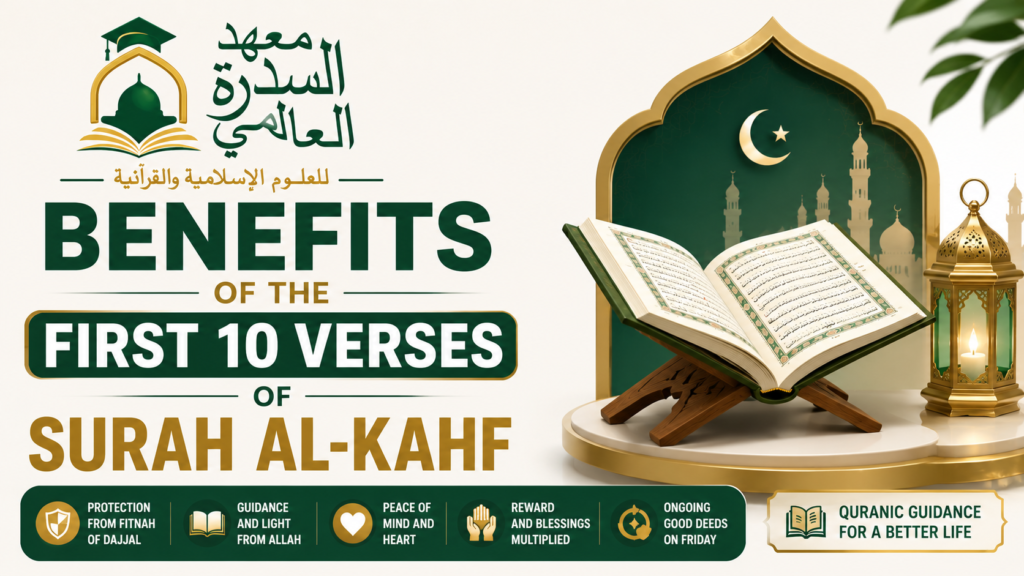
The first ten verses of Surah Al-Kahf are among the most frequently memorized passages of the Quran. Their importance comes from authentic Prophetic teachings and the powerful lessons they contain. It is important, however, to distinguish authentic virtues from popular claims that have no reliable evidence.
1. Protection from the Trial of the Dajjal
One of the greatest virtues associated with these verses comes from an authentic hadith recorded in Sahih Muslim:
“Whoever memorizes the first ten verses of Surah Al-Kahf will be protected from the Dajjal.”
Some authentic narrations also mention the last ten verses. Scholars have reconciled these narrations by explaining that both the beginning and the end of the Surah carry this virtue, and memorizing both is even more beneficial.
The protection mentioned in the hadith is by Allah’s permission. It is connected to sincere faith, understanding, and living according to the guidance of these verses—not treating them as a charm or superstition.
2. Strengthening Faith (Iman)
The opening verses repeatedly remind believers that:
- Allah alone deserves worship.
- The Quran is the perfect source of guidance.
- Worldly life is temporary.
- Eternal success belongs to those who believe and do righteous deeds.
Reflecting on these meanings strengthens a Muslim’s relationship with Allah and increases certainty in His guidance.
3. Encouraging Reflection on the Quran
These verses teach that the Quran was revealed to guide humanity, not merely to be recited. Reading the translation and a reliable tafsir helps believers:
- Understand Allah’s message.
- Apply Quranic teachings in daily life.
- Develop love for learning the Quran.
4. Building Patience During Trials
The opening verses prepare readers for the story of the People of the Cave—a group of young believers who chose faith over comfort and security.
Their example reminds Muslims that:
- Remaining steadfast can require sacrifice.
- Allah never abandons sincere believers.
- Every trial is an opportunity to grow closer to Him.
5. Developing a Weekly Quran Habit
Many Muslims recite Surah Al-Kahf every Friday following the Sunnah. This regular practice helps:
- Maintain a connection with the Quran.
- Reflect on its guidance each week.
- Establish a consistent routine of worship.
Consistency, even in small acts of worship, is beloved to Allah.
Main Themes of the First 10 Verses
| Theme | Explanation | Practical Application |
| Allah’s Perfect Revelation | The Quran is free from error and contradiction. | Read and trust the Quran as your primary source of guidance. |
| Tawheed | Allah is One and unique. | Strengthen your belief and avoid ideas that contradict Islamic monotheism. |
| Hope and Warning | Believers receive glad tidings while disbelief is warned against. | Balance hope in Allah’s mercy with accountability for your actions. |
| Temporary Nature of the World | Earthly beauty is a test. | Use blessings responsibly and remember the Hereafter. |
| Importance of Knowledge | Faith should be based on authentic evidence. | Learn Islam from reliable scholars and authentic sources. |
| Reliance on Allah | The People of the Cave began with dua. | Turn to Allah before making important decisions. |
How to Memorize the First 10 Verses of Surah Al-Kahf
Memorization becomes easier when it is consistent and accompanied by understanding.
Step 1: Learn Correct Pronunciation
Begin by listening to a qualified Quran reciter and reading with proper Tajweed if possible. Correct pronunciation helps prevent mistakes from becoming habits.
Step 2: Memorize One Verse at a Time
Rather than trying to memorize all ten verses in one sitting, focus on one verse until you can recite it confidently before moving to the next.
Step 3: Understand the Meaning
Knowing what each verse means creates stronger mental connections and makes memorization easier.
Ask yourself:
- What is Allah teaching in this verse?
- How can I apply this lesson today?
Step 4: Repeat Daily
Even five to ten minutes of revision each day is more effective than long, irregular study sessions.
A suggested weekly plan:
| Day | Goal |
| Monday | Verse 1–2 |
| Tuesday | Verse 3–4 |
| Wednesday | Verse 5–6 |
| Thursday | Verse 7–8 |
| Friday | Verse 9–10 and recite the entire passage |
| Saturday | Review all verses |
| Sunday | Revise and reflect on meanings |
Step 5: Recite During Salah
After memorizing the verses correctly, recite them in voluntary prayers. Frequent recitation strengthens long-term retention.
Common Misconceptions
Misconception 1: Simply reciting the verses guarantees protection.
Correct understanding: The authentic hadith encourages memorizing these verses, and scholars explain that their protection is by Allah’s permission for those who sincerely believe, understand, and strive to live according to His guidance.
Misconception 2: Reading only the Arabic is enough.
Reading the Arabic is an act of worship, but understanding the meaning allows believers to benefit more fully from Allah’s guidance.
Misconception 3: Surah Al-Kahf should only be read on Friday.
Friday is a recommended time to recite the Surah, but Muslims may read or study it on any day of the week.
Misconception 4: The first ten verses are more important than the rest of the Surah.
The entire Surah is part of Allah’s revelation and deserves reflection. The first ten verses have a specific virtue mentioned in authentic hadith, but this does not lessen the importance of the remaining verses.
Frequently Asked Questions
What are the first 10 verses of Surah Al-Kahf?
They are the opening ten verses of Chapter 18 of the Quran. They introduce Allah’s perfect revelation, emphasize Tawheed, promise reward to believers, warn against false beliefs, and begin the story of the People of the Cave.
Why are the first 10 verses of Surah Al-Kahf important?
They contain foundational lessons about faith and guidance, and an authentic hadith in Sahih Muslim mentions that memorizing them is a means of protection from the trial of the Dajjal.
What is the reward for reading the first 10 verses?
The authentic narrations specifically mention protection from the trial of the Dajjal for those who memorize these verses. Muslims should avoid attributing additional specific rewards unless supported by authentic evidence.
Should Surah Al-Kahf be recited every Friday?
Yes. Reciting Surah Al-Kahf on Friday is a well-known Sunnah supported by authentic narrations, and many Muslims observe this practice each week.
Can I read the English translation instead of Arabic?
Reading the English translation helps you understand Allah’s message. However, the Quran itself is the Arabic revelation. If you are able, combine recitation of the Arabic with reading a reliable translation and tafsir.
How long does it take to memorize the first 10 verses?
This varies from person to person. With consistent daily revision, many learners can memorize them over several weeks. Understanding the meaning and reciting regularly during prayer often make memorization easier.
Key Takeaways
- The first ten verses of Surah Al-Kahf establish the Quran as Allah’s perfect guidance.
- They emphasize Tawheed, righteous deeds, and preparation for the Hereafter.
- An authentic hadith states that memorizing these verses is a means of protection from the trial of the Dajjal, by Allah’s permission.
- Reflecting on the meanings of the verses is just as important as reciting them.
- Regular recitation—especially on Fridays—helps maintain a strong connection with the Quran.
- Consistent memorization, sincere worship, and applying the lessons of these verses can strengthen a believer’s faith throughout life.
Conclusion
The first ten verses of Surah Al-Kahf are more than a passage to memorize—they are a timeless reminder of Allah’s guidance, mercy, and wisdom. They teach believers to hold firmly to the truth, remain sincere in worship, and view the attractions of this world as temporary tests rather than ultimate goals.
The authentic hadith regarding these verses encourages Muslims to preserve them in their hearts, while their meanings encourage steadfast faith, reliance on Allah, and hope in His eternal reward.
Whether you are beginning your Quran journey, improving your Tajweed, or memorizing the Quran, make these verses part of your regular study. Read them carefully, understand their message, reflect on their lessons, and strive to live by them. Through sincere effort and Allah’s help, they can become a lasting source of guidance and spiritual strength.
For structured learning, beginners can follow:
To continue your Islamic learning journey, you may also like our guides on [Sunnahs of Eid al-Adha: Complete Authentic Guide (2026)], [Word-by-Word Translation and Tafsir of Surah Al-Fatiha Explained ], and [What Is Tajweed in Quran? Rules, Principles & Importance]. Exploring related topics can help you build a stronger understanding of Islam, the Quran, and everyday Islamic practices.