
Introduction
For every Muslim woman, Salah (Namaz) is more than a daily obligation—it is a direct act of worship and communication with Allah. It strengthens faith, brings peace to the heart, and reminds believers of their purpose throughout the day. Whether you are a born Muslim, a new Muslim sister, or someone returning to regular prayer, learning the correct method of Salah is one of the most important steps in your Islamic journey.
Many sisters ask questions such as:
- How do females pray Salah step by step?
- Is women’s Salah different from men’s?
- What should a woman recite during each Rak’ah?
- What clothing is required for Salah?
- Can a beginner learn Salah even without memorizing everything?
This guide answers these questions in a simple, authentic, and beginner-friendly way. It explains the essential steps of Salah according to the Quran and Sunnah, while also mentioning areas where qualified Islamic scholars have held different opinions. Our goal is to help you understand the foundations of prayer with clarity and confidence.
Quick Answer: How Do Females Pray Salah?
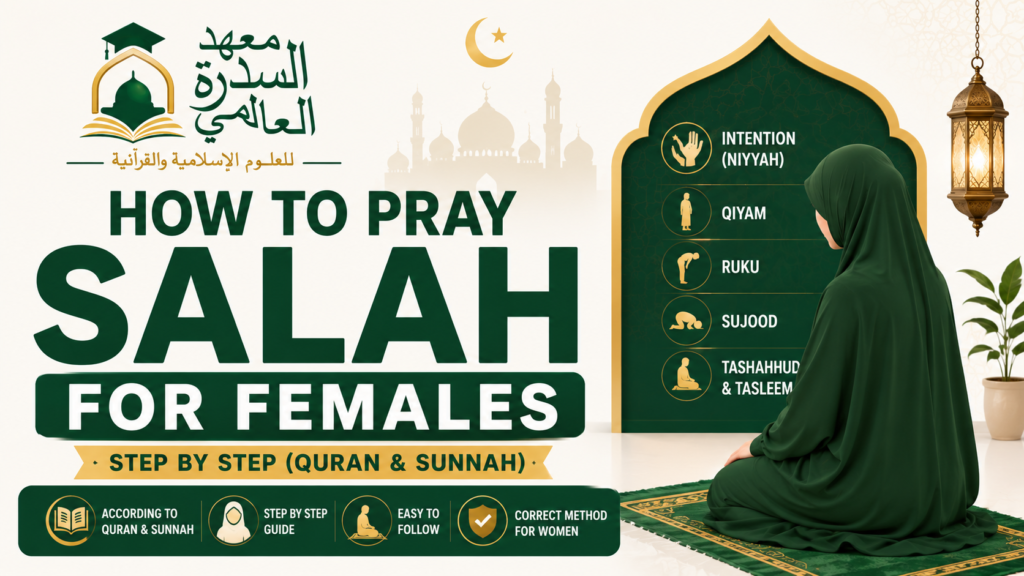
A Muslim woman performs Salah by first ensuring she is in a state of purity through Wudu, wearing clothing that fulfills the requirements of modesty, facing the Qiblah, making the intention (Niyyah), and praying with the prescribed movements and recitations. She begins with Takbir, recites Surah Al-Fatihah followed by Quranic verses, performs Ruku and Sujood, sits for Tashahhud, and concludes the prayer with Tasleem.
The essential pillars of Salah are the same for both men and women. Some scholars have discussed differences in certain physical postures based on juristic interpretation, but all agree that the obligation, purpose, and spiritual reward of Salah are the same for every Muslim.
Featured Snippet
How do females pray Salah?
Females pray Salah by performing Wudu, facing the Qiblah, making the intention (Niyyah), saying the opening Takbir, reciting Surah Al-Fatihah and another portion of the Quran, completing Ruku and Sujood, sitting for Tashahhud, and ending the prayer with Tasleem. The core pillars of Salah are identical for men and women, although scholars have differed regarding certain prayer postures.
What Is Salah?
Salah is the obligatory daily prayer that Allah has prescribed for every accountable Muslim. It is the second pillar of Islam after the declaration of faith (Shahadah) and serves as a constant reminder of our relationship with our Creator.
Allah says in the Quran:
“Indeed, prayer has been decreed upon the believers at specified times.”
(Quran 4:103)
This verse reminds Muslims that Salah is not optional. Every prayer has an appointed time that should be observed faithfully.
Salah includes:
- Standing before Allah with humility.
- Reciting verses from the Quran.
- Bowing (Ruku).
- Prostrating (Sujood).
- Remembering Allah through supplications and remembrance.
Each movement reflects humility, gratitude, and submission to Allah.
Why Is Salah Obligatory for Muslim Women?
The obligation of Salah applies equally to every adult Muslim man and woman who is mentally sound. While Islam recognizes certain circumstances—such as menstruation and postpartum bleeding—in which women are exempt from prayer, the importance of Salah remains unchanged.
Allah commands:
“Establish prayer and give zakah and bow with those who bow.”
(Quran 2:43)
The Prophet Muhammad ﷺ also emphasized the central importance of Salah, teaching that it is among the first deeds for which a person will be held accountable on the Day of Judgment.
Regular prayer helps Muslim women:
- Strengthen their relationship with Allah.
- Develop discipline and consistency.
- Find peace during life’s challenges.
- Seek forgiveness daily.
- Increase gratitude.
- Build strong Islamic character.
For many sisters, Salah becomes a source of comfort during happiness, hardship, and uncertainty.
Conditions Before Salah
Before beginning Salah, several conditions must be fulfilled. These conditions ensure that the prayer is valid according to Islamic teachings.
1. Be in a State of Purity (Wudu)
Before praying, a Muslim woman should perform Wudu (ablution) unless she already has valid purification.
The basic steps of Wudu include:
- Make the intention.
- Wash both hands.
- Rinse the mouth.
- Clean the nose.
- Wash the face.
- Wash both arms including the elbows.
- Wipe the head.
- Wipe the ears.
- Wash both feet including the ankles.
Allah says:
“O you who believe! When you rise to pray, wash your faces and your hands up to the elbows, wipe your heads, and wash your feet to the ankles.”
(Quran 5:6)
If Wudu becomes invalid before Salah begins, it should be renewed.
2. Pray at the Correct Time
Each Salah has its own appointed time.
| Prayer | Number of Fard Rak’ahs |
| Fajr | 2 |
| Dhuhr | 4 |
| Asr | 4 |
| Maghrib | 3 |
| Isha | 4 |
Praying before the prescribed time begins is not valid, and delaying a prayer without a valid excuse should be avoided.
3. Face the Qiblah
Every Muslim should face the direction of the Ka’bah in Makkah while praying whenever possible.
Allah says:
“So turn your face toward Al-Masjid Al-Haram.”
(Quran 2:144)
If someone genuinely does not know the direction after making a reasonable effort, scholars explain that Allah does not burden a person beyond their ability.
4. Make the Niyyah (Intention)
Niyyah means intending in the heart which prayer you are about to perform.
Examples include:
- Fajr prayer
- Dhuhr prayer
- Asr prayer
- Maghrib prayer
- Isha prayer
There is no authentic evidence requiring a verbal statement of intention before Salah. The intention resides in the heart.
5. Wear Proper Clothing
Islam teaches modesty during worship.
For a Muslim woman praying Salah, scholars generally agree that:
- The entire body should be covered except the face and hands (according to the majority opinion).
- Clothing should not be transparent.
- Clothing should not be tight enough to reveal the body’s shape.
- The clothing should be clean from impurity (najāsah).
Many women wear:
- Prayer hijab
- Long abaya
- Khimar
- Loose prayer garment
Comfortable, modest clothing helps maintain concentration during worship.
6. Choose a Clean Place for Prayer
The place of prayer should be free from impurities.
A prayer mat is helpful but not obligatory. Salah may be performed on any clean surface, including:
- Carpet
- Clean floor
- Grass
- Sand
- Clean outdoor ground
The Prophet ﷺ prayed on different clean surfaces depending on the circumstances.
7. Maintain Khushu’ (Humble Concentration)
Preparing the heart is just as important as preparing the body.
Before beginning Salah:
- Silence distractions.
- Remember that you are standing before Allah.
- Avoid rushing.
- Focus on the meanings of the recitations.
- Pray sincerely.
Khushu’ develops gradually and increases with regular practice and understanding of the Quran.
Five Daily Prayers at a Glance
| Prayer | Time | Fard Rak’ahs | Purpose |
| Fajr | Before sunrise | 2 | Begin the day with remembrance of Allah |
| Dhuhr | After midday | 4 | Pause worldly activities to worship Allah |
| Asr | Late afternoon | 4 | Renew faith before evening |
| Maghrib | Just after sunset | 3 | Thank Allah for the day |
| Isha | Night | 4 | End the day with worship and reflection |
Although these prayers differ in the number of Rak’ahs, the essential method of performing Salah remains the same.
Before You Begin the Prayer
Many beginners worry that they must memorize every supplication perfectly before they can pray. This concern is understandable, but it should not prevent anyone from learning Salah.
A practical approach is to:
- Learn Wudu correctly.
- Memorize Surah Al-Fatihah first.
- Learn the essential phrases of Salah gradually.
- Understand the meanings of what you recite.
- Practice each prayer consistently.
With sincere effort and regular practice, confidence grows over time. Allah knows the intention of every believer and rewards those who strive to learn His religion.
Step-by-Step Guide: How to Perform Salah for Females
Once you have completed Wudu, are dressed appropriately, have confirmed the prayer time, and are facing the Qiblah, you are ready to begin Salah.
The following steps describe the general method of Salah according to the Quran and authentic Sunnah. Where there are recognized scholarly differences regarding certain postures for women, those will be discussed later in this guide.
Step 1: Make the Intention (Niyyah)
Before starting Salah, make the intention in your heart for the prayer you are about to perform.
For example:
- Fajr Prayer
- Dhuhr Prayer
- Asr Prayer
- Maghrib Prayer
- Isha Prayer
There is no authentic narration requiring Muslims to verbally announce their intention before Salah. The intention is an act of the heart.
Step 2: Face the Qiblah
Stand facing the Ka’bah in Makkah.
Stand calmly with humility, remembering that you are about to worship Allah.
Avoid unnecessary movements or distractions.
Step 3: Say the Opening Takbir (Takbirat al-Ihram)
Raise your hands and say:
Allahu Akbar
الله أكبر
Allah is the Greatest.
This marks the official beginning of Salah.
After saying the opening Takbir, worldly conversation and unrelated actions are no longer part of the prayer.
Step 4: Stand in Qiyam (Standing Position)
Remain standing respectfully.
Many scholars describe placing the hands over the chest or upper body based on authentic narrations regarding the Prophet ﷺ. Other details of hand placement have been discussed by scholars of the different schools of jurisprudence.
Maintain a humble posture.
Lower your gaze toward the place of prostration.
Avoid looking around during prayer.
Step 5: Opening Supplication (Optional Sunnah)
The Prophet ﷺ sometimes recited an opening supplication before Surah Al-Fatihah.
One well-known supplication is:
Subhanak Allahumma wa bihamdika, wa tabarakasmuka, wa ta’ala jadduka, wa la ilaha ghayruk.
Meaning:
“Glory is to You, O Allah, and praise. Blessed is Your Name, exalted is Your Majesty, and none has the right to be worshipped except You.”
This supplication is Sunnah and not obligatory.
Step 6: Seek Refuge in Allah
Quietly recite:
A’udhu billahi min ash-shaytan ir-rajim
Meaning:
“I seek refuge in Allah from the accursed Satan.”
Then say:
Bismillah ir-Rahman ir-Rahim
Meaning:
“In the name of Allah, the Most Compassionate, the Most Merciful.”
Step 7: Recite Surah Al-Fatihah
Every Rak’ah includes the recitation of Surah Al-Fatihah.
The Prophet Muhammad ﷺ said:
“There is no prayer for the one who does not recite the Opening of the Book.”
After Al-Fatihah, say:
Ameen
In prayers where the recitation is silent, “Ameen” is also said quietly.
Step 8: Recite Another Portion of the Quran
After Al-Fatihah in the first two Rak’ahs, recite another Surah or several verses.
Beginners often start with:
- Surah Al-Ikhlas
- Surah Al-Falaq
- Surah An-Nas
- Surah Al-Kawthar
- Surah Al-Asr
As your memorization grows, you can recite additional chapters from the Quran.
Step 9: Perform Ruku (Bowing)
Say:
Allahu Akbar
Then bow.
During Ruku:
- Keep the back as straight as comfortably possible.
- Place the hands on the knees.
- Keep the head aligned naturally with the back.
- Remain calm without rushing.
While in Ruku recite at least three times:
Subhana Rabbiyal ‘Azim
Meaning:
“Glory be to my Lord, the Most Great.”
Take a moment to reflect on Allah’s greatness while bowing in humility.
Step 10: Rise from Ruku
Stand upright while saying:
Sami’ Allahu liman hamidah
Meaning:
“Allah hears the one who praises Him.”
Once standing, say:
Rabbana wa lakal hamd
Meaning:
“Our Lord, to You belongs all praise.”
Stand completely before moving to the next position.
Step 11: Perform the First Sujood (Prostration)
Say:
Allahu Akbar
Move gently into Sujood.
During prostration, seven body parts should touch the ground:
- Forehead (including the nose)
- Two hands
- Two knees
- Toes of both feet
While in Sujood recite at least three times:
Subhana Rabbiyal A’la
Meaning:
“Glory be to my Lord, the Most High.”
The Prophet ﷺ taught that Sujood is among the moments when a servant is closest to Allah, making it an excellent time for sincere supplication after the prescribed remembrance.
Step 12: Sit Between the Two Sujood
Say:
Allahu Akbar
Sit calmly.
One authentic supplication is:
Rabbighfir li
Meaning:
“My Lord, forgive me.”
Some authentic narrations include longer supplications asking Allah for forgiveness, mercy, guidance, health, and provision.
Pause briefly before the second prostration.
Step 13: Perform the Second Sujood
Again say:
Allahu Akbar
Perform the second prostration exactly as the first.
Recite:
Subhana Rabbiyal A’la
at least three times.
Complete the prostration with calmness and humility.
Step 14: Stand for the Second Rak’ah
After completing the second Sujood, stand up saying:
Allahu Akbar
The second Rak’ah follows the same general order:
- Surah Al-Fatihah
- Another Surah (for the first two Rak’ahs)
- Ruku
- Standing
- Two Sujood
Consistency in the prayer helps develop focus and tranquility.
Step 15: Sit for Tashahhud
After completing the required Rak’ahs, sit for Tashahhud.
Recite the well-known Tashahhud:
At-tahiyyatu lillahi was-salawatu wat-tayyibat. As-salamu ‘alayka ayyuhan-Nabiyyu wa rahmatullahi wa barakatuh. As-salamu ‘alayna wa ‘ala ‘ibadillahis-salihin. Ashhadu an la ilaha illallah wa ashhadu anna Muhammadan ‘abduhu wa rasuluh.
Meaning:
“All greetings, prayers, and pure words are for Allah. Peace be upon you, O Prophet, and the mercy and blessings of Allah. Peace be upon us and upon the righteous servants of Allah. I bear witness that there is no deity worthy of worship except Allah, and I bear witness that Muhammad is His servant and Messenger.”
Step 16: Send Blessings Upon the Prophet ﷺ
In the final sitting, recite Salat Ibrahimiyyah after the Tashahhud.
This is an important Sunnah before ending the prayer.
You may also make authentic personal supplications before concluding the Salah.
Step 17: End the Prayer with Tasleem
Turn your head to the right and say:
As-salamu ‘alaykum wa rahmatullah
Then turn to the left and repeat:
As-salamu ‘alaykum wa rahmatullah
With the Tasleem, the Salah is complete.
What Should Women Recite During Salah?
For beginners, it is helpful to focus on memorizing the essential recitations first.
Essential Recitations
| Part of Salah | Required Recitation |
| Opening | Allahu Akbar |
| Standing | Surah Al-Fatihah |
| First Two Rak’ahs | Another Surah or Quran verses |
| Ruku | Subhana Rabbiyal ‘Azim |
| Standing After Ruku | Sami’ Allahu liman hamidah, Rabbana wa lakal hamd |
| Sujood | Subhana Rabbiyal A’la |
| Sitting Between Sujood | Rabbighfir li |
| Final Sitting | Tashahhud |
| End of Prayer | Tasleem |
Understanding the Meaning Improves Khushu’
While memorization is important, understanding what you are reciting can greatly improve concentration (Khushu’).
For example:
- Allahu Akbar reminds you that Allah is greater than every worldly concern.
- Subhana Rabbiyal ‘Azim glorifies Allah’s greatness during bowing.
- Subhana Rabbiyal A’la praises Allah’s supreme majesty during prostration.
- Rabbighfir li is a sincere request for Allah’s forgiveness.
Reflecting on these meanings helps transform Salah from a routine action into a heartfelt conversation with your Creator.
Tips for Sisters Learning Salah
If you are just beginning your journey, remember:
- Learn one step at a time.
- Memorize Surah Al-Fatihah before adding additional Surahs.
- Practice each prayer consistently.
- Listen to qualified Quran recitations to improve pronunciation.
- Review your Salah regularly with a knowledgeable teacher or trusted Islamic learning resource.
- Do not become discouraged by small mistakes made while sincerely learning.
Allah rewards sincere effort, patience, and the desire to worship Him correctly.
Is Women’s Salah Different from Men’s?
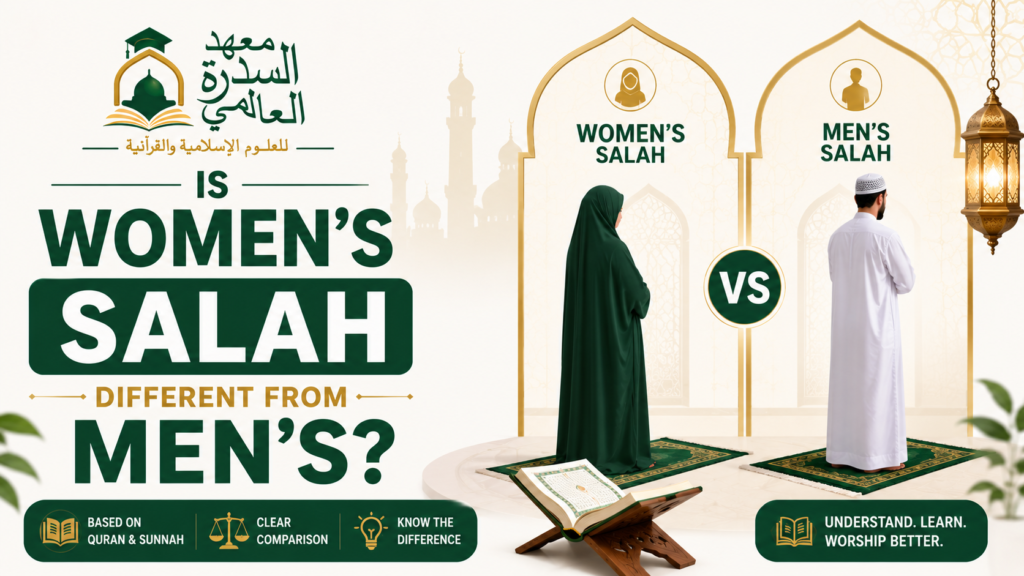
This is one of the most frequently asked questions about Salah.
Quick Answer
The essential pillars (Arkān), obligations (Wājibāt), conditions (Shurūt), and recitations of Salah are the same for both men and women. Every Muslim is required to perform the prescribed prayers, beginning with purification, facing the Qiblah, making the intention, reciting the Quran, bowing, prostrating, sitting for Tashahhud, and ending with Tasleem.
The discussion among scholars concerns certain physical postures and details of prayer, not the validity or obligation of Salah itself.
What Does the Sunnah Teach?
One of the most well-known narrations regarding the method of prayer is the statement of the Prophet Muhammad ﷺ:
“Pray as you have seen me praying.”
(Sahih al-Bukhari)
Based on this hadith, many scholars—including those from the Shafi’i and Hanbali schools, as well as many contemporary scholars—hold that the basic manner of Salah is the same for men and women unless there is authentic evidence indicating otherwise.
Some scholars within the Hanafi and Maliki traditions have discussed certain recommended differences in posture for women, often emphasizing modesty and concealment. These discussions are based on juristic reasoning and interpretations rather than explicit, universally accepted authentic hadith prescribing a separate prayer method.
For beginners, the most important point is to learn the agreed-upon pillars of Salah correctly and seek guidance from reliable scholars or teachers if following a particular school of jurisprudence.
Areas of Scholarly Discussion
The following table summarizes areas where jurists have expressed different opinions.
| Topic | Scholarly Agreement |
| Number of daily prayers | Same |
| Number of Rak’ahs | Same |
| Recitations | Same |
| Wudu requirements | Same |
| Conditions of Salah | Same |
| Obligation of Salah | Same |
| Takbir | Same |
| Ruku | Same |
| Sujood | Same |
| Tasleem | Same |
| Certain physical postures | Some juristic differences exist |
These differences should never become a cause for argument among Muslims. Respecting valid scholarly opinions is part of Islamic etiquette.
Can Women Pray Salah at Home?
Yes.
Women are permitted to pray in the mosque, and they are also permitted to pray at home.
The Prophet ﷺ said:
“Do not prevent the female servants of Allah from going to the mosques of Allah.”
He also indicated that praying at home may be better for many women, reflecting considerations of modesty and convenience. Scholars explain these narrations together, concluding that women may attend the mosque while observing Islamic etiquette, and they may also choose to pray at home.
For many sisters today, praying at home offers:
- Greater concentration.
- Privacy.
- Convenience for family responsibilities.
- A peaceful worship environment.
Both options are recognized within Islamic teachings.
What Should Women Wear During Salah?
Proper clothing is one of the conditions for a valid prayer.
Generally, scholars state that a woman should ensure:
- The body is covered according to the requirements of Salah.
- Clothing is loose and modest.
- Clothing is clean.
- Clothing is not transparent.
Many Muslim women use:
- Prayer hijab
- Khimar
- Abaya
- Loose jilbab
- Prayer dress (telekung in some cultures)
Can Women Pray Without a Hijab?
If a woman has reached puberty, the majority of scholars state that covering the hair during Salah is required, even if she is praying alone.
Common Mistakes Women Make During Salah
Learning from mistakes is an important part of improving one’s worship.
1. Rushing Through the Prayer
Some people move quickly from one position to another without pausing.
The Prophet ﷺ emphasized calmness (ṭuma’nīnah) in every position of Salah.
Take a brief pause in:
- Ruku
- Standing after Ruku
- Both Sujood
- Sitting between the two prostrations
2. Incorrect Wudu
A valid Salah begins with valid purification.
Common mistakes include:
- Leaving parts of the face dry.
- Forgetting the elbows.
- Not washing the ankles completely.
Take your time while performing Wudu.
3. Not Facing the Qiblah Correctly
Whenever possible:
- Confirm the Qiblah direction before starting.
- Use a reliable Qiblah application or local mosque if unsure.
4. Neglecting Proper Modest Clothing
Avoid:
- Tight clothing that clearly outlines the body.
- Transparent fabrics.
- Clothing that uncovers required areas during prayer.
Comfortable and loose clothing helps maintain focus.
5. Looking Around Frequently
During Salah:
- Keep your eyes toward the place of Sujood.
- Avoid unnecessary movement.
- Silence mobile devices before beginning.
Concentration grows with practice.
6. Forgetting the Meanings of the Recitations
Many Muslims memorize Arabic without understanding its meaning.
Learning the translation of:
- Surah Al-Fatihah
- Tashahhud
- Subhana Rabbiyal ‘Azim
- Subhana Rabbiyal A’la
can greatly improve Khushu’.
7. Delaying Salah Without a Valid Reason
Allah has prescribed fixed times for prayer.
Developing the habit of praying early helps strengthen consistency and discipline.
Special Situations for Women
Islam is a religion of mercy and recognizes different life circumstances.
During Menstruation (Hayd)
A woman who is menstruating does not perform Salah during this period.
She is not required to make up the missed obligatory prayers afterward.
When her period ends:
- Perform the required purification (Ghusl).
- Resume Salah at the next prayer time.
This exemption is a mercy from Allah and should not be viewed as a shortcoming in worship.
During Postpartum Bleeding (Nifas)
The ruling for postpartum bleeding is similar to menstruation.
A woman:
- Does not pray during Nifas.
- Performs Ghusl when the bleeding ends.
- Resumes Salah thereafter.
Specific durations and rulings may vary depending on individual circumstances, so consulting a qualified scholar is beneficial when questions arise.
During Pregnancy
Pregnancy does not exempt a woman from Salah.
However, Islam allows ease where genuine hardship exists.
If standing becomes difficult:
- Pray sitting.
If sitting is not possible:
- Pray in the most capable position available, following the guidance found in authentic Sunnah for those unable to stand.
Allah does not burden a soul beyond its capacity.
During Illness
If illness prevents normal movements:
A person may:
- Pray sitting.
- Pray on a chair.
- Pray lying down if necessary.
- Indicate Ruku and Sujood with gentle movements when physically unable.
The obligation of Salah remains according to one’s ability.
While Traveling
Women who travel have the same concessions as men regarding travel prayers when the conditions for travel are met.
Depending on the situation, travelers may be permitted to:
- Shorten certain obligatory prayers (Qasr).
- Combine certain prayers (Jam’).
These rulings should be learned from reliable scholarly sources, as they depend on the nature and distance of the journey.
Tips for Building Consistency in Salah
Many sisters struggle with maintaining all five daily prayers, especially when balancing work, studies, or family responsibilities.
The following habits can help:
1. Learn One Prayer at a Time
If you are a beginner, focus first on learning the structure of Salah correctly.
Confidence develops through repetition.
2. Pray at the Beginning of the Prayer Time
Avoid delaying Salah unnecessarily.
Praying early reduces the chance of missing a prayer.
3. Understand What You Recite
Even learning the meaning of one Surah each week can transform your prayer.
Knowledge increases focus.
4. Create a Peaceful Prayer Space
Choose a clean, quiet place where distractions are minimal.
Keep your prayer mat, Quran, and prayer clothing organized and easily accessible.
5. Continue Learning
Salah is a lifelong act of worship.
As your knowledge grows, continue improving:
- Tajweed
- Quran memorization
- Understanding of the Sunnah
- Khushu’
- Daily supplications
Each improvement strengthens your relationship with Allah.
Common Misconceptions About Women’s Salah
Many misunderstandings about women’s prayer arise from cultural practices, incomplete knowledge, or confusion between scholarly opinions and universally agreed-upon rulings. Clarifying these misconceptions helps Muslim women worship Allah with confidence and authenticity.
Misconception 1: Women Pray a Completely Different Salah Than Men
Reality:
No. The pillars, conditions, obligatory acts, and recitations of Salah are the same for both men and women.
Some scholars have held different opinions regarding certain postures based on juristic interpretation, but these do not change the fundamental structure of Salah.
Misconception 2: Women Cannot Pray in the Mosque
Reality:
Women are permitted to attend the mosque while observing Islamic etiquette.
The Prophet ﷺ said:
“Do not prevent the female servants of Allah from the mosques of Allah.”
(Sahih Muslim)
At the same time, authentic narrations also indicate the virtue of praying at home for many women. Islam allows both, and the choice may depend on personal circumstances and local conditions.
Misconception 3: A Woman Must Memorize the Entire Quran Before She Can Pray
Reality:
This is incorrect.
A beginner only needs to gradually learn the required recitations for Salah, beginning with Surah Al-Fatihah and the essential phrases of prayer.
Learning additional Surahs is a continuous process.
Misconception 4: Small Mistakes Make Every Salah Invalid
Reality:
Islam distinguishes between mistakes made unintentionally and deliberate neglect.
If a person sincerely forgets something while learning, Allah is Most Merciful. Certain mistakes may require Sujood as-Sahw (prostration of forgetfulness) depending on the situation, while others do not invalidate the prayer.
If you are unsure about a specific mistake, ask a qualified scholar.
Misconception 5: Older Women No Longer Need to Learn Salah Properly
Reality:
Seeking beneficial Islamic knowledge is encouraged throughout life.
Whether someone is 15 or 75 years old, improving the quality of Salah is a lifelong act of worship.
Frequently Asked Questions (FAQs)
How do females pray Salah?
A Muslim woman prays Salah by performing Wudu, facing the Qiblah, making the intention in her heart, saying the opening Takbir, reciting Surah Al-Fatihah and Quranic verses, performing Ruku and Sujood, sitting for Tashahhud, and ending with Tasleem. The essential method is the same as the prayer taught by the Prophet Muhammad ﷺ.
What is the correct way for women to pray Salah?
The correct way is to follow the guidance of the Quran and the authentic Sunnah. The pillars of Salah—including standing (when able), recitation, bowing, prostration, and concluding with Tasleem—remain the same for men and women. Some juristic schools differ on certain postures, but these differences do not change the core acts of prayer.
Is women’s Salah different from men’s?
The essential acts and recitations are the same.
Some scholars have expressed different opinions regarding certain physical positions based on juristic reasoning. These are recognized scholarly differences and should be respected without causing division.
How many Rak’ahs should women pray?
Women perform the same number of obligatory (Fard) Rak’ahs as men.
| Prayer | Fard Rak’ahs |
| Fajr | 2 |
| Dhuhr | 4 |
| Asr | 4 |
| Maghrib | 3 |
| Isha | 4 |
What should women recite during Salah?
The essential recitations include:
- Allahu Akbar
- Surah Al-Fatihah
- Another Surah (in the first two Rak’ahs)
- Subhana Rabbiyal ‘Azim
- Rabbana wa lakal hamd
- Subhana Rabbiyal A’la
- Rabbighfir li
- Tashahhud
- Salat Ibrahimiyyah
- Tasleem
Can women pray Salah at home?
Yes.
Women may pray at home or in the mosque while observing Islamic etiquette. Both are permissible within Islamic teachings.
What should women wear during Salah?
A woman should wear clean, loose, and modest clothing that fulfills the requirements of Salah according to the majority of scholars. The clothing should not be transparent or reveal the shape of the body.
Can a woman read from a prayer guide while learning Salah?
Many contemporary scholars permit a beginner or a new Muslim to use a prayer guide when necessary as a temporary learning aid, especially until the essential recitations are memorized. If you follow a particular madhhab, consult a trusted scholar for guidance according to that school.
Can women pray while sitting?
Yes.
If illness, pregnancy, injury, or another genuine difficulty prevents standing, a woman may pray according to her ability, as taught in the Sunnah.
What invalidates Salah for women?
The factors that invalidate Salah are generally the same for men and women. Examples include:
- Losing Wudu.
- Intentionally speaking during Salah.
- Deliberately eating or drinking.
- Excessive unnecessary movement.
- Intentionally omitting an essential pillar of the prayer.
If a person is uncertain whether their Salah is valid, they should seek guidance from a qualified scholar.
Beginner’s Learning Roadmap
If you are just starting to learn Salah, don’t try to memorize everything in one day. Build your knowledge step by step.
1 Week
- Learn the importance of Salah.
- Learn Wudu.
- Memorize Allahu Akbar.
- Memorize Surah Al-Fatihah.
2 Week
- Learn Ruku and Sujood.
- Memorize the Tasbih recited in each position.
- Practice two Rak’ahs slowly.
3 Week
- Memorize the Tashahhud.
- Learn one short Surah such as Surah Al-Ikhlas.
- Focus on praying the five daily prayers consistently.
Week 4
- Improve pronunciation.
- Learn the meanings of the recitations.
- Develop greater Khushu’ (humble concentration).
Small, consistent steps often lead to lasting progress.
Key Takeaways
- Salah is the second pillar of Islam and is obligatory for every adult Muslim woman unless a valid exemption applies.
- The conditions before Salah include purification, proper clothing, facing the Qiblah, entering the prayer time, and making the intention.
- The pillars and essential recitations of Salah are the same for men and women.
- Scholars have differed on certain physical postures, but these differences do not affect the shared foundations of the prayer.
- Beginners should focus on learning one step at a time without becoming discouraged.
- Understanding the meanings of the recitations helps increase humility and concentration.
- Consistency in the five daily prayers is one of the greatest means of strengthening faith.
Conclusion
Learning how to pray Salah correctly is one of the most valuable investments a Muslim woman can make in her relationship with Allah. Every prayer is an opportunity to seek His mercy, express gratitude, ask for forgiveness, and renew faith.
If you are a beginner, remember that mastery comes with patience and regular practice. Start with the essentials, learn the meanings of what you recite, and continue improving over time. Islam encourages steady growth in worship rather than perfection from the very beginning.
Most importantly, approach Salah with sincerity, humility, and hope in Allah’s mercy. Every step you take to learn His religion is an act of worship that carries great reward.
Continue Your Islamic Learning
To strengthen your understanding of Salah and Quran recitation, you may also find these topics helpful:
Related Articles
- Surah Kahf First Ten Verses with Arabic, Transliteration & Tafsir
- What Is the Connection Between Hajj and Eid al-Adha?
- What Is Tajweed in Quran? Rules, Principles & Importance
- Sunnahs of Eid al-Adha: Complete Authentic Guide (2026)
- Word-by-Word Translation and Tafsir of Surah Al-Fatiha Explained
Recommended Courses
By combining authentic knowledge with regular practice, you can continue building a stronger connection with Allah and perform your daily prayers with confidence, understanding, and devotion.