
Introduction
Every Muslim recites Surah Al-Fatiha in every unit of prayer, yet many of us repeat its words without fully understanding their depth. One of the most powerful verses in this Surah is:
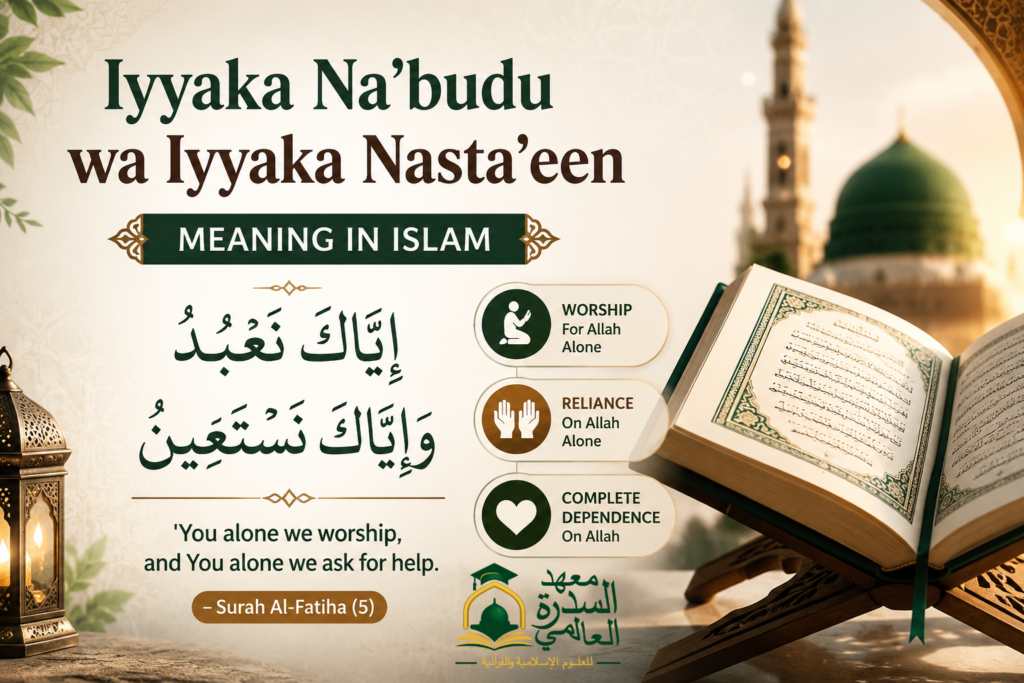
“Iyyaka Na’budu wa Iyyaka Nasta’een”
This short Arabic phrase carries a complete philosophy of Islamic life. It defines who a believer worships, how a believer depends on Allah, and what true Tawheed (Islamic monotheism) really means in practice.
In this article, we will break down the meaning, Tafseer, spiritual message, and real-life application of this verse in a simple and deeply meaningful way.
Quick Answer: Meaning of “Iyyaka Na’budu wa Iyyaka Nasta’een”
“Iyyaka Na’budu wa Iyyaka Nasta’een” means:
👉 “You alone we worship, and You alone we ask for help.”
It expresses two core beliefs:
- All worship belongs only to Allah.
- All help and reliance ultimately come only from Allah.
This verse is a direct declaration of complete devotion and dependence on Allah.
Featured Snippet (SEO Answer)
“Iyyaka Na’budu wa Iyyaka Nasta’een” is a verse from Surah Al-Fatiha meaning “You alone we worship and You alone we ask for help.” It teaches absolute monotheism (Tawheed), emphasizing that worship and reliance must be directed only to Allah without partners.
Word-by-Word Meaning
Understanding this verse becomes easier when we break it down:
| Arabic Word | Meaning | Explanation |
| Iyyaka | You alone | Exclusively Allah |
| Na’budu | We worship | Acts of worship (prayer, obedience, devotion) |
| Wa | And | Connection between two statements |
| Iyyaka | You alone | Repeated for emphasis |
| Nasta’een | We seek help | Asking for support, guidance, and strength |
Key Insight:
The repetition of “Iyyaka” (You alone) is not accidental. It strongly emphasizes exclusivity—nothing and no one shares Allah’s right in worship or help.
Tafsir of “Iyyaka Na’budu wa Iyyaka Nasta’een”
Classical scholars explain this verse as the center of Surah Al-Fatiha and the heart of Islamic belief.
1. Exclusive Worship for Allah
“Iyyaka Na’budu” means:
- We worship only Allah
- We do not associate partners with Him
- All acts of worship (Salah, Dua, fasting) are for Allah alone
This is the essence of Tawheed in worship.
2. Complete Dependence on Allah
“Iyyaka Nasta’een” means:
- We ask help only from Allah in a ultimate sense
- Even when using means (people, tools), the heart relies on Allah
- Allah is the true source of all strength and guidance
This teaches that reliance on Allah is not optional—it is essential.
3. The Balance Between Worship and Help
Islam teaches a balance:
- Worship = our duty toward Allah
- Seeking help = our need from Allah
Both are placed together to show:
👉 A believer cannot live without worshiping Allah
👉 A believer cannot succeed without Allah’s help
Spiritual Meaning Behind the Verse
This verse is not only a translation—it is a spiritual contract between the believer and Allah.
It teaches:
- Humility before Allah
- Total surrender of ego
- Awareness that nothing happens without Allah’s will
- Strengthening of faith in hardship and ease
When a Muslim recites this verse in Salah, they are declaring:
“My life, worship, success, and support all belong to Allah alone.”
Connection to Tawheed (Islamic Monotheism)
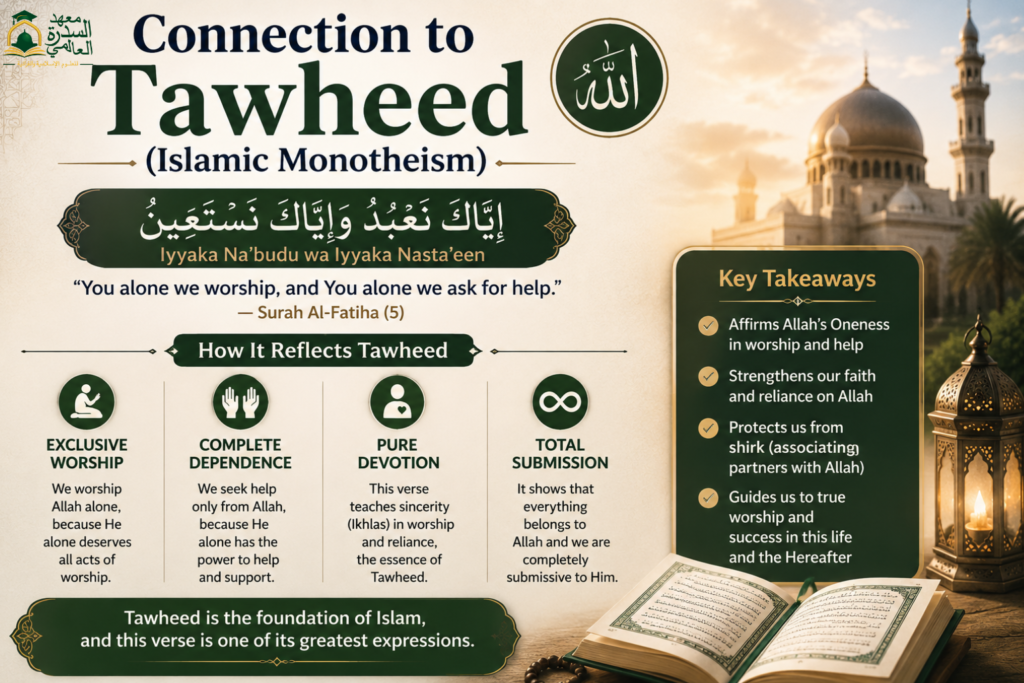
This verse is one of the strongest proofs of Tawheed in the Quran.
Tawheed is divided into:
- Tawheed al-Rububiyyah – Allah is the Creator and Sustainer
- Tawheed al-Uluhiyyah – Only Allah deserves worship
- Tawheed al-Asma wa Sifat – Allah’s names and attributes are unique
“Iyyaka Na’budu” directly supports Tawheed al-Uluhiyyah
“Iyyaka Nasta’een” strengthens dependence on Allah alone
Together, they complete the foundation of Islamic belief.
Why This Verse Is Central in Prayer
A major reason this verse is so powerful is its position in Salah.
In every rak’ah of prayer, a Muslim says it while standing before Allah.
This means:
- You renew your commitment to Allah repeatedly
- You declare your loyalty multiple times daily
- You reset your intention constantly
This makes Salah not just ritual—but a continuous spiritual renewal
Practical Life Lessons from the Verse
1. Don’t rely on people completely
People can help, but only Allah gives results.
2. Worship should be sincere
Acts of worship should not be for attention or status.
3. Ask Allah first
Before stress, decisions, or difficulty—turn to Allah.
4. Stay humble
Everything you have is from Allah’s help.
5. Build trust in Allah
Even when solutions are not visible, Allah’s help is always near.
Real-Life Application Examples
Example 1: Financial difficulty
Instead of panic:
- Make Dua
- Work hard
- Trust Allah for outcomes
Example 2: Exams or studies
- Study with effort
- Ask Allah for success
- Don’t rely only on preparation
Example 3: Emotional stress
- Seek comfort in Salah
- Ask Allah for patience and strength
This verse trains the heart to stay balanced between effort and reliance.
Common Misconceptions
❌ Misconception 1: We don’t need to ask people for help
✔ Correction: Islam allows seeking help from people in normal matters, but ultimate reliance is only on Allah.
❌ Misconception 2: This verse means no effort is needed
✔ Correction: Islam teaches effort + reliance on Allah (tawakkul), not laziness.
❌ Misconception 3: Worship is only prayer
✔ Correction: Worship includes every act done for Allah’s pleasure.
Deep Spiritual Reflection
When a believer truly understands this verse:
- Pride decreases
- Anxiety reduces
- Faith strengthens
- Heart becomes peaceful
It creates a direct emotional connection with Allah, because the believer realizes:
“I cannot worship properly without Allah’s help, and I cannot survive without Him.”
Benefits of Reflecting on This Verse
- Strengthens faith (Iman)
- Builds trust in Allah (Tawakkul)
- Removes dependency on creation
- Improves sincerity in worship
- Brings inner peace during hardship
Frequently Asked Questions (FAQs)
1. What is the meaning of Iyyaka Na’budu?
It means “You alone we worship,” referring to Allah alone being worthy of worship.
2. What is the meaning of Nasta’een?
It means “We seek help,” specifically from Allah in ultimate dependence.
3. Why is this verse important in Surah Al-Fatiha?
It represents the core message of the entire Quran—worship and reliance on Allah alone.
4. What is the connection between this verse and Tawheed?
It directly expresses Tawheed al-Uluhiyyah—worshiping Allah alone without partners.
5. Why do we repeat this verse in every prayer?
To renew our commitment, sincerity, and dependence on Allah multiple times a day.
6. Can we ask people for help in Islam?
Yes, in practical matters, but ultimate reliance and belief in success is only from Allah.
Conclusion
The verse “Iyyaka Na’budu wa Iyyaka Nasta’een” is not just a phrase—it is a complete way of life. It teaches Muslims to direct all worship to Allah alone and depend on Him completely in every situation.
When understood deeply, this verse transforms prayer from repetition into a powerful spiritual experience that strengthens faith, builds humility, and creates true connection with Allah.
Every time a Muslim recites it in Surah Al-Fatiha, they are renewing their promise:
“O Allah, we worship only You, and we depend only on You.”
To continue your Islamic learning journey, you may also like our guides on [How Many Rakats Are in Isha Prayer? Complete Guide], and [Who Wrote the Quran? When Was It Written? Islamic History]. Exploring related topics can help you build a stronger understanding of Islam, the Quran, and everyday Islamic practices.