
Quick Answer
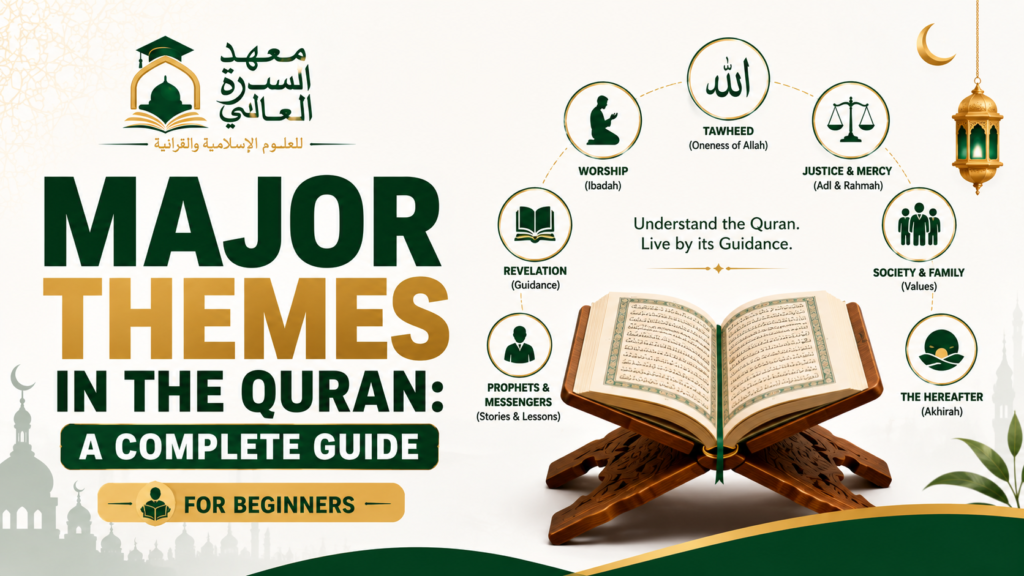
The major themes in the Quran are the central messages that appear repeatedly throughout Allah’s revelation. They include Tawheed (the Oneness of Allah), Prophethood, Divine Revelation, worship (Ibadah), morality, justice, mercy, repentance, family values, accountability, and the Hereafter. Together, these themes teach Muslims how to build a strong relationship with Allah, develop good character, and live a balanced, purposeful life. Understanding these recurring teachings helps readers see the Quran as a complete guide rather than a collection of separate stories or rulings.
What Are the Major Themes in the Quran?
The major themes in the Quran are the recurring teachings that form the foundation of Islam. They include belief in the Oneness of Allah (Tawheed), the mission of the Prophets, Divine Revelation, worship, justice, mercy, morality, the Hereafter, and guidance for personal and social life. These themes appear throughout the Quran to guide humanity toward faith, righteous actions, and success in this life and the next.
At a Glance: Major Themes in the Quran
| Theme | What It Teaches | Practical Lesson |
| Tawheed | Allah is One and alone deserves worship | Build sincere faith in Allah |
| Prophethood | Allah guided humanity through His Messengers | Follow authentic divine guidance |
| Revelation | The Quran is Allah’s final revelation | Learn and apply the Quran |
| Worship | Worship strengthens faith and obedience | Pray, fast, give charity, and remember Allah |
| Morality | Good character is part of faith | Be honest, patient, and kind |
| Justice | Treat everyone fairly | Respect the rights of others |
| Mercy | Allah is Most Merciful | Forgive others and seek forgiveness |
| Family | Strong families build strong communities | Honor parents and maintain family ties |
| Charity | Help those in need | Practice generosity regularly |
| Hereafter | Every person will be accountable | Live with purpose and responsibility |
Introduction
The Quran is more than a holy book—it is Allah’s complete guidance for humanity. Revealed over approximately 23 years to Prophet Muhammad ﷺ, it addresses every aspect of human life, from belief and worship to family, morality, justice, and personal character.
Although the Quran covers many subjects, its teachings revolve around several major recurring themes. These themes connect its chapters and verses into one unified message, helping believers understand their purpose, strengthen their relationship with Allah, and live according to divine guidance.
For beginners, learning these themes provides an excellent foundation for understanding the Quran. Instead of reading individual verses in isolation, recognizing the Quran’s central messages makes its guidance clearer and more meaningful.
In this guide, we will explore the most important themes of the Quran, explain why they are repeated throughout the revelation, and discuss how they apply to everyday life.
Key Takeaway: The Quran presents a unified message that combines faith, worship, ethics, and practical guidance for every stage of life.
What Are the Major Themes in the Quran?
Understanding Quranic Themes
A theme is a central idea that appears repeatedly throughout a text. In the Quran, themes are the recurring teachings that Allah emphasizes to guide humanity toward truth and righteousness.
Rather than discussing one subject from beginning to end, the Quran often revisits important topics from different perspectives. This unique style encourages reflection and helps believers remember essential lessons.
These recurring themes include:
- Belief in the Oneness of Allah
- The mission of the Prophets
- Divine Revelation
- Worship and obedience
- Moral character
- Justice and compassion
- Accountability in the Hereafter
- Family and social responsibilities
- Repentance and forgiveness
- Reflection upon Allah’s signs
Together, these themes provide a complete framework for understanding Islam and living according to Allah’s guidance.
Why Are These Themes Repeated?
The Quran repeats important themes because people learn through reminder and reflection. Repetition reinforces faith, strengthens understanding, and highlights the importance of key principles.
Allah says:
“And We have certainly diversified in this Quran for the people from every kind of example, but most of the people refused except disbelief.”
(Quran 17:89)
Each repetition adds new wisdom, context, or lessons rather than merely repeating the same information.
Key Takeaway: Repeated themes in the Quran are a deliberate teaching method that deepens understanding and strengthens faith.
Tawheed: The Central Theme of the Quran
What Is Tawheed?
Tawheed means believing that Allah alone is the Creator, Sustainer, and the only One worthy of worship. It is the foundation of Islam and the central message of the Quran.
Every Prophet, from Adam (peace be upon him) to Muhammad ﷺ, called people to worship Allah alone without associating partners with Him.
Allah says:
“And We certainly sent into every nation a messenger, saying, ‘Worship Allah and avoid false deities.'”
(Quran 16:36)
This message unites all divine revelations and remains the heart of Islamic belief.
Why Is Tawheed So Important?
Belief in the Oneness of Allah shapes every aspect of a Muslim’s life.
It teaches that:
- Allah alone deserves worship.
- Every blessing comes from Allah.
- Human beings are accountable only to Him.
- True success comes through obedience to Allah.
When Tawheed is firmly established, worship becomes sincere, intentions become pure, and daily actions gain spiritual purpose.
Tawheed in Daily Life
Understanding Tawheed influences everyday decisions.
For example, a Muslim who believes that Allah sees every action strives to:
- Pray sincerely.
- Speak truthfully.
- Earn lawful income.
- Treat others fairly.
- Avoid dishonesty, even when no one is watching.
Tawheed is not only a belief—it is a way of living.
Common Misconception
Some people think Tawheed simply means believing that Allah exists.
However, the Quran teaches that Tawheed also requires:
- Worshipping Allah alone.
- Trusting Him completely.
- Following His guidance.
- Avoiding every form of shirk (associating partners with Allah).
Belief without sincere worship does not fulfill the Quran’s complete understanding of Tawheed.
Key Takeaway: Tawheed is the foundation upon which every other Quranic teaching is built.
Prophethood and Divine Revelation
Why Did Allah Send Prophets?
Throughout history, Allah sent Prophets to guide humanity whenever people strayed from the truth.
Their mission was consistent:
- Teach people to worship Allah alone.
- Convey Allah’s revelation.
- Explain right and wrong.
- Serve as practical examples of righteous living.
The Quran mentions many Prophets, including:
- Adam (peace be upon him)
- Nuh (Noah)
- Ibrahim (Abraham)
- Musa (Moses)
- Isa (Jesus)
- Muhammad ﷺ
Although their communities differed, their essential message remained the same.
Allah says:
“We certainly sent a messenger into every nation.”
(Quran 16:36)
The Quran as the Final Revelation
Muslims believe the Quran is Allah’s final revealed Book, sent to Prophet Muhammad ﷺ as guidance for all humanity.
Unlike previous scriptures, the Quran has been preserved in its original form.
Allah says:
“Indeed, it is We who sent down the Reminder, and indeed, We will be its guardian.”
(Quran 15:9)
This divine preservation ensures that Muslims today can access the same revelation that was conveyed to the Prophet Muhammad ﷺ over fourteen centuries ago.
Why Revelation Matters
Without divine revelation, people would rely only on human opinions, which can differ across cultures and generations.
The Quran provides an unchanging moral and spiritual framework that helps believers distinguish truth from falsehood.
Its guidance covers:
- Faith
- Worship
- Family life
- Business ethics
- Social justice
- Personal conduct
- Accountability before Allah
For Muslims, the Quran is not only a book to be recited but also a guide to be understood and applied.
Key Takeaway: Allah sent His Prophets with revelation to guide humanity, and the Quran is the final, preserved source of that guidance.
Worship (Ibadah): Living in Obedience to Allah
Worship (Ibadah) is one of the major themes in the Quran. While many people think worship only refers to prayer, the Quran presents a much broader understanding. Every sincere action performed to please Allah can become an act of worship when it follows His guidance.
The purpose of worship is to strengthen a believer’s relationship with Allah, develop self-discipline, and remind people of their dependence on their Creator.
Allah says:
“And I did not create the jinn and mankind except to worship Me.”
(Quran 51:56)
This verse highlights that worship is the primary purpose of human life.
Forms of Worship in the Quran
The Quran repeatedly encourages different acts of worship, including:
- Salah (Prayer): Builds a daily connection with Allah.
- Zakat (Obligatory Charity): Purifies wealth and supports those in need.
- Sawm (Fasting): Develops patience and self-control.
- Hajj (Pilgrimage): Demonstrates unity and submission to Allah.
- Dhikr (Remembrance of Allah): Keeps the heart connected to its Creator.
- Dua (Supplication): Encourages believers to seek Allah’s help in every situation.
Each act of worship nurtures faith while benefiting both the individual and society.
Worship Beyond Rituals
The Quran teaches that worship is not limited to religious rituals.
Everyday actions can become acts of worship when performed with sincerity and in accordance with Islamic teachings. Examples include:
- Earning an honest livelihood.
- Caring for parents.
- Treating neighbors kindly.
- Fulfilling promises.
- Seeking beneficial knowledge.
- Helping those in need.
This broad understanding of worship encourages Muslims to remember Allah throughout every aspect of life.
Key Takeaway: Worship in Islam is a complete way of life that combines devotion to Allah with righteous actions and sincere intentions.
Morality and Good Character (Akhlaq)
One of the Quran’s most consistent messages is the importance of good character (Akhlaq). Faith is not only expressed through belief and worship but also through how people treat others.
The Quran repeatedly encourages virtues that strengthen individuals, families, and communities.
Core Moral Values in the Quran
Among the most emphasized values are:
- Honesty
- Truthfulness
- Patience (Sabr)
- Gratitude (Shukr)
- Humility
- Kindness
- Forgiveness
- Compassion
- Trustworthiness
- Respect for parents
- Keeping promises
These qualities are presented as signs of sincere faith.
Allah says:
“Indeed, Allah commands justice, excellence, and giving to relatives, and He forbids immorality, bad conduct, and oppression.”
(Quran 16:90)
This verse summarizes many of the ethical principles that the Quran promotes.
Morality in Everyday Life
Quranic ethics apply to all areas of life, including:
- Family relationships.
- Friendships.
- Business transactions.
- Education.
- Community service.
- Leadership.
- Conflict resolution.
A Muslim who follows Quranic morals strives to be fair, truthful, patient, and compassionate in every interaction.
Character Reflects Faith
The Quran consistently connects righteous actions with sincere belief.
For example, someone who prays regularly but mistreats others has not fully embodied the Quran’s teachings. Faith and character are meant to support one another.
Key Takeaway: The Quran teaches that true faith is reflected in honesty, kindness, patience, and good conduct toward others.
Justice and Social Responsibility
Justice is one of the Quran’s central themes because it protects the rights and dignity of every individual.
The Quran calls believers to establish justice even when it is difficult or against their own interests.
Allah says:
“Indeed, Allah commands you to render trusts to whom they are due and when you judge between people to judge with justice.”
(Quran 4:58)
Justice in Islam is not selective. It applies equally to family members, friends, strangers, and even opponents.
Areas Where the Quran Emphasizes Justice
The Quran encourages justice in:
- Personal relationships.
- Family matters.
- Business dealings.
- Legal decisions.
- Leadership.
- Financial transactions.
- Community affairs.
Every Muslim is responsible for avoiding oppression and protecting the rights of others.
Social Responsibility
The Quran teaches that believers are responsible not only for themselves but also for the well-being of society.
Examples include:
- Caring for the poor.
- Supporting orphans.
- Helping travelers.
- Protecting vulnerable people.
- Promoting honesty.
- Preventing injustice where possible.
- Cooperating in righteousness.
This balance between personal faith and social responsibility is one of the Quran’s defining characteristics.
Justice with Compassion
The Quran combines justice with mercy. Fairness should never become cruelty, and compassion should never ignore justice.
This balanced approach helps create peaceful families and strong communities.
Key Takeaway: The Quran teaches that justice is an obligation for every believer and must always be accompanied by compassion and integrity.
Mercy, Forgiveness, and Repentance
One of the most comforting themes in the Quran is Allah’s boundless mercy.
Nearly every chapter of the Quran begins by reminding readers that Allah is the Most Compassionate, the Most Merciful.
This recurring message gives hope to believers while encouraging them to return to Allah after making mistakes.
Allah’s Mercy
Allah says:
“Say, ‘O My servants who have transgressed against themselves, do not despair of the mercy of Allah. Indeed, Allah forgives all sins. Indeed, it is He who is the Most Forgiving, the Most Merciful.'”
(Quran 39:53)
This verse inspires hope while encouraging sincere repentance.
The Importance of Repentance (Tawbah)
The Quran teaches that every person makes mistakes, but believers should not lose hope.
True repentance includes:
- Recognizing the mistake.
- Feeling genuine remorse.
- Asking Allah for forgiveness.
- Leaving the sin.
- Resolving not to return to it.
Repentance is a sign of humility and faith, not weakness.
Showing Mercy to Others
The Quran encourages believers to imitate this value by showing compassion to:
- Parents.
- Children.
- Neighbors.
- Friends.
- The poor.
- Those who have wronged them, when forgiveness is appropriate.
Forgiveness strengthens relationships and promotes peace within society.
Key Takeaway: Allah’s mercy is vast, and sincere repentance always opens the door to forgiveness and spiritual growth.
Family and Community
The Quran places great importance on family because healthy families form the foundation of a healthy society.
Its guidance covers relationships between:
- Parents and children.
- Husbands and wives.
- Siblings.
- Relatives.
- Neighbors.
- The wider community.
Honoring Parents
The Quran repeatedly instructs believers to treat their parents with kindness and respect.
Allah says:
“And your Lord has decreed that you worship none but Him, and that you show kindness to parents.”
(Quran 17:23)
Notice how honoring parents is mentioned immediately after worshipping Allah alone, highlighting its significance.
Maintaining Family Ties
The Quran encourages believers to:
- Care for relatives.
- Resolve family disputes peacefully.
- Show patience and forgiveness.
- Support one another during hardship.
Strong family relationships help preserve love, trust, and stability across generations.
Building a Compassionate Community
Beyond the family, Muslims are encouraged to:
- Help neighbors.
- Welcome guests.
- Care for those in need.
- Cooperate in acts of goodness.
- Avoid gossip and backbiting.
- Promote peace and reconciliation.
The Quran’s vision extends from the individual to the family and then to the wider community.
Key Takeaway: Strong families and caring communities are essential parts of the Quran’s guidance for a balanced and compassionate society.
Knowledge, Reflection, and Wisdom
Another recurring theme in the Quran is the pursuit of beneficial knowledge and thoughtful reflection.
The Quran repeatedly invites people to observe creation, think deeply, and learn from history. Faith is presented as something that grows through understanding, not blind imitation.
Reflection on Allah’s Signs
The Quran encourages believers to reflect on:
- The heavens and the earth.
- The changing seasons.
- The creation of human beings.
- The stories of earlier nations.
- The signs of Allah in everyday life.
This reflection strengthens faith and increases gratitude toward the Creator.
Seeking Beneficial Knowledge
Islam values knowledge that brings people closer to Allah and benefits humanity.
Learning the Quran, understanding its meanings, and applying its teachings are among the greatest forms of beneficial knowledge.
The Quran also encourages believers to ask questions, seek wisdom, and continue learning throughout their lives.
Wisdom in Daily Decisions
Knowledge should lead to wise action.
The Quran teaches believers to:
- Think before acting.
- Verify information.
- Speak with wisdom.
- Avoid spreading rumors.
- Make decisions based on justice and truth.
A knowledgeable believer is expected to combine understanding with humility and good character.
Key Takeaway: The Quran encourages lifelong learning, thoughtful reflection, and wise action as essential parts of a believer’s spiritual journey.
The Hereafter and Accountability
One of the most frequently repeated themes in the Quran is the Hereafter (Akhirah). The Quran reminds believers that life in this world is temporary and that every person will one day stand before Allah to account for their beliefs, words, and actions.
This theme gives meaning to worldly life by encouraging people to live responsibly and remain conscious of their ultimate destination.
Allah says:
“So whoever does an atom’s weight of good will see it, and whoever does an atom’s weight of evil will see it.”
(Quran 99:7–8)
These verses emphasize that no good deed or wrongdoing is insignificant in the sight of Allah.
The Day of Judgment
The Quran describes the Day of Judgment as the day when every individual will be judged with complete justice.
On that day:
- Every deed will be recorded.
- No one will be treated unfairly.
- Allah’s perfect justice will be established.
- Believers will hope for His mercy.
- Every person will face the consequences of their choices.
This reminder motivates Muslims to strive for righteousness while avoiding injustice and sin.
Paradise (Jannah) and Hell (Jahannam)
The Quran frequently mentions Jannah (Paradise) and Jahannam (Hell) to encourage hope and inspire caution.
Descriptions of Paradise highlight Allah’s mercy and the eternal reward awaiting those who believe and do righteous deeds.
Descriptions of Hell serve as a warning against disbelief, oppression, and persistent disobedience.
The Quran presents both hope and accountability together, encouraging believers to worship Allah with love, hope, and reverence.
Key Takeaway: Remembering the Hereafter helps Muslims prioritize eternal success over temporary worldly gains.
Practical Lessons from the Major Themes of the Quran
Understanding the Quran’s major themes should lead to positive changes in daily life. These teachings are not meant only for study—they are meant to be practiced.
Here are some practical ways to apply them:
| Quranic Theme | Practical Application |
| Tawheed | Place your trust in Allah alone and avoid anything that compromises sincere worship. |
| Worship | Perform Salah consistently, make dua regularly, and remember Allah throughout the day. |
| Morality | Speak truthfully, keep promises, and treat others with kindness and respect. |
| Justice | Be fair in family matters, work, and business dealings. |
| Mercy | Forgive others when appropriate and seek Allah’s forgiveness sincerely. |
| Charity | Give from what Allah has blessed you with, even if it is a small amount. |
| Family | Honor parents, strengthen family ties, and show patience within the home. |
| Knowledge | Continue learning the Quran and reflecting on its meanings. |
| Accountability | Make decisions while remembering that Allah knows every action and intention. |
Small, consistent actions inspired by the Quran can have a lasting impact on both personal faith and community life.
Key Takeaway: The Quran’s teachings become truly meaningful when they are translated into everyday actions.
Common Misconceptions About the Major Themes in the Quran
Understanding what the Quran teaches also involves correcting common misunderstandings.
Misconception 1: The Quran Is Only About Worship
Reality: While worship is central, the Quran also provides guidance on family life, justice, ethics, education, business, compassion, and social responsibility.
Misconception 2: The Quran Repeats the Same Stories Without Purpose
Reality: Repetition in the Quran is intentional. Each repeated account or reminder highlights different lessons, contexts, and wisdom to deepen understanding and reflection.
Misconception 3: The Quran Focuses Only on the Hereafter
Reality: The Quran encourages preparation for the Hereafter while also teaching believers how to live responsibly, ethically, and compassionately in this world.
Misconception 4: Quranic Teachings Apply Only to Scholars
Reality: The Quran was revealed as guidance for all people. Every Muslim is encouraged to read, understand, and apply its teachings according to their ability while seeking knowledge from reliable sources.
Misconception 5: Faith Alone Is Enough
Reality: The Quran consistently links faith (Iman) with righteous actions (Amal Salih). Belief should be reflected in worship, character, and good deeds.
Key Takeaway: A balanced understanding of the Quran helps believers avoid misconceptions and appreciate its comprehensive guidance.
Summary of the Major Themes in the Quran
| Theme | Core Message | Why It Matters |
| Tawheed | Worship Allah alone | Foundation of Islamic belief |
| Prophethood | Follow Allah’s Messengers | Learn divine guidance |
| Revelation | The Quran is Allah’s final revelation | Source of guidance |
| Worship | Obey Allah sincerely | Strengthens faith |
| Morality | Develop good character | Improves personal and social life |
| Justice | Be fair to everyone | Protects rights and dignity |
| Mercy | Seek and show compassion | Builds hope and healthy relationships |
| Repentance | Return to Allah after mistakes | Encourages spiritual growth |
| Family | Strengthen family bonds | Creates stable communities |
| Charity | Help those in need | Promotes compassion and equality |
| Knowledge | Learn and reflect | Deepens faith and wisdom |
| Hereafter | Prepare for eternal life | Encourages accountability |
Key Takeaways
- The Quran’s teachings revolve around recurring themes that guide every aspect of life.
- Tawheed is the central message and foundation of all other teachings.
- Worship in Islam includes both acts of devotion and righteous daily conduct.
- Good character, justice, mercy, and compassion are essential parts of faith.
- The Quran emphasizes family, community, and social responsibility alongside personal worship.
- Reflection, learning, and seeking knowledge are encouraged throughout the Quran.
- Remembering the Hereafter inspires believers to live with purpose and accountability.
- Studying these themes provides a strong foundation for understanding the Quran as a whole.
Frequently Asked Questions (FAQs)
1. What are the major themes in the Quran?
The major themes in the Quran include Tawheed (the Oneness of Allah), Prophethood, Divine Revelation, worship, morality, justice, mercy, repentance, family values, charity, knowledge, and the Hereafter. Together, these themes provide complete guidance for faith and daily life.
2. What is the central message of the Quran?
The central message of the Quran is Tawheed—that Allah alone deserves worship and obedience. From this foundation, the Quran teaches believers how to live righteous, balanced, and compassionate lives.
3. Why are Quranic themes repeated?
The Quran repeats important themes to reinforce guidance, encourage reflection, and help readers understand essential lessons from different perspectives.
4. What does the Quran teach about daily life?
The Quran provides guidance on worship, family relationships, business ethics, honesty, justice, charity, patience, gratitude, and personal responsibility, making it a complete guide for everyday living.
5. How can beginners understand the major themes in the Quran?
Beginners should start by learning the Quran’s central themes, reading reliable translations, studying authentic Tafsir, and reflecting on how each teaching applies to daily life.
6. Which theme is most important in the Quran?
The most important theme is Tawheed, because belief in the Oneness of Allah forms the foundation of all other Islamic beliefs and practices.
7. Does the Quran discuss morality and ethics?
Yes. The Quran repeatedly encourages honesty, justice, patience, gratitude, kindness, forgiveness, humility, and compassion as essential qualities of a believer.
8. What does the Quran teach about the Hereafter?
The Quran teaches that every person will be resurrected, judged fairly by Allah, and rewarded or punished according to their faith and deeds. This belief encourages accountability and righteous living.
9. Why is understanding the Quran’s themes important?
Understanding the Quran’s major themes helps readers see the connection between its verses, strengthens faith, and makes it easier to apply Allah’s guidance in everyday life.
10. Is the Quran only a religious book?
The Quran is the holy book of Islam, but it is also a comprehensive guide that addresses belief, worship, ethics, family life, justice, personal development, and social responsibility.
Conclusion
The Quran is a unified book of guidance whose teachings are connected through recurring themes rather than isolated topics. From Tawheed and Prophethood to justice, mercy, good character, and the Hereafter, each theme helps believers understand their purpose and strengthen their relationship with Allah.
For beginners, studying these major themes is one of the best ways to build a strong foundation before exploring individual Surahs or detailed Tafsir. As your understanding grows, you will begin to see how the Quran’s teachings complement one another and provide timeless guidance for every stage of life.
Most importantly, the Quran is meant to be read, understood, reflected upon, and practiced. By learning its central messages and applying them sincerely, Muslims can nurture stronger faith, better character, and a closer connection with Allah.
Continue Your Quran Islamic Learning
To strengthen your understanding of Salah and Quran recitation, you may also find these topics helpful:
Related Articles
Should I Read the Quran from the Beginning to the End? Full Guide
Surah Kahf First Ten Verses with Arabic, Transliteration & Tafsir
Word-by-Word Translation and Tafsir of Surah Al-Fatiha Explained
What Is Surah Al-Fatiha? Meaning, Translation & Importance
Rules of Waqf in Quran: Meaning, Signs, Types and Examples
Recommended Courses
By combining authentic knowledge with regular practice, you can continue building a stronger connection with Allah and perform your daily prayers with confidence, understanding, and devotion.