
Quick Answer
Sayyida Fatima bint Muhammad (RA), also known as Fatimah al-Zahra (RA), was the beloved daughter of Prophet Muhammad (ﷺ) and Khadijah bint Khuwaylid (RA). She is highly honored by Muslims for her faith, modesty, patience, generosity, and devotion to Allah. As the wife of Ali ibn Abi Talib (RA) and the mother of Hasan (RA) and Husayn (RA), she occupies a central place in the history of Islam and among the Ahl al-Bayt (the Household of the Prophet ﷺ). Her life continues to inspire Muslims through her unwavering worship, noble character, dedication to family, and steadfastness during times of hardship.
Who Was Sayyida Fatima bint Muhammad (RA)?
Sayyida Fatima bint Muhammad (RA) was the youngest daughter of Prophet Muhammad (ﷺ) and Khadijah bint Khuwaylid (RA). She was born in Makkah before the Prophet’s migration (Hijrah) to Madinah and grew up during the earliest years of Islam.
From childhood, Fatima (RA) witnessed the challenges faced by the first Muslims. She saw her father endure persecution from the Quraysh, the boycott of Banu Hashim, and the many sacrifices made to spread the message of Islam. These experiences helped shape her remarkable patience, compassion, and deep trust in Allah.
Among her well-known titles is Al-Zahra, meaning “the Radiant” or “the Luminous.” Muslims remember her not because of worldly status or wealth, but because of her sincere faith, excellent character, and close relationship with the Messenger of Allah (ﷺ).
Today, she is regarded as one of the greatest women in Islamic history and a timeless role model for Muslims seeking to strengthen their faith and character.
At a Glance: Sayyida Fatima (RA)
| Information | Details |
| Full Name | Fatima bint Muhammad (RA) |
| Honorary Title | Fatimah al-Zahra (RA) |
| Father | Prophet Muhammad (ﷺ) |
| Mother | Khadijah bint Khuwaylid (RA) |
| Husband | Ali ibn Abi Talib (RA) |
| Children | Hasan (RA), Husayn (RA), Zaynab, and Umm Kulthum |
| Tribe | Quraysh (Banu Hashim) |
| Birthplace | Makkah |
| Residence After Hijrah | Madinah |
| Known For | Piety, modesty, patience, generosity, devotion, and being among the Ahl al-Bayt |
Early Life of Sayyida Fatima (RA)
Sayyida Fatima (RA) was raised in a home unlike any other. Her father, Prophet Muhammad (ﷺ), was chosen by Allah to deliver the final divine message, while her mother, Khadijah (RA), was among the first people to accept Islam and remained a constant source of strength for the Prophet.
As a young girl, Fatima (RA) witnessed difficult moments in Islamic history. She saw the persecution of Muslims in Makkah, the ridicule directed toward her father, and the economic and social boycott imposed on Banu Hashim. These experiences nurtured resilience and unwavering faith from an early age.
Historical reports describe her as deeply caring toward her father. On one well-known occasion, when the Prophet (ﷺ) was mistreated by some leaders of Quraysh near the Ka’bah, Fatima (RA) came forward to remove the filth that had been placed upon him. This incident reflects both her courage and her profound love for the Messenger of Allah (ﷺ).
Despite living through hardship, she remained patient, dignified, and devoted to Allah. Her upbringing in the household of Prophethood became the foundation of the noble character for which she is remembered today.
Family Background
Fatima (RA) belonged to Banu Hashim, a respected clan of the Quraysh tribe in Makkah. However, the honor of her family was not based merely on lineage—it was rooted in faith, sacrifice, and service to Allah.
Her family included some of the most influential figures in Islamic history:
- Father: Prophet Muhammad (ﷺ), the final Messenger of Allah.
- Mother: Khadijah bint Khuwaylid (RA), the first believer in Islam and a pillar of support for the Prophet.
- Husband: Ali ibn Abi Talib (RA), one of the earliest Muslims and later the fourth Rightly Guided Caliph.
- Sons: Hasan (RA) and Husayn (RA), both beloved grandsons of the Prophet (ﷺ).
- Daughters: Zaynab and Umm Kulthum.
Together, they formed part of the Ahl al-Bayt, the Household of the Prophet (ﷺ), who are held in high esteem by Muslims.
Why Is She Called Al-Zahra?
One of the most famous titles of Fatima (RA) is Al-Zahra, which means “the Radiant” or “the Luminous.”
Classical Islamic literature records this title as an expression of her noble character, purity, and distinguished status. While scholars have offered different explanations for the title, Muslims commonly associate it with her righteousness, spiritual excellence, and honorable position among the family of the Prophet (ﷺ).
Because historical reports vary regarding the exact reason for the title, it is best to avoid presenting any single explanation as definitive unless supported by authentic evidence. What is beyond dispute is the deep respect and love Muslims have for Fatima (RA) because of her faith and exemplary life.
The Special Love Between the Prophet (ﷺ) and Fatima (RA)
The relationship between Prophet Muhammad (ﷺ) and his daughter Fatima (RA) is among the most touching examples of parental love in Islamic history.
Authentic hadith narrate that whenever Fatima (RA) visited the Prophet (ﷺ), he welcomed her warmly, stood to receive her, and seated her with honor. Likewise, when he visited her, she showed him the highest respect and affection.
The Prophet (ﷺ) also said:
“Fatimah is a part of me. Whoever angers her angers me.”
(Sahih al-Bukhari and Sahih Muslim)
This authentic narration demonstrates the Prophet’s deep love for his daughter and highlights her honored status. It also reflects the importance Islam places on maintaining strong family relationships, showing kindness to one’s children, and honoring righteous family members.
Key Takeaways
- Sayyida Fatima bint Muhammad (RA) was the beloved daughter of Prophet Muhammad (ﷺ) and Khadijah (RA).
- She grew up during the earliest and most challenging years of Islam.
- Her life was marked by faith, patience, compassion, and unwavering devotion to Allah.
- She is remembered as one of the greatest women in Islamic history and an enduring role model for Muslims.
- Her noble example continues to inspire believers to strengthen their worship, family relationships, and Islamic character.
Marriage of Sayyida Fatima bint Muhammad (RA) and Ali ibn Abi Talib (RA)
One of the most inspiring chapters in Islamic history is the marriage of Sayyida Fatima bint Muhammad (RA) to Ali ibn Abi Talib (RA). Ali (RA), the cousin of Prophet Muhammad (ﷺ), was among the earliest people to embrace Islam and was known for his courage, honesty, and unwavering faith.
Their marriage took place in Madinah after the Hijrah. Although Ali (RA) had limited financial means, the Prophet Muhammad (ﷺ) valued his character and devotion to Allah above worldly wealth. Their marriage became a practical example of the Islamic principle that righteousness and good character are the strongest foundations of a successful family.
Rather than living a life of luxury, Fatima (RA) and Ali (RA) built their home on faith, mutual respect, patience, and gratitude. Their relationship continues to inspire Muslim families who seek happiness through Islamic values rather than material possessions.
Key Lesson
A successful Muslim marriage is built on faith, trust, kindness, and cooperation, not on wealth or social status.
A Home Filled with Simplicity and Contentment
The household of Fatima (RA) reflected the simple lifestyle encouraged by Islam. Despite being the beloved daughter of the Messenger of Allah (ﷺ), she chose humility over comfort and remained grateful for every blessing Allah granted her.
Fatima (RA) personally carried out many household responsibilities, including grinding grain and preparing food. The physical work sometimes left her hands tired and marked by hardship. Yet she remained patient and never allowed worldly difficulties to weaken her faith.
When Fatima (RA) and Ali (RA) requested a servant to help with their daily work, the Prophet Muhammad (ﷺ) lovingly guided them toward something even better.
He said:
“Shall I not tell you of something better than what you have asked for? When you go to bed, say ‘SubhanAllah’ thirty-three times, ‘Alhamdulillah’ thirty-three times, and ‘Allahu Akbar’ thirty-four times.”
Source: Sahih al-Bukhari and Sahih Muslim
This beautiful remembrance, commonly known as Tasbih Fatimah, remains a beloved Sunnah practiced by Muslims around the world before sleeping.
Practical Lesson
The remembrance of Allah strengthens the heart, brings inner peace, and reminds believers that spiritual wealth is greater than material comfort.
Children of Sayyida Fatima (RA)
Allah blessed Sayyida Fatima (RA) and Ali ibn Abi Talib (RA) with righteous children who became important figures in Islamic history.
| Child | Significance |
| Hasan ibn Ali (RA) | Elder grandson of Prophet Muhammad (ﷺ) and respected leader among the Muslims. |
| Husayn ibn Ali (RA) | Younger grandson of the Prophet (ﷺ), remembered for his courage, steadfastness, and sacrifice. |
| Zaynab bint Ali (RA) | Known for her wisdom, eloquence, patience, and strength. |
| Umm Kulthum bint Ali (RA) | Remembered for her noble character and upbringing within the household of the Prophet (ﷺ). |
Through her children, the noble lineage of Prophet Muhammad (ﷺ) continued, making Fatima (RA) a central figure in the history of the Prophet’s family.
The Noble Character of Sayyida Fatima (RA)
The greatness of Fatima (RA) was not based on wealth or status. Instead, Muslims honor her because of her sincere faith, excellent manners, and complete devotion to Allah.
1. Deep Faith and Worship
Fatima (RA) devoted herself to worship and remembrance of Allah. Her life demonstrates that true success lies in strengthening one’s relationship with the Creator.
She understood that every act of worship—whether prayer, remembrance, or patience during hardship—brought a believer closer to Allah.
Lesson for Muslims Today
Regular worship builds spiritual strength and helps believers remain patient during life’s challenges.
2. Patience During Trials
Fatima (RA) witnessed some of the most difficult periods in the early history of Islam. She experienced the persecution of Muslims in Makkah, the hardships faced by her family, and later the demanding responsibilities of family life.
Despite these challenges, she remained patient, hopeful, and steadfast.
Her example teaches Muslims that patience is not passive acceptance but steadfast trust in Allah while continuing to do what is right.
3. Modesty and Humility
Although she was the daughter of the final Messenger of Allah (ﷺ), Fatima (RA) never sought fame, luxury, or worldly recognition.
Her humility reflected one of the most important values taught by Islam: that honor comes through righteousness rather than social position or wealth.
For Muslims today, her life is a reminder that modesty begins with the heart and is reflected in one’s words, actions, and lifestyle.
4. Compassion and Kindness
Fatima (RA) cared deeply for her family and served them with love and sincerity. She showed kindness to her husband, compassion toward her children, and respect for her father.
Her home was a place where faith, mercy, and cooperation flourished.
This balance between worship and family responsibilities makes her an enduring role model for Muslim women and men alike.
5. Generosity Despite Limited Means
Although Fatima (RA) lived simply, she understood the importance of generosity and caring for others.
Her life reminds believers that generosity is measured by sincerity rather than the amount one gives. Even small acts of charity and kindness are beloved to Allah when offered with a pure intention.
Authentic Hadith About the Virtues of Fatima (RA)
The Prophet Muhammad (ﷺ) expressed his love and respect for Fatima (RA) on many occasions.
Among the most authentic narrations is his statement:
“Fatimah is a part of me, and whoever angers her angers me.”
Source: Sahih al-Bukhari and Sahih Muslim
This hadith highlights the close bond between the Prophet (ﷺ) and his daughter and demonstrates her honored position.
Another authentic narration records that the Prophet (ﷺ) said:
“Fatimah is the leader of the women of Paradise.”
Source: Sahih al-Bukhari (in meaning through authentic narrations regarding her virtues) and Sahih Muslim
These narrations reflect the immense respect that Muslims have for Sayyida Fatima (RA) while reminding believers that her honor came through faith, righteousness, and obedience to Allah.
Key Takeaways
- The marriage of Fatima (RA) and Ali (RA) was founded on faith, good character, and mutual respect.
- Their simple lifestyle teaches Muslims that contentment is more valuable than material wealth.
- Tasbih Fatimah remains a beautiful Sunnah for every Muslim before sleeping.
- Fatima (RA) raised a noble family whose members played important roles in Islamic history.
- Her worship, patience, humility, generosity, and compassion continue to inspire Muslims across generations.
- Authentic hadith confirm her distinguished status and the deep love the Prophet Muhammad (ﷺ) had for his beloved daughter.
The Status of Sayyida Fatima (RA) in Islam
Sayyida Fatima bint Muhammad (RA) holds a unique and honored position in Islam. She is respected as the beloved daughter of Prophet Muhammad (ﷺ), a devoted worshipper of Allah, the wife of Ali ibn Abi Talib (RA), and the mother of Hasan (RA) and Husayn (RA).
Her status is not based on lineage alone. Islam teaches that true honor comes through faith, righteousness, and obedience to Allah. Fatima (RA) embodied these qualities throughout her life, making her an enduring example for Muslims of every generation.
The Prophet Muhammad (ﷺ) consistently showed love and respect for his daughter. His treatment of Fatima (RA) also teaches Muslims the importance of honoring daughters, maintaining strong family relationships, and showing kindness within the home.
Takeaway
Fatima (RA) is remembered not simply because she was the Prophet’s daughter, but because she lived a life filled with faith, humility, patience, and devotion to Allah.
The Role of Sayyida Fatima (RA) Among the Ahl al-Bayt
The term Ahl al-Bayt refers to the Household of the Prophet Muhammad (ﷺ). Muslims have great love and respect for the Ahl al-Bayt because of their close relationship with the Messenger of Allah (ﷺ) and their dedication to Islam.
Fatima (RA) occupies a central place within the Ahl al-Bayt. Together with her husband, Ali (RA), and their children, Hasan (RA) and Husayn (RA), she became part of one of the most honored families in Islamic history.
Loving the family of the Prophet (ﷺ) is part of the respect Muslims have for him. At the same time, Islamic teachings remind believers that all people are judged by Allah according to their faith and righteous deeds.
This balanced understanding helps Muslims appreciate the noble status of the Ahl al-Bayt while remaining firmly grounded in the teachings of the Qur’an and the authentic Sunnah.
The Final Days of Sayyida Fatima (RA)
Following the passing of Prophet Muhammad (ﷺ), Fatima (RA) experienced immense grief. She deeply loved her father and felt the pain of losing him more than anyone could describe.
Authentic narrations indicate that she passed away only a few months after the Prophet (ﷺ). According to Sahih al-Bukhari, she was the first member of his household to join him after his death, fulfilling what the Prophet (ﷺ) had privately informed her during his final illness.
Her passing marked the end of a remarkable life dedicated to worship, family, patience, and service to Islam.
Although her earthly life was relatively short, her influence has continued for more than fourteen centuries.
The Legacy of Sayyida Fatima (RA)
The legacy of Fatima (RA) reaches far beyond her lifetime. Muslims around the world continue to admire her for her unwavering faith, noble manners, and complete trust in Allah.
She left behind a legacy that includes:
- Strong faith during times of hardship.
- Love and service within the family.
- Simplicity and contentment.
- Patience during trials.
- Generosity despite limited resources.
- Devotion to worship.
- Excellent moral character.
Her life demonstrates that lasting success is measured by one’s relationship with Allah rather than by wealth, fame, or power.
What Muslims Can Learn from Sayyida Fatima (RA)
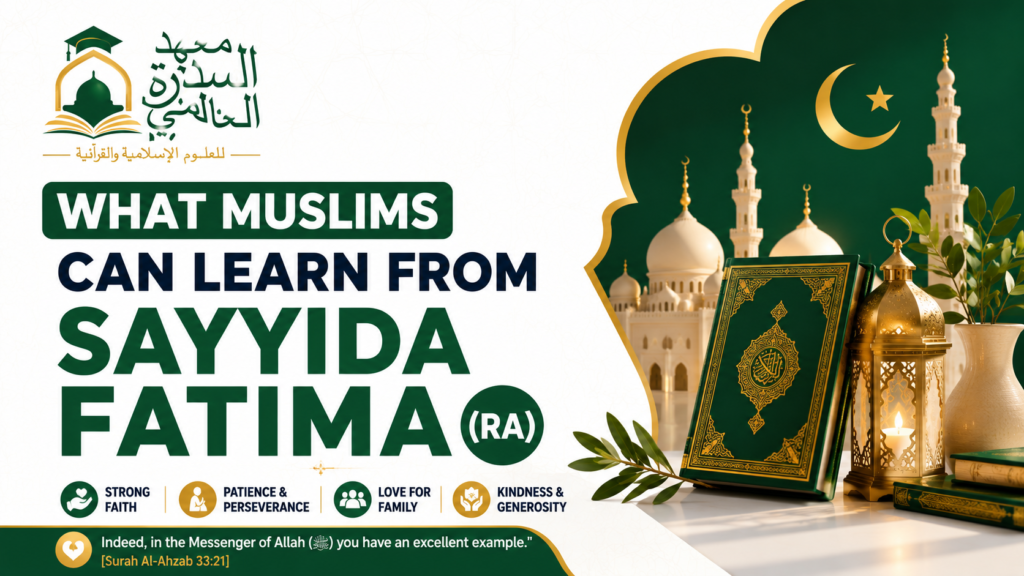
The life of Fatima (RA) offers timeless guidance for Muslims of every age.
1. Put Allah First
Every aspect of her life reflected sincere devotion to Allah. She reminds believers that spiritual success begins with faith and worship.
Practical Application
- Pray consistently.
- Remember Allah daily.
- Place obedience to Allah above worldly desires.
2. Practice Patience During Difficulties
Fatima (RA) faced hardship with dignity and trust in Allah.
Practical Application
When facing challenges:
- Remain hopeful.
- Make sincere du’a.
- Continue doing righteous deeds.
3. Value Family Relationships
She cared deeply for her parents, husband, and children.
Practical Application
- Honor parents.
- Strengthen marriages.
- Spend quality time with family.
- Show kindness inside the home.
4. Live Simply
Fatima (RA) teaches that happiness is not dependent upon luxury.
Practical Application
Choose gratitude over constant comparison with others.
5. Develop Excellent Character
Her kindness, humility, honesty, and compassion remain qualities every Muslim should strive to develop.
The Prophet (ﷺ) taught that the best believers are those with the best character, making Fatima (RA) a beautiful example of these teachings.
Timeline of Major Events in the Life of Sayyida Fatima (RA)
| Year (Approx.) | Event |
| Before Hijrah | Born in Makkah to Prophet Muhammad (ﷺ) and Khadijah (RA). |
| Early Prophethood | Witnessed the persecution of Muslims in Makkah. |
| After the Hijrah | Migrated to Madinah with the Muslim community. |
| 2 AH | Married Ali ibn Abi Talib (RA). |
| Following Years | Birth of Hasan (RA), Husayn (RA), Zaynab, and Umm Kulthum. |
| 11 AH | Passed away a few months after Prophet Muhammad (ﷺ). |
Common Misconceptions About Sayyida Fatima (RA)
Misconception 1: She Lived a Life of Luxury
Reality: Although she was the Prophet’s daughter, Fatima (RA) lived simply and experienced financial hardship with patience and gratitude.
Misconception 2: Her Honor Came Only Through Her Family Lineage
Reality: Islam teaches that her true greatness came from her faith, worship, patience, and righteous character.
Misconception 3: Her Story Is Only Relevant for Women
Reality: Fatima (RA) is a role model for all Muslims. Men and women alike can learn from her patience, humility, generosity, and devotion to Allah.
Key Lessons from the Life of Sayyida Fatima (RA)
| Lesson | How to Apply It Today |
| Faith | Strengthen your relationship with Allah through worship. |
| Patience | Remain steadfast during life’s challenges. |
| Gratitude | Appreciate Allah’s blessings, whether great or small. |
| Family | Build loving and respectful relationships at home. |
| Humility | Let good character define your success, not wealth or status. |
| Generosity | Give sincerely, even if your contribution is small. |
| Contentment | Find happiness in obedience to Allah rather than material possessions. |
Key Takeaways
- Sayyida Fatima bint Muhammad (RA) is among the most respected women in Islamic history.
- Her life demonstrates the values of faith, patience, humility, generosity, and family responsibility.
- She remains a central figure among the Ahl al-Bayt and an enduring role model for Muslims.
- Her legacy continues to inspire believers to strengthen their worship, improve their character, and place their trust in Allah.
Frequently Asked Questions (FAQs)
Who was Sayyida Fatima bint Muhammad (RA)?
Sayyida Fatima bint Muhammad (RA), also known as Fatimah al-Zahra (RA), was the youngest daughter of Prophet Muhammad (ﷺ) and Khadijah bint Khuwaylid (RA). She was the wife of Ali ibn Abi Talib (RA), the mother of Hasan (RA) and Husayn (RA), and one of the most respected women in Islamic history. Muslims admire her for her piety, modesty, patience, generosity, and devotion to Allah.
Why is Fatima (RA) called Al-Zahra?
The title Al-Zahra means “the Radiant” or “the Luminous.” Classical Islamic sources mention this honorific as a reflection of her noble character and distinguished status. While scholars have offered different explanations for the title, no single interpretation should be presented as definitive without authentic evidence.
Why is Sayyida Fatima (RA) important in Islam?
Fatima (RA) is important because she was the beloved daughter of Prophet Muhammad (ﷺ), a member of the Ahl al-Bayt, and an outstanding example of faith, patience, humility, and worship. Her life continues to inspire Muslims to strengthen their relationship with Allah and uphold strong family values.
Who was the husband of Fatima (RA)?
Fatima (RA) married Ali ibn Abi Talib (RA), the cousin of Prophet Muhammad (ﷺ) and the fourth Rightly Guided Caliph. Their marriage is remembered as an example of simplicity, mutual respect, and devotion to Allah.
How many children did Fatima (RA) have?
Fatima (RA) and Ali (RA) had four well-known children:
- Hasan ibn Ali (RA)
- Husayn ibn Ali (RA)
- Zaynab bint Ali
- Umm Kulthum bint Ali
Their family holds a special place in Islamic history.
What are the virtues of Fatima (RA)?
Among the most admired qualities of Fatima (RA) are:
- Strong faith in Allah
- Sincere worship
- Patience during hardship
- Modesty and humility
- Compassion
- Generosity
- Love for her family
- Excellent moral character
These virtues make her a timeless role model for Muslims.
Was Fatima (RA) part of the Ahl al-Bayt?
Yes. Fatima (RA) was one of the central members of the Ahl al-Bayt (Household of the Prophet ﷺ). Muslims love and respect the Ahl al-Bayt while recognizing that honor in Islam is ultimately based on faith and righteous deeds.
What can Muslims learn from Fatima (RA)?
Muslims can learn many valuable lessons from Fatima (RA), including:
- Trust Allah during difficult times.
- Live with humility and gratitude.
- Strengthen family relationships.
- Be patient during trials.
- Maintain regular worship.
- Show kindness and compassion to others.
When did Fatima (RA) pass away?
According to authentic Islamic sources, Fatima (RA) passed away approximately six months after the death of Prophet Muhammad (ﷺ). Her passing marked the end of a remarkable life devoted to faith, family, and service to Islam.
Why do Muslims love Sayyida Fatima (RA)?
Muslims love Fatima (RA) because of her close relationship with Prophet Muhammad (ﷺ), her exceptional character, and her unwavering devotion to Allah. Her life serves as a lasting example of sincerity, patience, and righteousness.
What is Tasbih Fatimah?
Tasbih Fatimah is the remembrance the Prophet (ﷺ) taught Fatima (RA) and Ali (RA) before sleeping:
- SubhanAllah – 33 times
- Alhamdulillah – 33 times
- Allahu Akbar – 34 times
This beautiful Sunnah is widely practiced by Muslims around the world.
Why is the life of Fatima (RA) still relevant today?
Although Fatima (RA) lived more than fourteen centuries ago, her values remain timeless. Her example teaches Muslims to balance worship, family responsibilities, patience, generosity, and good character in everyday life.
Conclusion
The life of Sayyida Fatima bint Muhammad (RA) is a remarkable example of faith, humility, patience, and devotion to Allah. As the beloved daughter of Prophet Muhammad (ﷺ), the wife of Ali ibn Abi Talib (RA), and the mother of Hasan (RA) and Husayn (RA), she occupies a unique place in Islamic history.
Yet her greatness was never defined by family lineage alone. It was her sincere worship, noble character, compassion, and steadfastness that earned her the admiration of generations of Muslims.
Her life reminds us that true success is measured not by wealth or status, but by our relationship with Allah, our treatment of others, and our commitment to righteous deeds.
Whether you are a student of Islamic history, a parent seeking role models for your family, or someone striving to strengthen your faith, the example of Sayyida Fatima (RA) offers timeless guidance.
May Allah enable us to follow the noble character of the Prophet’s family, increase us in beneficial knowledge, and grant us sincerity, patience, and steadfastness in our worship. Ameen.
Key Takeaways
- Sayyida Fatima bint Muhammad (RA) was the beloved daughter of Prophet Muhammad (ﷺ) and Khadijah (RA).
- She is honored for her faith, modesty, patience, generosity, and devotion to Allah.
- Her marriage to Ali ibn Abi Talib (RA) demonstrates the importance of faith and good character in family life.
- She was the mother of Hasan (RA) and Husayn (RA) and a central member of the Ahl al-Bayt.
- Tasbih Fatimah remains a cherished Sunnah that Muslims continue to practice.
- Her life offers timeless lessons in worship, gratitude, humility, and family values.
- Muslims continue to honor her as one of the greatest women in Islamic history and an enduring role model for all believers.
Continue Your Quran Islamic Learning
To strengthen your understanding of Salah and Quran recitation, you may also find these topics helpful:
Related Articles
Who Was Ayesha bint Abu Bakr (RA)? Biography, Hadith & Legacy
Who Was Ali ibn Abi Talib (RA)? Biography, Leadership & Legacy
Who Was Abu Bakr As-Siddiq (RA)? Biography & Leadership
Who Was Hussain ibn Ali (RA)? Life, Karbala & Lessons in Islam
What Are the Seven Layers of Hell in Islam? Full Explanation
Recommended Courses
By combining authentic knowledge with regular practice, you can continue building a stronger connection with Allah and perform your daily prayers with confidence, understanding, and devotion.