
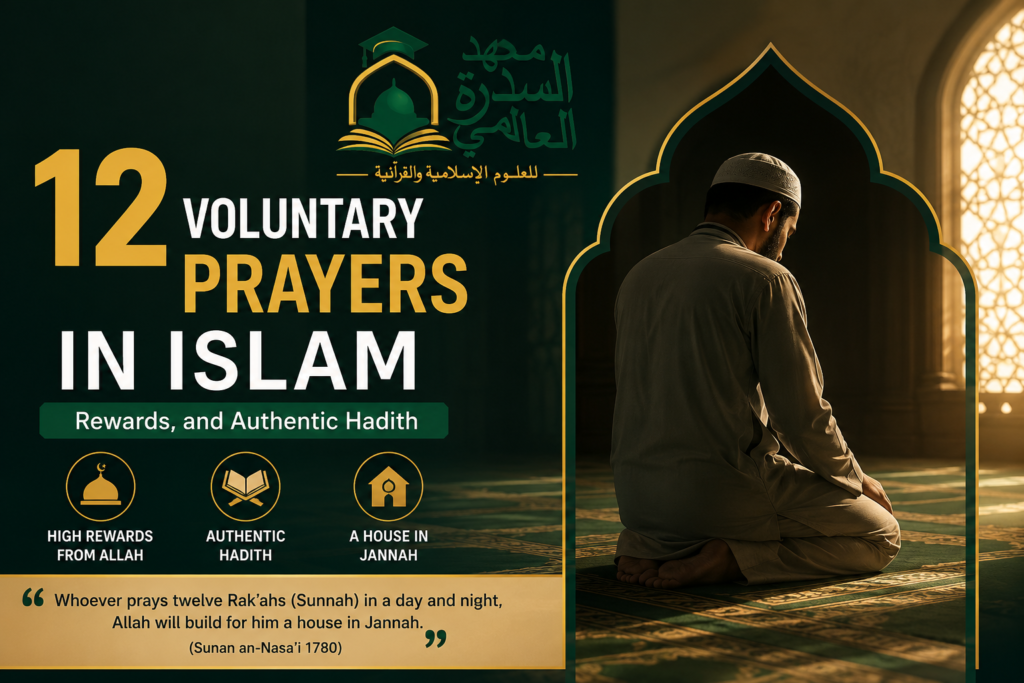
The five daily prayers are the foundation of a Muslim’s worship, but Islam also encourages believers to perform additional prayers that bring them closer to Allah. Among the most emphasized voluntary prayers are the 12 Voluntary Prayers in Islam, also known as the 12 Sunnah Rakats or Rawatib prayers.
These prayers were regularly performed by Prophet Muhammad and carry immense rewards. One authentic hadith even promises a house in Jannah for those who consistently observe them.
In this guide, you will learn what the 12 voluntary prayers are, their rewards, authentic evidence, practical tips for consistency, and how they fit into a Muslim’s daily worship routine.
Quick Answer: What Are the 12 Voluntary Prayers in Islam?
The 12 Voluntary Prayers in Islam are twelve Sunnah Rakats that the Prophet ﷺ regularly performed before and after the obligatory prayers. They consist of:
- 2 Rakats before Fajr
- 4 Rakats before Dhuhr
- 2 Rakats after Dhuhr
- 2 Rakats after Maghrib
- 2 Rakats after Isha
These prayers are known as Rawatib Sunnah prayers and are among the most highly rewarded voluntary acts of worship in Islam.
Featured Snippet Answer
The 12 Voluntary Prayers in Islam are the Sunnah Rawatib prayers performed around the five daily obligatory prayers. They include 2 before Fajr, 4 before Dhuhr, 2 after Dhuhr, 2 after Maghrib, and 2 after Isha. According to authentic hadith, whoever consistently performs these prayers will have a house built for them in Jannah.
What Are Rawatib Prayers?
Rawatib prayers are Sunnah prayers that are connected to the five daily obligatory prayers. They were regularly observed by the Prophet ﷺ and are strongly recommended for Muslims who wish to increase their rewards and strengthen their relationship with Allah.
The word “Rawatib” refers to prayers that are performed consistently and regularly.
These prayers help:
- Increase daily worship
- Compensate for shortcomings in obligatory prayers
- Strengthen spiritual discipline
- Follow the example of the Prophet ﷺ
Difference Between Rawatib and Nafl Prayers
Many Muslims use the terms interchangeably, but they are not exactly the same.
| Rawatib Prayers | Nafl Prayers |
| Connected to obligatory prayers | Can be prayed at any recommended time |
| Regularly performed by the Prophet ﷺ | Optional extra worship |
| Specific number of rakats | No fixed number |
| Strongly emphasized | General voluntary worship |
Every Rawatib prayer is voluntary, but not every voluntary prayer is considered Rawatib.
Authentic Hadith About the 12 Sunnah Rakats
One of the most famous hadith regarding these prayers was narrated by Umm Habibah (RA).
She reported that the Messenger of Allah ﷺ said:
“Whoever prays twelve rakats during the day and night, a house will be built for him in Paradise.”
This narration is found in Sahih Muslim and is considered authentic.
Why This Hadith Is Significant
This hadith highlights the extraordinary reward attached to a relatively small daily act of worship.
Praying twelve extra rakats every day may only take a short amount of time, yet Allah promises a reward that lasts forever in Jannah.
Summary Table of the 12 Voluntary Prayers
| Prayer | Sunnah Rakats |
| Before Fajr | 2 |
| Before Dhuhr | 4 |
| After Dhuhr | 2 |
| Before Asr | Not included in the 12 |
| After Maghrib | 2 |
| After Isha | 2 |
| Total | 12 Rakats |
Breakdown of the 12 Sunnah Rakats
1. Two Sunnah Rakats Before Fajr
The two Sunnah rakats before Fajr are among the most emphasized Sunnah prayers.
The Prophet ﷺ gave special importance to them and rarely left them, even while traveling.
Benefits
- Among the most beloved Sunnah prayers
- Consistently observed by the Prophet ﷺ
- Great spiritual preparation before Fajr
Many scholars consider these the most emphasized Sunnah prayer of the day.
2. Four Sunnah Rakats Before Dhuhr
Before the Dhuhr prayer, Muslims are encouraged to pray four rakats.
These can be prayed as:
- Two rakats + two rakats
This Sunnah helps a believer transition from worldly activities into worship.
Benefits
- Increases remembrance of Allah during the day
- Follows the regular practice of the Prophet ﷺ
- Earns additional reward before the obligatory prayer
3. Two Sunnah Rakats After Dhuhr
After completing the obligatory Dhuhr prayer, Muslims are encouraged to pray two additional rakats.
These prayers complete the Sunnah associated with Dhuhr.
Benefits
- Strengthens consistency in worship
- Completes the Rawatib connected to Dhuhr
- Brings additional rewards
4. Two Sunnah Rakats After Maghrib
Immediately after Maghrib prayer, Muslims are encouraged to pray two Sunnah rakats.
This is one of the daily Sunnah prayers that the Prophet ﷺ regularly maintained.
Benefits
- Extends worship after the obligatory prayer
- Helps maintain spiritual focus in the evening
- Forms part of the twelve rewarded rakats
5. Two Sunnah Rakats After Isha
The final part of the 12 Sunnah Rakats consists of two rakats after Isha.
These prayers conclude the daily Rawatib cycle.
Benefits
- Ends the day with worship
- Brings a believer closer to Allah
- Completes the twelve rakats mentioned in the hadith
Why Is Asr Not Included in the 12 Sunnah Rakats?
Many Muslims wonder why Asr is not included in the twelve rewarded rakats.
There are voluntary prayers before Asr, and the Prophet ﷺ encouraged them. However, they are not part of the specific twelve rakats mentioned in the hadith of Umm Habibah (RA).
Therefore:
- Praying before Asr is recommended.
- It carries reward.
- It is not counted among the specific twelve Rawatib rakats.
Benefits of Praying the 12 Voluntary Prayers
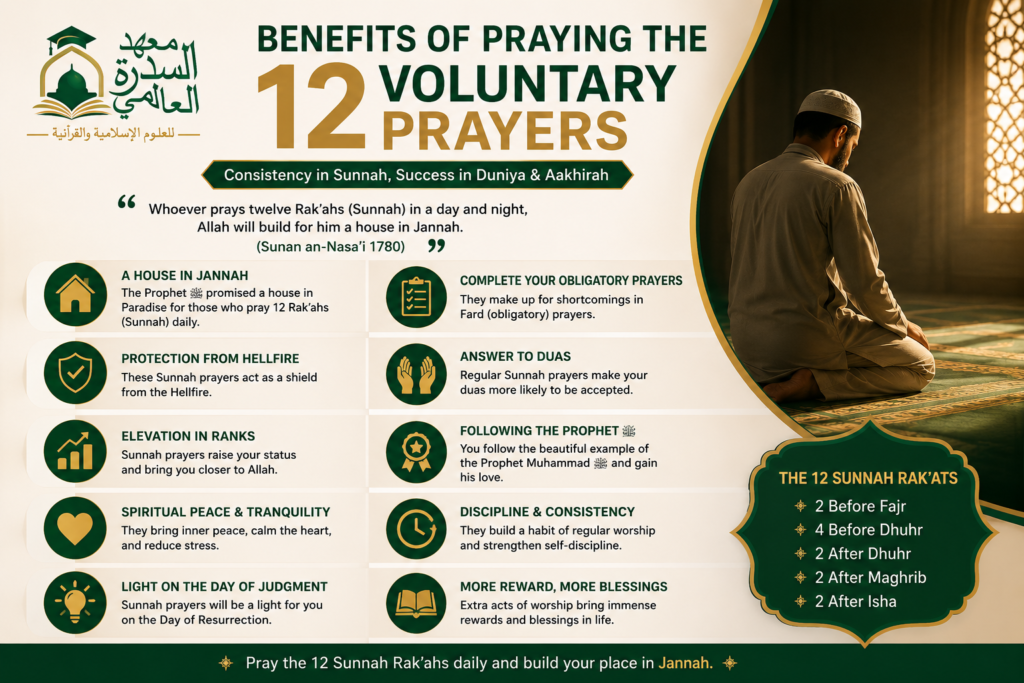
1. A House in Jannah
The most famous reward is the promise of a house in Paradise for those who consistently maintain these prayers.
This reward alone should motivate every Muslim to establish them in their daily routine.
2. Following the Sunnah of the Prophet ﷺ
The Prophet ﷺ regularly performed these prayers.
By observing them, Muslims demonstrate love for and obedience to his example.
3. Completing Deficiencies in Obligatory Prayers
No Muslim performs every prayer perfectly.
Voluntary prayers help compensate for mistakes, distractions, and shortcomings that may occur during obligatory Salah.
4. Strengthening Faith
Daily Sunnah prayers increase:
- Khushu (focus)
- Discipline
- Spiritual awareness
- Love for worship
5. Building Consistency in Worship
Small acts performed consistently are beloved to Allah.
The 12 Sunnah Rakats help establish a regular pattern of worship throughout the day.
Daily Schedule for the 12 Sunnah Rakats
| Time | Prayer |
| Before Fajr | 2 Rakats |
| Before Dhuhr | 4 Rakats |
| After Dhuhr | 2 Rakats |
| After Maghrib | 2 Rakats |
| After Isha | 2 Rakats |
| Total | 12 Rakats |
This simple schedule makes it easy for beginners to remember and implement.
Sunnah Muakkadah vs Nafl Prayers
| Sunnah Muakkadah | Nafl |
| Strongly emphasized by the Prophet ﷺ | General voluntary worship |
| Regularly observed | Optional at any time |
| Includes the 12 Rawatib Rakats | Includes Tahajjud and other optional prayers |
| Higher emphasis | Less emphasis |
Understanding this difference helps Muslims prioritize their voluntary worship correctly.
Common Misconceptions About the 12 Voluntary Prayers
Misconception 1: They Are Obligatory
These prayers are highly recommended but not obligatory.
A Muslim is not sinful for missing them, although they miss a great reward.
Misconception 2: Missing One Means Losing All Rewards
Allah is Most Merciful.
If a person misses a Sunnah prayer occasionally, they should simply continue their practice and strive for consistency.
Misconception 3: Rawatib and Nafl Are Exactly the Same
Rawatib are a specific category of Sunnah prayers linked to the obligatory prayers.
Nafl prayers include a wider range of optional worship.
Misconception 4: Only Scholars Should Perform Them
Every Muslim can pray the 12 Sunnah Rakats.
They are suitable for:
- Beginners
- New Muslims
- Students
- Working professionals
- Parents
Practical Tips for Consistently Praying the 12 Sunnah Rakats
Start With Fajr
Begin by protecting the two Sunnah rakats before Fajr.
Once this habit becomes easy, add the remaining Sunnah prayers.
Use a Prayer Tracker
Keep a simple checklist to monitor your consistency.
Pray Sunnah at Home When Possible
The Prophet ﷺ encouraged voluntary prayers at home.
This increases sincerity and strengthens the spiritual atmosphere of the household.
Focus on Consistency
It is better to pray these Sunnah prayers consistently than to perform large amounts of worship occasionally.
Learn Their Virtues
Understanding the rewards increases motivation and commitment.
Frequently Asked Questions
Are the 12 Sunnah Rakats compulsory?
No. They are voluntary but highly recommended Sunnah prayers.
What if I miss a Sunnah prayer?
You are not sinful. Continue praying them regularly and strive for consistency.
Which Sunnah prayer is most emphasized?
Most scholars consider the two Sunnah rakats before Fajr among the most emphasized Sunnah prayers.
Can women pray the 12 Sunnah Rakats?
Yes. The rewards and recommendations apply to both men and women.
Is Asr included in the 12 voluntary prayers?
No. Voluntary prayers before Asr are recommended but are not included in the specific twelve rakats mentioned in the hadith.
What reward is promised for these prayers?
According to authentic hadith, Allah will build a house in Jannah for the person who consistently observes them.
Can the Sunnah prayers be performed at home?
Yes. In fact, voluntary prayers are often best performed at home when possible.
Are Rawatib prayers the same as Tahajjud?
No. Rawatib are connected to obligatory prayers, while Tahajjud is a separate night prayer.
Key Takeaways
- The 12 Voluntary Prayers in Islam are known as the Rawatib Sunnah prayers.
- They consist of 2 before Fajr, 4 before Dhuhr, 2 after Dhuhr, 2 after Maghrib, and 2 after Isha.
- Authentic hadith promise a house in Jannah for those who regularly observe them.
- They are voluntary but highly emphasized.
- They help complete shortcomings in obligatory prayers.
- They strengthen faith and increase daily worship.
- They are suitable for Muslims of all ages and levels of knowledge.
Conclusion
The 12 Voluntary Prayers in Islam are among the greatest daily acts of worship a Muslim can perform. Though they require only a few extra minutes each day, their rewards are immense. These Sunnah prayers allow believers to follow the example of the Prophet ﷺ, strengthen their connection with Allah, and earn the glad tidings of a house in Jannah.
If you are not already praying these Sunnah Rakats regularly, start with the two rakats before Fajr and gradually build the habit. Consistency, sincerity, and devotion can transform these simple prayers into one of the most rewarding parts of your daily Islamic routine.
To continue your Islamic learning journey, you may also like our guides on [Top Quran Surahs Every Muslim Should Memorize with meanings], [Is Qurbani Mandatory or Sunnah? Complete Islamic Ruling Guide], and [Eid al-Adha Duas and Prayers (Arabic, Takbeer & Qurbani Dua)]. Exploring related topics can help you build a stronger understanding of Islam, the Quran, and everyday Islamic practices.