
Introduction
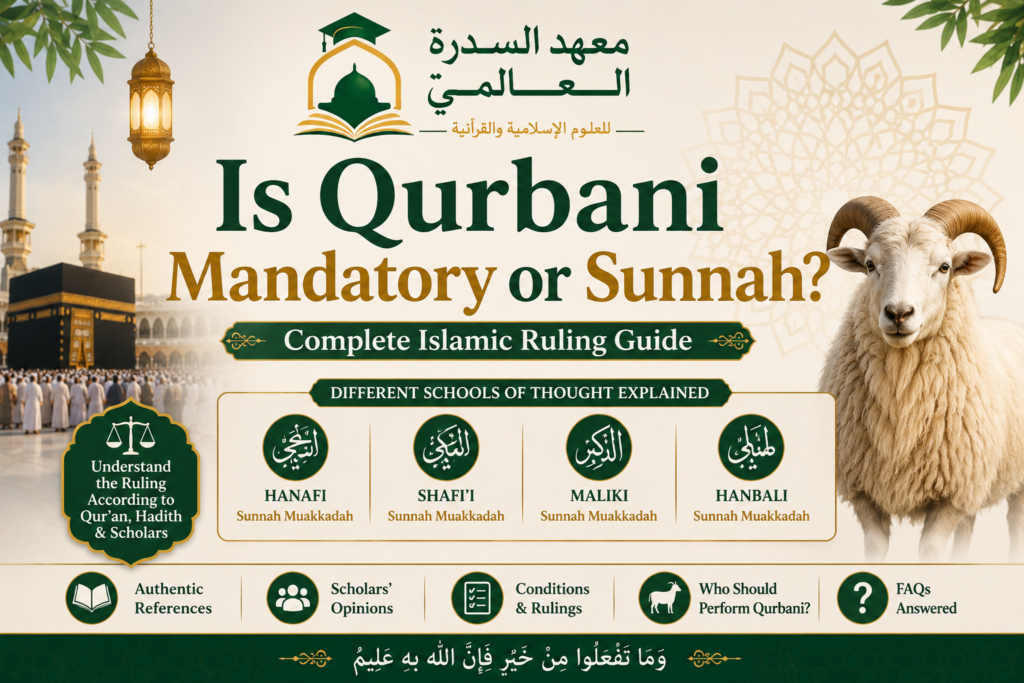
Every year, as Eid al-Adha approaches, many Muslims ask an important question: Is Qurbani mandatory or Sunnah? Some people hear that Qurbani is Wajib for every financially able Muslim, while others are told that it is a highly recommended Sunnah.
This difference of opinion often creates confusion, especially for Muslims who want to fulfill their religious responsibilities correctly. Understanding the ruling of Qurbani requires looking at the Quran, the Sunnah of Prophet Muhammad ﷺ, and the opinions of the four major schools of Islamic jurisprudence.
Before discussing the scholarly rulings, it is also beneficial to learn the supplications associated with Eid al-Adha. You can read our guide on Eid al-Adha Duas and Prayers (Arabic, Takbeer & Qurbani Dua) to learn the authentic Takbeer and Qurbani duas recited during these blessed days.
In this article, we will explain whether Qurbani is Wajib, Sunnah Muakkadah, or Fard, examine the views of the Hanafi, Shafi’i, Maliki, and Hanbali schools, and clarify who is required to perform Qurbani according to Islamic teachings.
Quick Answer: Is Qurbani Mandatory or Sunnah?
Qurbani (Udhiyah) is considered Wajib (obligatory) by the Hanafi school for financially able Muslims, while the Shafi’i, Maliki, and Hanbali schools generally regard it as Sunnah Muakkadah (a highly emphasized Sunnah). Although scholars differ regarding its legal classification, they agree that Qurbani is one of the most important acts of worship during Eid al-Adha and a powerful symbol of obedience to Allah.
For Muslims who can afford it, performing Qurbani is strongly encouraged regardless of which scholarly opinion they follow.
Featured Snippet Answer
Qurbani is Wajib according to the Hanafi school and Sunnah Muakkadah according to the Shafi’i, Maliki, and Hanbali schools. The difference comes from how scholars interpret Quranic commands and Prophetic practice. Despite this difference, all major schools agree that Qurbani is a highly virtuous act of worship during Eid al-Adha for Muslims who have the financial means.
What Is Qurbani (Udhiyah) in Islam?
Qurbani, also known as Udhiyah, refers to the ritual sacrifice of specific animals during Eid al-Adha in remembrance of the devotion and obedience of Prophet Ibrahim (AS).
The word “Qurbani” comes from the concept of drawing closer to Allah through acts of worship. It commemorates the moment when Prophet Ibrahim (AS) was willing to sacrifice his son in obedience to Allah’s command, and Allah replaced the sacrifice with a ram.
Today, Muslims perform Qurbani during the days of Eid al-Adha to honor this legacy of faith, submission, and gratitude.
Why Muslims Perform Qurbani During Eid al-Adha
Connection to Prophet Ibrahim (AS)
The story of Prophet Ibrahim (AS) teaches complete trust in Allah. When Allah tested him with a difficult command, he responded with sincerity and obedience.
Qurbani serves as a reminder that true faith requires sacrifice, commitment, and submission to Allah’s will.
Spiritual Lessons of Sacrifice
Qurbani teaches Muslims:
- Obedience to Allah
- Gratitude for blessings
- Generosity toward others
- Care for the needy
- Detachment from worldly possessions
It is not merely about slaughtering an animal; it is about demonstrating devotion and sincerity.
What Do the Four Madhabs Say About Qurbani?
Hanafi View on Qurbani
According to the Hanafi school, Qurbani is Wajib upon every adult Muslim who:
- Is sane
- Is resident (not a traveler)
- Possesses wealth equal to or above the Nisab threshold
Hanafi scholars cite Quranic commands and Prophetic practice as evidence that financially able Muslims should not neglect Qurbani.
Shafi’i View on Qurbani
The Shafi’i school considers Qurbani to be Sunnah Muakkadah, meaning a highly recommended Sunnah that should not be abandoned without a valid reason.
Although not viewed as obligatory, it remains among the most emphasized acts of worship during Eid al-Adha.
Maliki View on Qurbani
Maliki scholars generally classify Qurbani as Sunnah Muakkadah for Muslims who have the means.
Many Maliki scholars strongly encourage regular observance of Qurbani because of its importance in preserving an established Islamic practice.
Hanbali View on Qurbani
The Hanbali school also considers Qurbani Sunnah Muakkadah for those who can afford it.
Hanbali jurists emphasize the Prophet’s ﷺ consistent practice of offering sacrifice and encourage Muslims to maintain this Sunnah.
Comparison Table of the Four Schools of Thought
| School of Thought | Ruling on Qurbani | Who Must Perform It? |
| Hanafi | Wajib | Financially able resident Muslims |
| Shafi’i | Sunnah Muakkadah | Strongly recommended for able Muslims |
| Maliki | Sunnah Muakkadah | Strongly recommended for able Muslims |
| Hanbali | Sunnah Muakkadah | Strongly recommended for able Muslims |
This table highlights that the difference is primarily about legal classification rather than the importance of the practice itself.
Is Qurbani Wajib, Sunnah Muakkadah, or Fard?
Understanding Islamic legal terminology helps clarify this discussion.
What Is Fard?
Fard refers to an obligation established through definitive evidence. Deliberately abandoning a Fard act is considered sinful.
Examples include:
- Five daily prayers
- Fasting Ramadan
- Zakat (when applicable)
What Is Wajib?
In Hanafi jurisprudence, Wajib refers to a duty established through strong evidence, though not at the same level as Fard.
Neglecting a Wajib act without excuse is sinful.
What Is Sunnah Muakkadah?
Sunnah Muakkadah refers to practices that the Prophet ﷺ performed consistently and encouraged strongly.
Although not legally obligatory according to the majority view, repeatedly abandoning them without reason is discouraged.
Why Do Scholars Differ on the Ruling of Qurbani?
Differences among scholars arise from the methods used to interpret religious texts.
Interpretation of Quranic Commands
Some scholars understand Quranic instructions regarding sacrifice as mandatory, while others view them as strong recommendations.
Understanding Prophetic Practice
The Prophet ﷺ regularly performed Qurbani throughout his life.
Scholars differ on whether this consistent practice indicates obligation or strong recommendation.
Legal Methodologies of the Madhabs
Each school of thought applies specific principles when deriving rulings from the Quran and Sunnah.
These methodological differences explain why respected scholars reached different conclusions while remaining within orthodox Islamic scholarship.
Quranic Evidence for Qurbani
Several Quranic verses establish the importance of sacrifice.
One frequently cited verse is:
“So pray to your Lord and sacrifice.”
(Surah Al-Kawthar 108:2)
Another important passage discusses sacrificial animals and the remembrance of Allah during Hajj and Eid-related rites.
These verses form part of the scholarly discussion regarding the significance and legal status of Qurbani.
Hadith Evidence Related to Qurbani
Numerous authentic narrations mention the Prophet ﷺ offering Qurbani.
These narrations demonstrate:
- His regular practice of sacrifice
- His encouragement of the practice
- The virtues associated with Qurbani
Both Hanafi and majority scholars use these narrations, though they differ in how they interpret their legal implications.
Who Should Perform Qurbani?
Financial Requirements
A Muslim should assess whether they possess sufficient wealth according to the standards recognized by their school of thought.
The Hanafi school links Qurbani to the Nisab threshold, similar to certain financial obligations.
Eligibility Conditions
Generally, the person should be:
- Muslim
- Adult
- Sane
- Financially capable
Who Is Exempt?
Qurbani is generally not required from:
- Those below the Nisab threshold
- Individuals facing genuine financial hardship
- People unable to meet basic necessities
- Certain travelers according to some juristic opinions
Islam does not place hardship upon believers beyond their capacity.
Is Qurbani Compulsory for Every Family?
This is one of the most common questions.
Qurbani is not automatically required from every family member individually.
The ruling depends on:
- Financial status
- School of thought followed
- Ownership of qualifying wealth
In some situations, multiple eligible adults living in the same household may each be responsible for their own Qurbani according to the Hanafi school.
Can One Qurbani Be Shared?
The answer depends on the type of animal.
Animals That Can Be Shared
Large animals such as:
- Cows
- Buffaloes
- Camels
may generally be shared by up to seven individuals.
Animals That Cannot Be Shared
Smaller animals such as:
- Sheep
- Goats
are generally offered on behalf of a single person or household depending on scholarly interpretation.
Rules for Sacrificial Animals
Animals used for Qurbani must meet Islamic requirements.
Commonly accepted animals include:
- Sheep
- Goats
- Cows
- Buffaloes
- Camels
The animal should:
- Reach the required age
- Be healthy
- Be free from major defects
These conditions help preserve the integrity and purpose of the act of worship.
When Should Qurbani Be Performed?
Qurbani should be performed after the Eid prayer on the 10th of Dhul Hijjah.
The time for sacrifice continues during the days designated for Eid al-Adha sacrifices according to scholarly rulings.
Performing the sacrifice before the Eid prayer does not fulfill the requirements of Udhiyah.
To prepare fully for Eid al-Adha, learn the authentic Takbeer, Qurbani dua, and recommended supplications by reading our complete Eid al-Adha Duas and Prayers (Arabic, Takbeer & Qurbani Dua) guide.
Benefits and Importance of Qurbani in Islam
Spiritual Benefits
Qurbani strengthens:
- Faith
- Gratitude
- Sincerity
- Reliance upon Allah
Social Benefits
The distribution of meat supports:
- Families
- Relatives
- Neighbors
- Those in need
Community Benefits
Qurbani promotes:
- Unity
- Generosity
- Social responsibility
- Care for vulnerable members of society
Common Misconceptions About Qurbani
Misconception #1: Qurbani Is Fard According to Everyone
This is incorrect.
The four schools differ regarding its legal classification.
Misconception #2: Qurbani Is Optional and Unimportant
Even scholars who consider it Sunnah Muakkadah emphasize its great importance and reward.
Misconception #3: Only One Opinion Is Correct
All four Sunni schools are based on recognized scholarship and evidence.
Respectful disagreement within Islamic jurisprudence has existed throughout Islamic history.
Misconception #4: Qurbani Is Only About Meat Distribution
While feeding others is important, the primary purpose is worship and obedience to Allah.
The Quran teaches that Allah is not in need of the meat itself; rather, He values the piety and sincerity behind the act.
Practical Guidance for Muslims Living in Non-Muslim Countries
Muslims living in Western countries and other non-Muslim societies can still fulfill Qurbani through:
- Local Islamic organizations
- Certified halal slaughter services
- Trusted charitable organizations
- International Qurbani programs
Before participating, ensure the organization follows Islamic guidelines and performs the sacrifice during the prescribed days.
Key Takeaways
- Qurbani commemorates the obedience of Prophet Ibrahim (AS).
- Hanafi scholars classify Qurbani as Wajib for financially able Muslims.
- Shafi’i, Maliki, and Hanbali scholars generally classify it as Sunnah Muakkadah.
- All schools agree that Qurbani is highly important.
- Financial ability is a key factor in determining responsibility.
- Qurbani carries spiritual, social, and communal benefits.
- Muslims should respect legitimate scholarly differences while striving to uphold this important act of worship.
Frequently Asked Questions
Is Qurbani wajib according to the Hanafi school?
Yes. The Hanafi school considers Qurbani Wajib for adult, financially able Muslims who meet the required conditions.
Is Qurbani Sunnah Muakkadah?
According to the Shafi’i, Maliki, and Hanbali schools, Qurbani is generally classified as Sunnah Muakkadah.
Is Qurbani fard in Islam?
Most scholars do not classify Qurbani as Fard. The main scholarly discussion is whether it is Wajib or Sunnah Muakkadah.
Can Muslims skip Qurbani?
A Muslim who lacks the financial means is excused. Those who can afford it should not neglect this important act of worship.
Who is eligible for Qurbani?
Eligibility generally depends on being Muslim, financially capable, and meeting the conditions recognized by one’s school of thought.
Can one sheep count for an entire family?
Many scholars permit a sheep to be offered on behalf of a household, though details may differ among schools of thought.
What animals can be used for Qurbani?
Sheep, goats, cows, buffaloes, and camels are commonly accepted when they meet Islamic requirements.
What happens if Qurbani is missed?
The ruling depends on the school of thought followed and the circumstances involved. Muslims should consult knowledgeable scholars for specific situations.
Conclusion
The question “Qurbani Mandatory or Sunnah?” has been discussed by Islamic scholars for centuries. The Hanafi school considers Qurbani Wajib for financially able Muslims, while the Shafi’i, Maliki, and Hanbali schools regard it as Sunnah Muakkadah. Despite these differences, all major scholars agree that Qurbani is a highly significant act of worship that revives the Sunnah of Prophet Ibrahim (AS), strengthens faith, and benefits the wider Muslim community.
For Muslims who have the means, Eid al-Adha presents a valuable opportunity to express gratitude, obedience, and generosity through this blessed act of worship.
To continue your Islamic learning journey, you may also like our guides on [Eid al-Adha Duas and Prayers (Arabic, Takbeer & Qurbani Dua)], [Is Dua Qunoot Mandatory in Witr Prayer? IEN], and [Can You Listen to Music During Ramadan? What Islam Says]. Exploring related topics can help you build a stronger understanding of Islam, the Quran, and everyday Islamic practices.