
Introduction
Salah (also called Namaz) is the second pillar of Islam and one of the greatest acts of worship. It is the daily connection between a Muslim and Allah, performed five times each day according to the teachings of the Quran and the Sunnah of Prophet Muhammad ﷺ.
For a salah to be accepted as valid, certain obligatory (Fard) acts must be performed correctly. These essential acts are known as the Faraid of Salah (also called the Arkan or pillars of prayer). If any of these pillars are deliberately left out—or unintentionally omitted without properly correcting the prayer according to the relevant rulings—the salah is not valid.
Many Muslims learn how to pray from family members or local teachers, but they may not know which parts of the prayer are absolutely essential and which are recommended or Sunnah. Understanding the faraid helps ensure that every prayer is performed correctly and with confidence.
In this comprehensive guide, you’ll learn:
- What the Faraid of Salah are
- Why they are essential for a valid prayer
- The difference between Shurut (conditions) and Arkan (pillars)
- The complete list of obligatory acts
- General scholarly perspectives from the four Sunni schools
- Common mistakes to avoid
- Frequently asked questions about prayer validity
Whether you are a beginner learning Salah or someone reviewing your knowledge, this guide will help you better understand the foundations of Islamic prayer.
Quick Answer: What Are the Faraid of Salah?
The Faraid of Salah are the essential pillars of Islamic prayer that must be fulfilled for the prayer to be valid. They include beginning the prayer correctly, standing when able, reciting the required Quranic passages according to one’s school of thought, bowing (Ruku), prostrating (Sujood), the final sitting, and ending the prayer with Tasleem. Missing an obligatory pillar invalidates the prayer unless it is properly remedied according to the relevant fiqh rulings.
Featured Snippet Answer
The Faraid of Salah are the obligatory pillars of prayer that every Muslim must perform for a valid Salah. These include essential acts such as Takbir al-Ihram, standing (when able), bowing, prostration, the final sitting, and concluding with Tasleem. Intentionally leaving out a Fard invalidates the prayer.
What Are the Faraid of Salah?
The Arabic word Fard means something that Allah has made obligatory.
Its plural is Faraid.
In Salah, the faraid are those actions that are absolutely required. They are not optional, recommended, or voluntary. Rather, they are the essential components that make the prayer valid.
Islamic scholars explain that the faraid of Salah are derived from:
- The Quran
- The authentic Sunnah of Prophet Muhammad ﷺ
- The scholarly understanding of Islamic jurisprudence (Fiqh)
While scholars sometimes differ on the exact classification of certain actions, they all agree that a valid prayer must contain its essential pillars.
Why Are the Faraid of Salah Important?
Understanding the faraid is important because they determine whether a prayer is valid.
Knowing these obligations helps Muslims:
- Perform Salah correctly.
- Avoid mistakes that invalidate prayer.
- Pray with confidence and peace of mind.
- Follow the example of Prophet Muhammad ﷺ.
- Build consistency in daily worship.
- Teach family members and children the correct method of prayer.
Learning the faraid is especially valuable for new Muslims and beginners, as it provides a clear foundation before studying recommended (Sunnah) and optional acts.
Evidence for Establishing Salah
Allah says:
“Establish prayer, give zakah, and bow with those who bow.”
(Quran 2:43)
Allah also says:
“Indeed, prayer has been decreed upon the believers at specified times.”
(Quran 4:103)
The Prophet ﷺ instructed his companions:
“Pray as you have seen me praying.”
(Sahih al-Bukhari)
This hadith establishes that Muslims should perform Salah according to the authentic Sunnah while fulfilling its essential pillars.
Conditions (Shurut) vs. Faraid (Arkan)
Many people confuse the conditions of Salah with the pillars of Salah. They are related but not the same.
| Conditions (Shurut) | Faraid (Arkan/Pillars) |
| Must be fulfilled before Salah begins | Performed during Salah |
| Prepare a person for prayer | Form the actual structure of prayer |
| If missing, Salah cannot begin correctly | If missing, Salah becomes invalid |
| Examples: Wudu, covering the Awrah, facing the Qiblah | Examples: Ruku, Sujood, Takbir al-Ihram |
Think of it this way:
- Shurut prepare you for prayer.
- Faraid are the essential actions within the prayer itself.
Both are necessary for a valid Salah.
Common Conditions of a Valid Salah (Shurut)
Before starting the prayer, a Muslim should ensure that these conditions are fulfilled:
1. Purification (Taharah)
The worshipper must be in a state of ritual purity.
This includes:
- Performing Wudu when required.
- Performing Ghusl when obligatory.
- Ensuring the body is clean from impurities.
2. Clean Clothing
The clothing should be free from ritual impurities (Najasah).
3. Clean Place of Prayer
The place where Salah is offered should also be clean.
4. Covering the Awrah
Islam requires appropriate covering during prayer.
The exact limits differ for men and women according to Islamic rulings.
5. Facing the Qiblah
The worshipper should face the Ka’bah in Makkah whenever able.
6. Prayer Within Its Time
Every obligatory prayer has its prescribed time.
Offering Salah before its time begins is not valid.
7. Intention (Niyyah)
The worshipper should know which prayer they intend to perform.
The intention is made in the heart; verbalizing it is not a universally required practice.
The Complete List of the Faraid of Salah
Although scholars discuss the classification of certain acts differently, the following list covers the essential pillars recognized across Sunni scholarship, with notes on where schools may differ in terminology or categorization.
| Fard (Obligatory Act) | Why It Is Essential |
| Niyyah (Intention) | Worship must be done with sincere intention. |
| Takbir al-Ihram | Begins the prayer. |
| Qiyam (Standing when able) | Required in obligatory prayers for those who are physically able. |
| Required Quranic Recitation | Essential according to the rulings of the schools of fiqh. |
| Ruku (Bowing) | A fundamental pillar demonstrating humility. |
| Rising from Ruku (where classified as a pillar) | Returning to an upright position before prostration. |
| Sujood (Two Prostrations) | The greatest physical act of humility in each rak’ah. |
| Sitting Between the Two Sujoods (where classified as a pillar) | A required pause between the prostrations. |
| Calmness (Tuma’ninah) | Performing each pillar with proper composure. |
| Final Sitting (Qa’dah Akhirah) | Necessary before ending the prayer. |
| Final Tashahhud (according to many scholars) | Recitation during the last sitting. |
| Tasleem | Ends the prayer. |
| Correct Order (Tartib) | The pillars must be performed in their proper sequence. |
Important Note: The exact count of the faraid varies slightly between the four Sunni schools because scholars classify some acts differently. However, they all agree that these essential components form the foundation of a valid Salah.
How Many Faraid Are There in Salah?
One of the most frequently asked questions is:
“How many faraid are there in Salah?”
The answer depends on the school of Islamic jurisprudence (fiqh) being followed.
For example:
- The Hanafi school commonly teaches a set of faraid alongside wajib acts, distinguishing between the two categories.
- The Shafi’i, Maliki, and Hanbali schools generally classify a broader number of actions as pillars (arkan), though there are differences in detail.
Because of these scholarly classifications, you may come across different numbers in Islamic books. This does not mean the scholars disagree about the importance of performing Salah correctly. Rather, they differ in how they categorize certain actions based on their interpretation of the Quran, the Sunnah, and the legal methodology of their schools.
For everyday learning, the most important point is to understand and perform all of the essential acts taught according to reliable scholarship.
Summary
The faraid of Salah are the indispensable parts of the prayer. They are different from recommended or Sunnah actions because the validity of the prayer depends on them. Learning these obligations helps every Muslim pray with confidence, avoid major mistakes, and follow the guidance of the Prophet Muhammad ﷺ as accurately as possible.
The Faraid of Salah Explained in Detail
Understanding the names of the faraid is only the first step. To perform Salah correctly, it is important to know what each pillar means, why it is required, and how it should be performed according to the Quran, the authentic Sunnah, and the general understanding of Sunni scholars.
1. Niyyah (Intention)
What Is Niyyah?
Niyyah means having the intention in your heart to perform a specific prayer sincerely for the sake of Allah.
Every act of worship in Islam begins with sincerity. Without the proper intention, even a correctly performed action loses its religious value.
The Prophet ﷺ said:
“Actions are judged by intentions, and every person will have only what they intended.”
(Sahih al-Bukhari and Sahih Muslim)
This hadith establishes the importance of intention for every act of worship, including Salah.
Practical Example
Before praying Dhuhr, a Muslim simply knows in their heart:
“I intend to pray today’s obligatory Dhuhr prayer for Allah.”
There is no authentic hadith requiring the intention to be spoken aloud. The majority of scholars explain that the place of the intention is the heart.
Common Mistakes
- Thinking intention must be verbalized.
- Believing a complicated formula is required.
- Confusing intention with making a spoken declaration.
2. Takbir al-Ihram
Entering the State of Prayer
Every Salah officially begins by saying:
“Allahu Akbar.”
This opening Takbir is called Takbir al-Ihram because it marks the beginning of the prayer. Once it is said, the worshipper enters the sacred state of Salah, where actions such as talking, eating, or unnecessary movements are no longer permitted.
The Prophet ﷺ consistently began his prayers with the opening Takbir.
Why Is It Important?
Without Takbir al-Ihram, the prayer has not actually begun.
It is the gateway into Salah.
Practical Tips
- Face the Qiblah.
- Raise the hands according to the Sunnah.
- Say “Allahu Akbar” calmly and attentively.
- Avoid rushing into recitation before completing the Takbir.
3. Qiyam (Standing)
Standing Before Allah
Qiyam refers to standing during the obligatory prayer for anyone who is physically able.
Allah says:
“Stand before Allah with devotion.”
(Quran 2:238)
Standing reflects humility, attentiveness, and respect before Allah.
Who Is Excused?
Islam is a religion of ease.
A person who cannot stand because of illness, injury, or disability may pray sitting or according to their ability.
The Prophet ﷺ said:
“Pray standing; if you cannot, then sitting; if you cannot, then on your side.”
(Sahih al-Bukhari)
Common Mistakes
- Leaning unnecessarily.
- Standing carelessly without focus.
- Moving excessively during Qiyam.
4. Required Quranic Recitation
Reciting the Quran is one of the central acts of Salah.
Among the most important recitations is Surah Al-Fatihah, which holds a special place in the prayer according to authentic hadith. The juristic details of its obligation differ among the Sunni schools, particularly regarding followers praying behind an imam in certain situations.
The Prophet ﷺ said:
“There is no prayer for the one who does not recite the Opening of the Book.”
(Sahih al-Bukhari and Sahih Muslim)
Scholars discuss the application of this hadith in different prayer situations, but all agree that Quranic recitation is an essential component of Salah.
Learning Tip
If you are still learning Surah Al-Fatihah, continue practicing daily and seek guidance from a qualified teacher. Islam encourages gradual learning while striving to improve.
5. Ruku (Bowing)
A Symbol of Humility
Ruku is the act of bowing before Allah.
The worshipper bends forward until the back is level, placing the hands on the knees while glorifying Allah.
Allah commands:
“…Bow with those who bow.”
(Quran 2:43)
Sunnah During Ruku
The Prophet ﷺ would say:
“Subhana Rabbiyal-‘Azim”
(Glory is to my Lord, the Most Great.)
three times or more.
Common Mistakes
- Barely bending.
- Rushing through Ruku.
- Rising immediately without composure.
6. Rising from Ruku (Qawmah)
After bowing, the worshipper returns to a standing position.
The Prophet ﷺ would say:
“Sami’a Allahu liman hamidah.”
Followed by:
“Rabbana wa laka al-hamd.”
He remained standing briefly before proceeding to prostration.
Many scholars classify this calm standing as one of the essential components of the prayer.
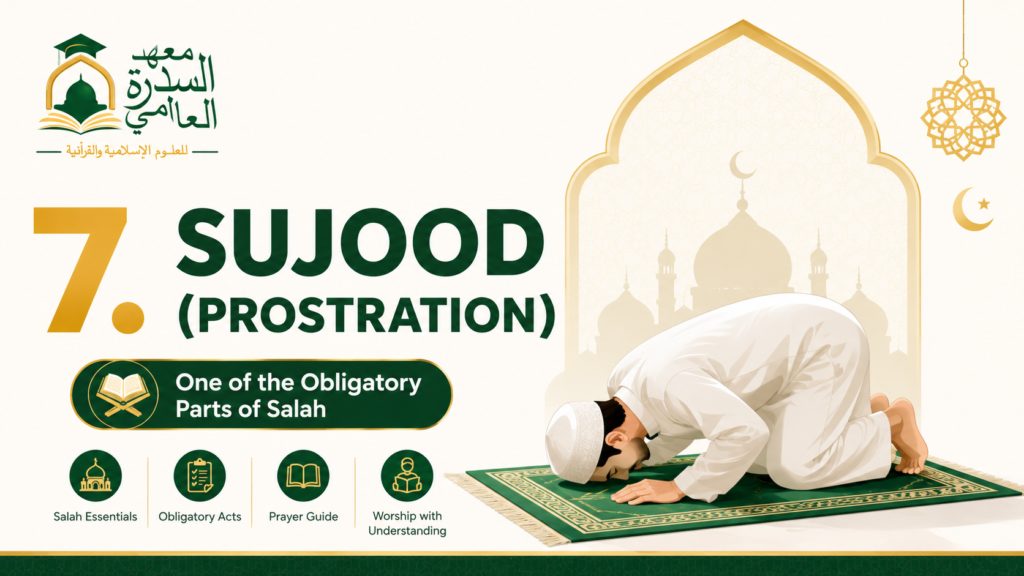
7. Sujood (Prostration)
The Highest Form of Worship
Although the worshipper physically lowers themselves during Sujood, spiritually it is the closest moment to Allah.
The Prophet ﷺ said:
“The closest a servant comes to his Lord is while he is prostrating, so make abundant supplication.”
(Sahih Muslim)
Each rak’ah contains two prostrations.
Seven Body Parts
Authentic hadith mention that prostration is performed upon seven body parts:
- Forehead (including the nose)
- Two hands
- Two knees
- Toes of both feet
Why Is Sujood Important?
Sujood demonstrates complete submission to Allah.
It combines humility, obedience, gratitude, and remembrance.
Common Mistakes
- Forehead not touching properly.
- Feet lifted from the ground without necessity.
- Rushing before becoming settled.
- Looking around while prostrating.
8. Sitting Between the Two Sujoods
After the first prostration, the worshipper briefly sits before performing the second Sujood.
This sitting is not merely a pause.
It is performed calmly while making the prescribed supplications from the Sunnah.
Some schools classify this sitting itself as a pillar, while others classify it differently, but all agree it should be performed properly as taught by the Prophet ﷺ.
9. Tuma’ninah (Calmness and Stillness)
One of the most overlooked aspects of Salah is Tuma’ninah, meaning composure and stillness in every pillar.
The Prophet ﷺ once corrected a man who prayed too quickly and instructed him to repeat his prayer because he had not performed its movements with proper calmness.
This famous hadith teaches that every major movement should be completed before moving to the next.
Practical Advice
Avoid turning Salah into a race.
Every bowing, standing, and prostration should be performed with dignity and tranquility.
10. Qa’dah Akhirah (The Final Sitting)
Near the end of the prayer comes the final sitting.
This sitting prepares the worshipper to complete the prayer by reciting the Tashahhud and ending with Tasleem.
Without the final sitting, the prayer is incomplete.
During the Final Sitting
The worshipper:
- Sits calmly.
- Recites the Tashahhud.
- Sends blessings upon the Prophet ﷺ (according to the prayer’s format and scholarly guidance).
- Makes supplication before concluding.
11. Tashahhud
The Tashahhud is the testimony of faith recited while sitting.
It includes:
- Praise of Allah.
- Greetings.
- Bearing witness that there is no deity worthy of worship except Allah.
- Bearing witness that Muhammad ﷺ is His Messenger.
The juristic classification of the Tashahhud differs in some details among the schools, but it remains an integral part of the prayer’s conclusion.
12. Tasleem
Ending the Prayer
The final pillar is Tasleem, which concludes the Salah.
The worshipper turns the head and says:
“As-salamu ‘alaykum wa rahmatullah.”
This marks the end of the prayer and the return to normal activities.
Before Tasleem, the worshipper remains within the formal state of Salah. After Tasleem, the prayer has ended.
13. Performing the Pillars in the Correct Order (Tartib)
The faraid are not performed randomly.
The Prophet ﷺ prayed in a consistent sequence, and Muslims follow this order.
For example:
- Intention
- Takbir al-Ihram
- Standing
- Quranic recitation
- Ruku
- Standing after Ruku
- First Sujood
- Sitting
- Second Sujood
- Continue the remaining rak’ahs
- Final sitting
- Tasleem
Changing the order of the pillars intentionally can invalidate the prayer.
Practical Example: One Rak’ah Using the Faraid
To make these pillars easier to understand, here’s how they come together in a single rak’ah of prayer:
| Step | Essential Act |
| 1 | Make the intention (Niyyah) |
| 2 | Say Takbir al-Ihram |
| 3 | Stand (Qiyam), if able |
| 4 | Recite the required Quranic passages |
| 5 | Bow (Ruku) with composure |
| 6 | Rise from Ruku calmly |
| 7 | Perform the first Sujood |
| 8 | Sit briefly between the two prostrations |
| 9 | Perform the second Sujood |
| 10 | Continue the prayer in the correct order |
Repeating this structure in each rak’ah helps ensure the prayer is performed according to its essential framework.
Key Takeaways So Far
- The faraid are the foundation of every valid Salah.
- They are supported by the Quran, authentic Sunnah, and the understanding of Sunni scholars.
- Missing an essential pillar affects the validity of the prayer.
- Calmness, sincerity, and following the Prophet’s ﷺ example are just as important as knowing the names of the pillars.
- While scholars differ on the classification of some acts, they all emphasize preserving the integrity and order of the prayer.
Differences Among the Four Sunni Schools of Thought
One question many Muslims ask is:
“Why do some books mention 7 Faraid of Salah, while others mention 14 or even more?”
The answer lies in Islamic jurisprudence (Fiqh).
All four Sunni schools agree on the core pillars of Salah. However, they sometimes classify certain actions differently. An act considered a pillar (Rukn/Fard) in one school may be classified as Wajib in another, even though everyone agrees it should be performed.
These differences are based on scholarly interpretation of the Quran and authentic Sunnah—not differences in the obligation of prayer itself.
| Sunni School | General Approach |
| Hanafi | Distinguishes between Fard and Wajib, resulting in a shorter list of faraid and a separate list of wajibat. |
| Maliki | Lists a greater number of pillars and places strong emphasis on composure (Tuma’ninah). |
| Shafi’i | Includes several acts as essential pillars, including intention and proper sequence (Tartib). |
| Hanbali | Similar to the Shafi’i school in many rulings while differing on some details of classification. |
Important: Ordinary Muslims do not need to compare schools to decide how to pray independently. It is best to learn Salah from a qualified teacher following a reliable Sunni school of jurisprudence while respecting valid scholarly differences.
Fard vs. Wajib vs. Sunnah: What’s the Difference?
Many beginners confuse these three terms. Understanding them helps you know which parts of Salah are absolutely essential and which complete or beautify the prayer.
| Fard | Wajib | Sunnah |
| Proven by definitive evidence. | Established by strong evidence according to the Hanafi school, though classified differently from Fard. | Practices regularly performed by the Prophet ﷺ that perfect the prayer. |
| Deliberately leaving it invalidates the prayer. | Intentionally leaving it is sinful according to the Hanafi school and may require Sujood as-Sahw if forgotten, depending on the circumstances. | Missing it does not invalidate the prayer, but it reduces its completeness and reward. |
| Essential for validity. | Necessary according to the relevant fiqh rulings. | Recommended and highly encouraged. |
Easy Way to Remember
- Fard = The prayer cannot be valid without it.
- Wajib = Important obligation according to the relevant school that should not be neglected.
- Sunnah = The Prophet’s ﷺ regular practice that perfects the prayer.
What Happens If a Fard Is Missed?
This is one of the most important rulings every Muslim should know.
If a Fard (pillar) is intentionally left out, the Salah is invalid.
If a pillar is forgotten, the ruling depends on which pillar was missed, when it was remembered, and the school of fiqh being followed. In many cases, the missed pillar must still be performed, or the rak’ah or prayer may need to be repeated. Sujood as-Sahw (the prostration of forgetfulness) does not generally replace a missed pillar itself.
Because these situations can be detailed, consult a knowledgeable scholar if you are unsure what to do after forgetting an essential part of the prayer.
Can Sujood as-Sahw Correct Every Mistake?
No.
A common misconception is that Sujood as-Sahw fixes every mistake made during Salah.
In reality:
- It is prescribed for certain types of forgetfulness, according to the detailed rulings of each school.
- It does not normally replace a missed Fard (pillar).
- It is commonly used for specific omissions or additions related to wajib or similar actions, depending on the school.
Understanding this distinction helps avoid relying on Sujood as-Sahw when the prayer actually needs to be completed or repeated.
Common Mistakes That Can Affect the Validity of Salah
Many prayer errors are unintentional and can be corrected through learning and practice. Here are some common mistakes:
1. Praying Without Proper Purification
Beginning Salah without valid Wudu or Ghusl (when required) means the prayer is not valid.
2. Forgetting an Essential Pillar
Skipping Ruku, Sujood, or another essential pillar affects the validity of the prayer.
3. Rushing Through the Prayer
The Prophet ﷺ corrected a man who prayed too quickly because he did not perform the movements with proper calmness (Tuma’ninah).
4. Facing the Wrong Direction Without Reasonable Effort
A Muslim who knowingly ignores the Qiblah direction without a valid excuse invalidates the prayer. Someone who sincerely tries to determine the Qiblah and later discovers an error is treated differently in Islamic law.
5. Praying Before the Prayer Time Begins
Each obligatory prayer has an appointed time. Performing it before its time does not fulfill the obligation.
6. Excessive Unnecessary Movements
Frequent, unnecessary actions that contradict the nature of prayer may invalidate Salah according to the detailed rulings of the scholars.
7. Talking During Salah
Speaking intentionally for worldly conversation invalidates the prayer.
Prayer Validity Checklist
Before every Salah, ask yourself the following:
| Checklist | ✓ |
| Am I praying within the correct prayer time? | ☐ |
| Do I have valid Wudu (or Ghusl if required)? | ☐ |
| Are my body, clothes, and prayer place clean? | ☐ |
| Is my Awrah properly covered? | ☐ |
| Am I facing the Qiblah? | ☐ |
| Have I made the intention in my heart? | ☐ |
| Did I begin with Takbir al-Ihram? | ☐ |
| Did I complete every pillar with calmness? | ☐ |
| Did I end the prayer correctly with Tasleem? | ☐ |
Using a simple checklist like this can help beginners build confidence and consistency.
Tips for Learning the Faraid of Salah
Learning Salah is a gradual process. These tips can make it easier:
- Learn one pillar at a time instead of trying to memorize everything at once.
- Read the meanings of the prayer to improve concentration (Khushu’).
- Practice regularly with a knowledgeable teacher or family member.
- Review authentic books and reliable Islamic educational resources.
- Ask questions whenever you are unsure about a ruling.
- Revise your knowledge from time to time, even if you have been praying for many years.
Remember that learning to pray correctly is an act of worship in itself.
Common Misconceptions About the Faraid of Salah
Misconception 1: Every Part of Salah Has the Same Ruling
Reality: Salah includes Fard, Wajib (according to some schools), Sunnah, and recommended acts. Each category has a different legal ruling.
Misconception 2: Saying the Intention Out Loud Is Required
Reality: The intention is primarily an action of the heart. There is no authentic narration making a verbal statement of intention a universal requirement before Salah.
Misconception 3: Sujood as-Sahw Fixes Every Mistake
Reality: It is prescribed for certain cases of forgetfulness, not as a replacement for every missed pillar.
Misconception 4: Small Differences Between Scholars Mean One Group Is Wrong
Reality: The four Sunni schools share the same goal of following the Quran and Sunnah. Their differences are generally matters of legal interpretation, not disagreement over the obligation of prayer itself.
Frequently Asked Questions (FAQs)
1. What are the faraid of Salah?
The faraid are the essential pillars of prayer that must be completed for Salah to be valid.
2. How many faraid are there in Salah?
The number varies slightly depending on the Sunni school of jurisprudence because scholars classify some acts differently. However, they agree on the essential framework of a valid prayer.
3. Are Fard and Wajib the same?
Not in every school. The Hanafi school distinguishes between them, while the other three schools generally do not make the same legal distinction in the same way.
4. Is Takbir al-Ihram a Fard?
Yes. Beginning the prayer with Takbir al-Ihram is an essential part of Salah.
5. Is Ruku compulsory?
Yes. Ruku (bowing) is one of the agreed-upon pillars of Salah.
6. Is Sujood required in every rak’ah?
Yes. Every rak’ah includes two prostrations.
7. What happens if I forget a Fard?
The ruling depends on which pillar was missed and when you remembered. In general, a missed pillar cannot simply be replaced by Sujood as-Sahw, and the prayer may need to be completed correctly or repeated according to the relevant fiqh rulings.
8. Can Sujood as-Sahw replace a missed pillar?
Generally, no. It addresses certain types of forgetfulness but does not normally replace a missed pillar.
9. Why do scholars mention different numbers of faraid?
Because some actions are classified differently in the various schools of Islamic jurisprudence, even though all agree on the importance of performing the prayer correctly.
10. Why is learning the faraid important?
Understanding the faraid helps ensure that your Salah is valid and performed according to the guidance of the Quran and the Sunnah.
Key Takeaways
- The Faraid of Salah are the essential pillars that make a prayer valid.
- The conditions (Shurut) prepare a person for prayer, while the pillars (Arkan/Faraid) are performed during the prayer.
- Every Muslim should learn the faraid before focusing on recommended details.
- The four Sunni schools agree on the importance of the essential pillars, though they differ in classifying some acts.
- Learning the faraid strengthens confidence, improves worship, and helps preserve the correctness of Salah.
Conclusion
The Faraid of Salah form the foundation of every valid prayer. They are not merely ritual actions but acts of devotion that reflect humility, obedience, and submission to Allah. By understanding these essential pillars, Muslims can perform Salah with greater confidence and sincerity, knowing they are following the guidance of the Quran and the authentic Sunnah.
Although the four Sunni schools differ in how they classify some actions, they are united in emphasizing that prayer should be offered carefully, with composure, and in accordance with the teachings of Prophet Muhammad ﷺ.
Whether you are learning Salah for the first time or reviewing your knowledge, make it a habit to study the essentials, ask qualified scholars when you have questions, and continue improving your prayer throughout your life. A sound understanding of the faraid is an investment in a lifetime of meaningful worship.
Next Step: After learning the faraid, study the wajibat, Sunnah acts, and recommended etiquettes of Salah to further improve the quality and completeness of your prayer.
Continue Your Islamic Learning
To strengthen your understanding of Salah and Quran recitation, you may also find these topics helpful:
Related Articles
- How to Pray Salah for Females Step by Step (Quran & Sunnah)
- How to Make Istighfar Within the Salah Correctly: Islamic Guide
- 12 Voluntary Prayers in Islam: Rewards, and Authentic Hadith
- How To Pray Witr Salah: Complete Step-by-Step Guide for Muslims
- Which Dua Qunoot Is Correct to Recite in Witr Prayer?
Recommended Courses
By combining authentic knowledge with regular practice, you can continue building a stronger connection with Allah and perform your daily prayers with confidence, understanding, and devotion.