
Introduction
Learning to recite the Quran correctly begins with understanding the pronunciation of Arabic letters. One of the most important foundations of Tajweed is Makhraj, which refers to the exact place from which a letter is pronounced. Without learning the correct Makhraj, a reciter may unintentionally change the sound of a letter and, in some cases, alter the meaning of a Quranic word.
Whether you are a beginner studying Noorani Qaida, a Quran student improving your recitation, or someone revising Tajweed rules, understanding Makharij is essential for accurate Quran recitation.
Quick Answer: What Is Makhraj in Tajweed?
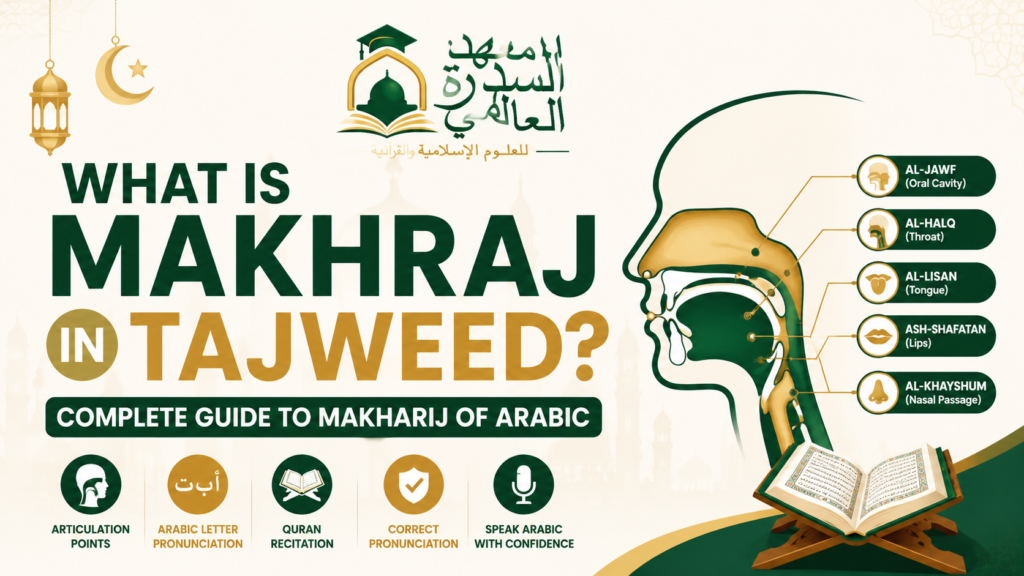
Makhraj in Tajweed is the articulation point from which an Arabic letter originates when pronounced. Every Arabic letter has a specific place of pronunciation within the mouth, throat, lips, or nasal passage. Learning the correct Makhraj helps Muslims recite the Quran accurately and prevents pronunciation mistakes that may affect meaning.
Featured Snippet Answer
Makhraj in Tajweed is the articulation point from which an Arabic letter is pronounced. Classical Tajweed scholars identified 17 specific Makharij grouped into five major areas: the oral cavity, throat, tongue, lips, and nasal passage. Correct Makhraj is essential for proper Quran recitation and accurate pronunciation of Arabic letters.
Understanding the Meaning of Makhraj in Tajweed
Linguistic Meaning of Makhraj
The Arabic word Makhraj (مخرج) comes from the root word meaning “to exit” or “to come out.” In simple terms, it refers to the place from which something emerges.
The plural form of Makhraj is Makharij (مخارج).
Technical Meaning in Tajweed
In Tajweed, Makhraj refers to the exact point in the speech organs where a letter originates when pronounced.
Scholars of Tajweed carefully studied the sounds of Arabic letters and identified their precise articulation points. These points help distinguish one letter from another, even when letters appear similar.
For example:
- س (Seen) and ص (Saad) have different articulation characteristics.
- ق (Qaaf) and ك (Kaaf) originate from different positions in the mouth.
- ح (Haa) and ه (Haa) are pronounced from different parts of the throat.
Understanding these distinctions is essential for correct Quran recitation.
Why Is Makhraj Important in Quran Recitation?
Preserving the Meaning of Quranic Words
Arabic is a highly precise language. Changing the pronunciation of a single letter can change the meaning of an entire word.
For this reason, Muslims strive to pronounce Quranic words exactly as they were revealed.
Improving Recitation Accuracy
Correct Makharij help reciters:
- Pronounce letters clearly
- Differentiate similar sounds
- Improve fluency
- Read with confidence
Following Proper Tajweed Rules
Allah says:
“And recite the Qur’an with measured recitation.” (Surah Al-Muzzammil 73:4)
This verse highlights the importance of careful and proper recitation. Learning Makharij is one of the practical ways to fulfill this command.
The Five Major Makharij of Arabic Letters
Classical Tajweed scholars grouped the articulation points into five major areas.
| Major Makhraj | Location | Description |
| Al-Jawf | Oral cavity | Empty space inside the mouth |
| Al-Halq | Throat | Different sections of the throat |
| Al-Lisan | Tongue | Various positions of the tongue |
| Ash-Shafatan | Lips | Upper and lower lips |
| Al-Khayshum | Nasal passage | Area responsible for nasal sound |
These five areas contain the seventeen articulation points used for Arabic letters.
Al-Jawf (The Oral Cavity)
Al-Jawf refers to the empty space inside the mouth and throat.
Three long vowel letters originate from this area:
- ا (Alif Madd)
- و (Waw Madd)
- ي (Yaa Madd)
Examples:
- قَالَ
- يَقُولُ
- قِيلَ
These letters rely on airflow and elongation rather than direct contact with speech organs.
Al-Halq (The Throat)
The throat contains three articulation regions that produce six letters.
Deepest Part of the Throat
Letters:
- ء (Hamzah)
- ه (Haa)
Examples:
- أَحَد
- هُدًى
Middle Part of the Throat
Letters:
- ع (‘Ayn)
- ح (Haa)
Examples:
- عَلِيم
- حَكِيم
Upper Part of the Throat
Letters:
- غ (Ghayn)
- خ (Khaa)
Examples:
- غَفُور
- خَبِير
Many non-Arabic speakers find throat letters challenging and require regular practice to master them.
Al-Lisan (The Tongue)
The tongue is responsible for the largest number of Arabic letters.
Different areas of the tongue interact with the palate, gums, and teeth to produce specific sounds.
Back of the Tongue
Letters:
- ق (Qaaf)
- ك (Kaaf)
Middle of the Tongue
Letters:
- ج (Jeem)
- ش (Sheen)
- ي (Yaa non-Madd)
Side of the Tongue
Letter:
- ض (Dhaad)
The letter Dhaad is unique and one of the most distinctive sounds in Arabic.
Tip of the Tongue
Produces several letters including:
- ن (Noon)
- ر (Raa)
- ل (Laam)
- ط (Taa)
- د (Daal)
- ت (Taa)
- ص (Saad)
- س (Seen)
- ز (Zay)
Because many letters originate from nearby tongue positions, students often confuse them during recitation.
Ash-Shafatan (The Lips)
The lips produce several important Arabic letters.
Letters Produced by Both Lips
- ب (Baa)
- م (Meem)
- و (Waw)
Letters Produced by Lower Lip and Upper Teeth
- ف (Faa)
Examples:
- بَاب
- مُؤْمِن
- فَضْل
Lip positioning plays a major role in achieving correct pronunciation.
Al-Khayshum (The Nasal Passage)
Al-Khayshum refers to the nasal cavity.
It is responsible for Ghunna, the nasal sound associated mainly with:
- Noon (ن)
- Meem (م)
Examples include:
- إِنَّ
- ثُمَّ
A proper Ghunna should resonate through the nasal passage rather than the mouth alone.
The Seventeen Makharij of Arabic Letters Explained
The most widely accepted view among Tajweed scholars identifies 17 articulation points distributed across the five major areas.
| Area | Number of Makharij |
| Al-Jawf | 1 |
| Al-Halq | 3 |
| Al-Lisan | 10 |
| Ash-Shafatan | 2 |
| Al-Khayshum | 1 |
| Total | 17 |
This classification remains the standard in modern Tajweed education.
Makhraj and Sifaat – What Is the Difference?
Many students confuse Makhraj with Sifaat.
Although related, they are not the same.
| Makhraj | Sifaat |
| Place of articulation | Characteristics of the sound |
| Identifies where a letter originates | Identifies how a letter sounds |
| Physical location | Sound quality |
| Learned first | Learned after Makharij |
Example
The letter ق (Qaaf):
- Makhraj: Back of the tongue
- Sifaat: Strong, elevated, emphatic characteristics
A student must know both the Makhraj and the Sifaat to pronounce the letter correctly.
Common Pronunciation Mistakes in Quran Recitation
Confusing Qaaf and Kaaf
Incorrect:
- ق pronounced as ك
Correct:
- Qaaf should originate deeper from the back of the tongue.
Confusing Saad and Seen
Incorrect:
- ص pronounced like س
Correct:
- Saad has a heavier and stronger sound.
Weak Throat Letters
Many learners pronounce:
- ح like ه
- خ like ك
Regular practice is necessary to distinguish these sounds.
Practical Quran Examples of Makharij
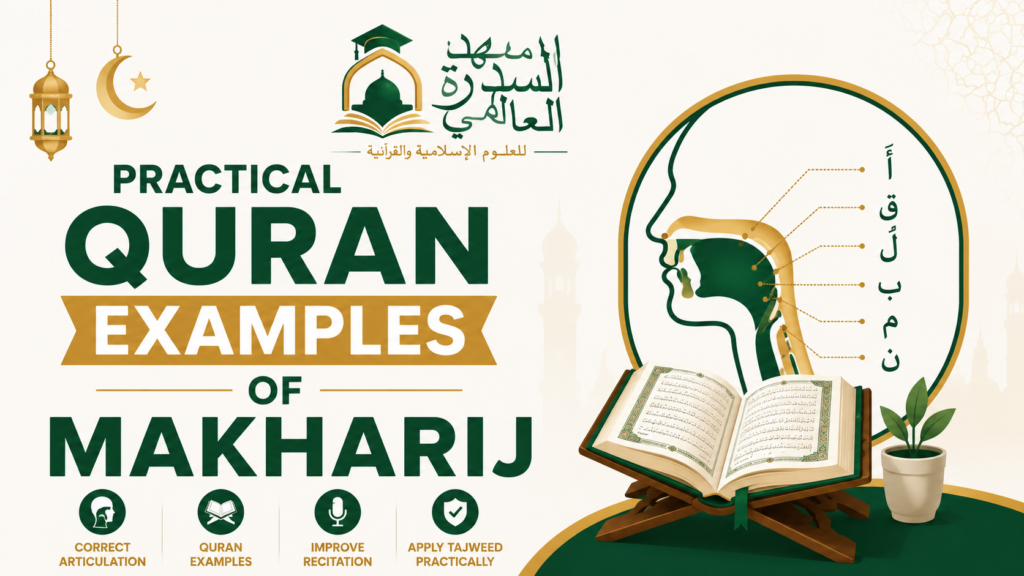
Letter Qaaf (ق)
Example:
- قُلْ
The sound should emerge from the back portion of the tongue.
Letter ‘Ayn (ع)
Example:
- عَلِيم
The sound originates from the middle throat.
Letter Faa (ف)
Example:
- فَتْح
The lower lip touches the upper front teeth.
These examples help students connect theory with actual Quran recitation.
Common Challenges When Learning Makharij
Similar-Sounding Letters
Examples:
- ت and ط
- س and ص
- د and ض
- ك and ق
Native Language Influence
Many learners apply sounds from their own language when reading Arabic.
Lack of Listening Practice
Reading alone is not enough. Students benefit greatly from listening to qualified Quran reciters.
Limited Teacher Feedback
Without correction, pronunciation mistakes can become habits.
How to Improve Your Makhraj
Learn Through Noorani Qaida
Noorani Qaida introduces Arabic letters systematically and helps students identify their articulation points from the beginning.
Practice Slowly
Do not rush Quran recitation.
Slow recitation allows you to focus on each letter’s pronunciation.
Listen to Qualified Reciters
Listening to experienced Quran reciters helps train the ear to recognize correct sounds.
Study With a Teacher
A qualified Tajweed teacher can identify mistakes that learners may not notice themselves.
Record Your Recitation
Recording your voice allows you to compare your pronunciation with expert recitations.
Practice Daily
Even ten to fifteen minutes of focused Makharij practice each day can produce noticeable improvement over time.
Beginner Makhraj Practice Exercises
Exercise 1: Isolate Individual Letters
Repeat:
- ق ق ق
- ك ك ك
- ص ص ص
- س س س
Focus on where each sound originates.
Exercise 2: Practice Throat Letters
Repeat:
- ع
- ح
- غ
- خ
Pay attention to the different throat positions.
Exercise 3: Read Short Quranic Words
Examples:
- قُل
- حَق
- غَفُور
- عَلِيم
Concentrate on one letter at a time.
Common Misconceptions About Makharij
Misconception 1: Tajweed Is Only for Advanced Students
Reality:
Every Muslim who learns Quran recitation benefits from basic Tajweed and Makharij.
Misconception 2: Makhraj and Sifaat Are the Same
Reality:
Makhraj refers to the origin of the letter, while Sifaat describe its characteristics.
Misconception 3: Reading Arabic Automatically Means Correct Pronunciation
Reality:
A person may read Arabic fluently while still making pronunciation mistakes.
Misconception 4: Makharij Can Be Mastered Without Practice
Reality:
Correct pronunciation develops through consistent practice and correction.
Frequently Asked Questions
What is Makhraj in Tajweed?
Makhraj is the articulation point from which an Arabic letter originates during pronunciation.
How many Makharij are there in Arabic?
The most widely accepted scholarly view identifies seventeen articulation points.
What are the five major articulation points?
The five major articulation areas are Al-Jawf, Al-Halq, Al-Lisan, Ash-Shafatan, and Al-Khayshum.
Why is Makhraj important?
It ensures accurate Quran recitation and helps preserve the correct pronunciation of Arabic words.
What is the difference between Makhraj and Sifaat?
Makhraj identifies where a letter originates, while Sifaat describe the qualities and characteristics of that sound.
Can I learn Makharij without a teacher?
Self-study can help, but learning from a qualified Tajweed teacher usually produces faster and more accurate results.
Is Makhraj taught in Noorani Qaida?
Yes. Noorani Qaida introduces the pronunciation and articulation of Arabic letters as a foundation for Quran recitation.
Key Takeaways
- Makhraj is the articulation point of an Arabic letter.
- Correct Makharij are essential for proper Quran recitation.
- Arabic letters originate from five major articulation areas.
- Classical Tajweed scholars identified seventeen Makharij.
- Makhraj and Sifaat are related but different concepts.
- Consistent practice improves pronunciation accuracy.
- Noorani Qaida provides an excellent foundation for learning Makharij.
Conclusion
Makhraj is one of the most important foundations of Tajweed. It teaches where Arabic letters originate and helps Muslims recite the Quran accurately and beautifully. By understanding the five major articulation areas and the seventeen Makharij, students can improve their pronunciation, avoid common mistakes, and gain greater confidence in Quran recitation.
Whether you are beginning with Noorani Qaida or advancing your Tajweed studies, investing time in learning Makharij will strengthen your connection with the Quran and help you recite its words as accurately as possible.
For structured learning, beginners can follow:
To continue your Islamic learning journey, you may also like our guides on [The Role of Caliph Uthman in Standardising the Qur’an Explained ], [When Can You Eat During Ramadan? Complete Guide ], and [Can You Recite Ayatul Kursi in Salah? Islamic Ruling Explained]. Exploring related topics can help you build a stronger understanding of Islam, the Quran, and everyday Islamic practices.