
The preservation of the Qur’an is one of the most remarkable aspects of Islamic history. From the time of the Prophet Muhammad ﷺ until today, Muslims have carefully preserved Allah’s words through memorization, writing, and transmission from generation to generation.
Among the key figures in this preservation effort was Uthman ibn Affan, the third Caliph of Islam. His decision to standardise the written Qur’an helped unite the Muslim community and protect the authenticity of the Qur’anic text as Islam spread across vast regions.
Many people hear about the Mushaf Uthmani and wonder: Why did Caliph Uthman standardise the Qur’an? Did he change the Qur’an? What exactly happened during his caliphate?
This guide explains the historical background, the reasons behind the standardisation project, and its lasting importance for Muslims today.
Quick Answer
Caliph Uthman ibn Affan (RA) standardised the Qur’an to prevent disputes among Muslims regarding recitation as Islam expanded into different regions. Using the authenticated manuscript compiled during the caliphate of Abu Bakr As-Siddiq and preserved by Hafsa bint Umar, a committee led by Zayd ibn Thabit prepared official copies of the Qur’an. These copies were distributed throughout the Islamic Caliphate, ensuring the preservation of a unified and authentic Qur’anic text.
Featured Snippet Answer
The role of Caliph Uthman in standardising the Qur’an was to unify Muslims upon an authentic written text when differences in recitation began causing confusion. He appointed a committee led by Zayd ibn Thabit (RA) to prepare official copies based on the original compilation, then distributed these copies throughout the Muslim world to preserve Qur’anic unity and accuracy.
Who Was Caliph Uthman ibn Affan (RA)?
His Position in Islamic History
Uthman ibn Affan (RA) was the third of the Rightly Guided Caliphs (Khulafa al-Rashidun). He was among the earliest converts to Islam and was known for his generosity, piety, and dedication to serving the Muslim community.
He was also honored with the title Dhun-Nurayn (Possessor of Two Lights) because he married two daughters of the Prophet Muhammad ﷺ at different times.
His Service to the Muslim Ummah
During his caliphate, the Islamic state expanded significantly. New Muslims entered Islam from various regions, languages, and cultural backgrounds. While this expansion brought many blessings, it also introduced challenges related to Qur’anic recitation and teaching.
One of Uthman’s greatest contributions was ensuring the preservation of the Qur’an in a unified written form for future generations.
Historical Background: How the Qur’an Was Preserved Before Uthman
To understand Uthman’s role, it is important to know how the Qur’an was preserved before his caliphate.
During the Lifetime of Prophet Muhammad ﷺ
The Qur’an was revealed gradually to the Prophet Muhammad ﷺ over approximately 23 years.
The Prophet ﷺ ensured that:
- The revelations were memorized by companions.
- Verses were written by designated scribes.
- The placement of verses and chapters was taught directly by revelation.
- The Qur’an was regularly reviewed with Angel Jibril (AS).
Allah says:
“Indeed, it is We who sent down the Reminder, and indeed, We will surely preserve it.”
(Surah Al-Hijr 15:9)
The Qur’an therefore existed both in written form and in the hearts of thousands of believers.
Compilation Under Abu Bakr As-Siddiq (RA)
After the Prophet ﷺ passed away, many Qur’an memorizers were martyred during the Battle of Yamamah.
Concerned that portions of the written record could become difficult to collect if more memorizers died, Umar ibn Al-Khattab (RA) advised Abu Bakr (RA) to gather the Qur’an into a single manuscript.
Abu Bakr (RA) appointed Zayd ibn Thabit (RA) to lead this effort.
The compilation process was extremely careful:
- Written materials were collected.
- Memorized recitations were verified.
- Multiple witnesses confirmed authenticity.
- Every verse was checked rigorously.
The result was a master manuscript of the Qur’an.
Preservation by Hafsa (RA)
After Abu Bakr (RA), the manuscript remained with Umar ibn Al-Khattab (RA).
Following Umar’s death, it was entrusted to his daughter Hafsa (RA), one of the wives of the Prophet ﷺ.
This manuscript would later become the primary reference during Uthman’s standardisation project.
Why Did Caliph Uthman Standardise the Qur’an?
Expansion of the Islamic Caliphate
As Islam spread into regions such as Iraq, Syria, Egypt, Persia, and beyond, Muslims from different backgrounds learned the Qur’an from different teachers.
Many of these new Muslims were unfamiliar with the Arabic dialects spoken by Arab tribes.
Emerging Recitation Differences
The Qur’an had been revealed in multiple accepted modes (Ahruf) to facilitate ease among different Arab tribes.
However, as Islam expanded, some Muslims began assuming that their recitation was the only correct one.
Disagreements arose between groups from different regions.
Protecting Muslim Unity
One famous report mentions that Hudhayfah ibn al-Yaman (RA) witnessed disputes among Muslim soldiers regarding Qur’anic recitation.
Fearing future divisions, he urged Caliph Uthman (RA) to address the issue before disagreements became widespread.
Uthman recognized the seriousness of the matter and took action to preserve unity within the Muslim Ummah.
How the Standardisation Process Took Place
Formation of the Committee
Caliph Uthman (RA) requested the manuscript preserved by Hafsa (RA).
He then appointed a committee of knowledgeable companions to prepare standardized copies.
The committee included:
- Zayd ibn Thabit (RA)
- Abdullah ibn az-Zubayr (RA)
- Sa’id ibn al-As (RA)
- Abdur Rahman ibn al-Harith ibn Hisham (RA)
Role of Zayd ibn Thabit (RA)
Zayd ibn Thabit (RA) was the ideal choice because:
- He served as one of the Prophet’s scribes.
- He led the earlier compilation under Abu Bakr (RA).
- He possessed exceptional knowledge of the Qur’an.
His experience helped ensure continuity and accuracy.
Reviewing the Master Manuscript
The committee carefully compared and copied the text from the authenticated manuscript.
Whenever linguistic variations appeared, the committee followed the dialect of Quraysh, the tribe of the Prophet Muhammad ﷺ, according to Uthman’s instructions.
Producing Official Copies
After verification, several official copies were produced.
These copies became known as the Mushaf Uthmani or Uthmanic Qur’an Codex.
What Is the Mushaf Uthmani?
Meaning of the Term
The word Mushaf refers to a written collection of Qur’anic pages bound together.
The Mushaf Uthmani refers to the standardized copies produced during Uthman’s caliphate.
Characteristics of the Standard Mushaf
The Mushaf Uthmani:
- Was based on the authenticated manuscript compiled earlier.
- Preserved the authentic Qur’anic text.
- Unified Muslims upon a standard written form.
- Became the foundation for later Qur’anic manuscripts.
Every printed Qur’an used by Muslims today traces its textual foundation back to this standardization effort.
Comparison: Abu Bakr’s Compilation vs Uthman’s Standardisation
| Aspect | Compilation Under Abu Bakr (RA) | Standardisation Under Uthman (RA) |
| Primary Goal | Preserve Qur’an in one manuscript | Unify written copies |
| Reason | Death of memorizers | Recitation disputes |
| Lead Scholar | Zayd ibn Thabit (RA) | Zayd ibn Thabit (RA) |
| Outcome | Master manuscript | Official copies distributed |
| Scope | Collection and preservation | Standardization and distribution |
Understanding this distinction helps remove a common misconception that Uthman (RA) was the first to compile the Qur’an. The initial compilation occurred under Abu Bakr (RA), while Uthman’s project focused on standardisation.
How Many Copies Did Uthman Send?
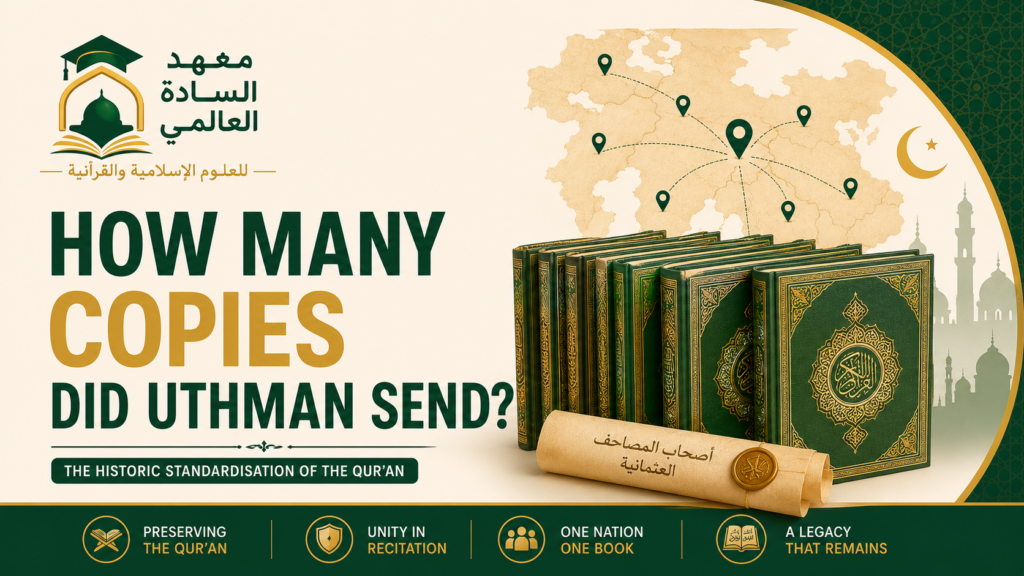
Historical reports differ regarding the exact number.
Most scholars mention that several official copies were sent to major centers of the Islamic world, including:
- Makkah
- Madinah
- Kufa
- Basra
- Syria
Qualified teachers were often sent along with these copies to ensure correct recitation and instruction.
This helped maintain consistency throughout the growing Muslim community.
Why Were Other Qur’an Copies Removed?
This is one of the most misunderstood aspects of the story.
Preventing Confusion
Before standardisation, individuals often possessed personal written notes containing:
- Explanatory comments
- Personal study notes
- Dialectal variations
- Partial collections
These were not intended to serve as official reference manuscripts.
Preserving Accuracy
Uthman (RA) instructed that unofficial materials likely to create confusion should be removed after the official copies were distributed.
His objective was not to eliminate the Qur’an but to prevent future disputes regarding the authentic written text.
Did Uthman Change the Qur’an?
No.
Classical Islamic scholarship unanimously maintains that Uthman’s project preserved the Qur’an rather than altering it.
The committee worked from the authenticated manuscript already compiled under Abu Bakr (RA) and verified by leading companions.
Understanding Ahruf, Dialects, and Qira’at
Many modern readers confuse these concepts.
What Are Ahruf?
The Qur’an was revealed in multiple accepted modes known as Ahruf.
These modes accommodated linguistic differences among Arab tribes during the Prophet’s lifetime.
What Are Qira’at?
Qira’at are authenticated methods of Qur’anic recitation transmitted through reliable chains of narration.
They remain part of Islamic scholarship today.
Why They Do Not Contradict Each Other
Authentic Qira’at:
- Preserve the same message.
- Trace back to the Prophet ﷺ.
- Operate within accepted transmission principles.
The standardisation project did not eliminate authentic recitations. Rather, it established a unified written reference to preserve harmony among Muslims.
The Importance of Uthman’s Contribution to Qur’an Preservation
Protecting the Authentic Quran Text
Without standardisation, regional differences could have grown into major disputes.
The project helped ensure that Muslims throughout the world referred to the same authenticated text.
Preserving Quranic Unity
The Qur’an became a unifying force for Muslims regardless of geography, language, or ethnicity.
Supporting Future Generations
Every generation since Uthman (RA) has benefited from this effort.
Millions memorize the same Qur’an today, demonstrating the success of the preservation process.
Common Misconceptions About Uthman’s Standardisation
Misconception 1: Uthman Changed the Qur’an
Reality:
He standardized existing authentic material and did not introduce new content or remove revelation.
Misconception 2: Different Qur’ans Existed Before Uthman
Reality:
The Qur’an itself was one. Differences primarily involved recitation modes, dialectal variations, and personal study materials.
Misconception 3: Uthman Removed Verses
Reality:
No authentic Islamic source states that Uthman removed revealed verses from the Qur’an.
Misconception 4: Modern Qur’ans Are Different From Early Qur’ans
Reality:
The Qur’an used by Muslims today follows the textual tradition preserved through the Mushaf Uthmani.
Lessons Muslims Can Learn Today
The Importance of Unity
Uthman’s actions demonstrate the importance of preventing unnecessary divisions within the Muslim community.
Preserving Authentic Knowledge
Islam emphasizes careful verification before transmitting religious knowledge.
Respecting Scholarly Expertise
The standardisation effort involved consultation, scholarship, and verification rather than individual opinion.
Taking Responsibility for Future Generations
Uthman (RA) acted not only for his own time but for generations yet to come.
His foresight continues to benefit Muslims more than fourteen centuries later.
Key Takeaways
- The Qur’an was preserved through memorization and writing during the Prophet’s lifetime.
- Abu Bakr (RA) commissioned the first complete compilation after the Battle of Yamamah.
- Hafsa (RA) safeguarded the master manuscript.
- Uthman (RA) standardised the Qur’an when recitation disputes emerged.
- Zayd ibn Thabit (RA) led the standardisation committee.
- Official copies were distributed across the Islamic Caliphate.
- The Mushaf Uthmani became the standard reference text.
- Uthman’s effort strengthened Qur’anic unity and preservation for future generations.
Frequently Asked Questions
Why did Caliph Uthman standardise the Qur’an?
He standardised the Qur’an to prevent disputes over recitation and preserve unity among Muslims as Islam spread to new regions.
Who compiled the Qur’an into one book?
The first complete compilation was commissioned by Abu Bakr As-Siddiq (RA) and carried out by Zayd ibn Thabit (RA).
What is the Mushaf Uthmani?
The Mushaf Uthmani is the standardized written Qur’an produced during the caliphate of Uthman ibn Affan (RA).
Did Uthman change the Qur’an?
No. He standardized the written text based on the authenticated manuscript already compiled under Abu Bakr (RA).
Why were other copies removed?
To prevent confusion caused by unofficial personal materials and to ensure reliance on verified official copies.
Who helped Caliph Uthman in the project?
A committee of companions led by Zayd ibn Thabit (RA) supervised the preparation of the official copies.
How many copies of the Qur’an did Uthman send?
Historical reports vary, but several official copies were distributed to major centers of the Islamic world.
How was the Qur’an preserved after Prophet Muhammad ﷺ?
It was preserved through memorization, written records, compilation under Abu Bakr (RA), and standardisation under Uthman (RA).
What is the difference between Abu Bakr’s compilation and Uthman’s standardisation?
Abu Bakr’s effort gathered the Qur’an into a single manuscript, while Uthman’s project produced standardized copies for distribution.
Why is Uthman’s contribution important today?
His efforts helped preserve a unified and authentic Qur’anic text that Muslims continue to read and memorize worldwide.
Conclusion
The role of Caliph Uthman in standardising the Qur’an represents one of the most important achievements in Islamic history. Faced with the challenge of maintaining unity among a rapidly expanding Muslim community, he implemented a careful and scholarly process that preserved the authentic Qur’anic text while preventing future disputes.
Working with trusted companions and relying on the manuscript compiled under Abu Bakr (RA), Uthman (RA) ensured that Muslims across the Islamic world would share a common written reference for the Qur’an. His efforts did not alter the revelation; rather, they strengthened its preservation.
Today, every Muslim who reads, memorizes, or studies the Qur’an benefits from the foresight, dedication, and service of Uthman ibn Affan (RA) and the companions who helped safeguard Allah’s Book for future generations.
To continue your Islamic learning journey, you may also like our guides on [When Can You Eat During Ramadan? Complete Guide], [Can You Recite Ayatul Kursi in Salah? Islamic Ruling Explained], and [Why Surah Fatiha Is Called Ummul Quran:The Mother of the Quran]. Exploring related topics can help you build a stronger understanding of Islam, the Quran, and everyday Islamic practices.