
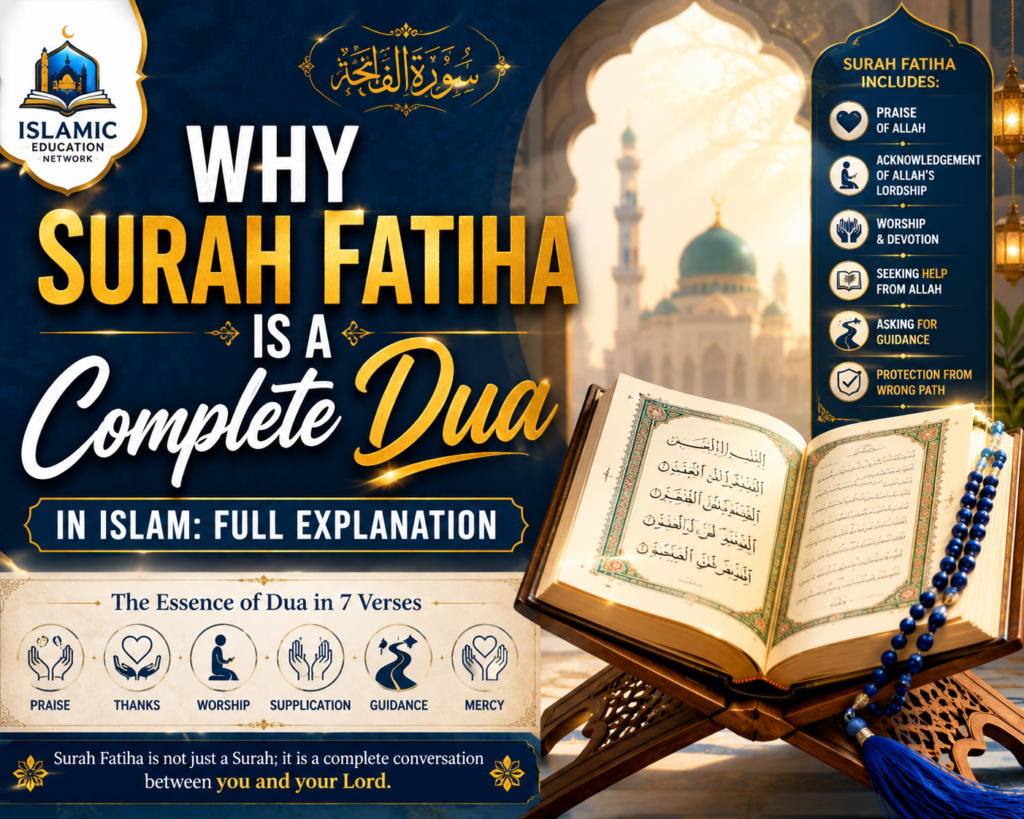
Surah Al-Fatiha is the most frequently recited chapter of the Quran. Every practicing Muslim reads it multiple times each day during Salah, yet many people wonder: Why is Surah Fatiha considered a complete dua?
The answer lies in its unique structure. Surah Al-Fatiha combines praise of Allah, recognition of His mercy and authority, worship, dependence, and a direct request for guidance. It teaches believers not only what to ask from Allah but also how to ask Him. This is why scholars often describe it as one of the most comprehensive Quranic supplications.
Whether you are a beginner learning about Islam or someone seeking a deeper understanding of your daily prayers, understanding Surah Al-Fatiha can transform the way you connect with Allah in Salah.
Quick Answer: Why Surah Fatiha Is a Complete Dua
Surah Al-Fatiha is called a complete dua because it contains all the essential elements of supplication. It begins by praising Allah, acknowledges His mercy and sovereignty, expresses sincere worship and dependence upon Him, and then asks for the most important blessing of all—guidance to the Straight Path. Through just seven verses, it teaches Muslims the perfect manner of making dua and building a relationship with their Creator.
Featured Snippet Answer
Surah Al-Fatiha is a complete dua because it combines praise, worship, reliance on Allah, and a direct request for guidance. It teaches Muslims the ideal way to make supplication by beginning with gratitude and glorification of Allah before asking Him for the greatest blessing—the Straight Path.
What Is Surah Al-Fatiha?
Surah Al-Fatiha is the first chapter of the Quran and serves as an introduction to the entire message of Islam. The word “Al-Fatiha” means “The Opening.”
It consists of seven verses and is recited in every unit (rak’ah) of Salah. Because of its central role in worship, it is often described as the heart of a Muslim’s daily prayer.
Meaning of Al-Fatiha
The name Al-Fatiha comes from the Arabic root meaning “to open.” It is called The Opening because it opens the Quran and opens the recitation of Salah.
Names of Surah Al-Fatiha
Surah Al-Fatiha has several honored names, including:
- Umm al-Kitab (The Mother of the Book)
- Umm al-Quran (The Mother of the Quran)
- As-Sab’ al-Mathani (The Seven Oft-Repeated Verses)
- Surah Al-Hamd (The Chapter of Praise)
- Ash-Shifa (The Healing)
Each name highlights a different aspect of its importance and comprehensive nature.
Why It Is Called Umm al-Kitab
Scholars explain that Surah Al-Fatiha is called Umm al-Kitab because it summarizes the central themes of the Quran:
- Belief in Allah
- Worship of Allah alone
- Divine mercy
- Accountability in the Hereafter
- Guidance
- Righteous living
The entire Quran expands upon the principles introduced in Surah Al-Fatiha.
Why Is Surah Fatiha Called a Complete Dua?
To understand why Surah Al-Fatiha is a complete dua, we need to understand what makes a supplication complete in Islam.
A meaningful dua generally includes:
- Praising Allah
- Recognizing His attributes
- Showing humility
- Expressing dependence upon Him
- Asking for one’s needs
Surah Al-Fatiha contains all of these elements.
Praise Before Request
The Surah begins with:
“Alhamdulillahi Rabbil Alamin”
“All praise belongs to Allah, Lord of the worlds.”
Before making a request, the believer praises Allah. This teaches an important etiquette of dua.
Worship and Dependence
The Surah then declares:
“Iyyaka na’budu wa iyyaka nasta’een”
“You alone we worship, and You alone we ask for help.”
This verse demonstrates complete reliance upon Allah.
The Prayer for Guidance
After praise and worship comes the request:
“Ihdinas Siratal Mustaqeem”
“Guide us to the Straight Path.”
This is the heart of the supplication.
The believer asks for guidance, which is the foundation of success in this life and the next.
Verse-by-Verse Explanation of Surah Fatiha as a Dua
Understanding each verse reveals why this Surah is such a comprehensive prayer.
Bismillahir Rahmanir Raheem
“In the name of Allah, the Most Compassionate, the Most Merciful.”
The recitation begins by remembering Allah and seeking blessings through His name.
This teaches believers that every act should begin with awareness of Allah.
Alhamdulillahi Rabbil Alamin
“All praise is for Allah, Lord of the worlds.”
This verse establishes gratitude.
A believer recognizes that every blessing comes from Allah.
Before asking for anything, Surah Al-Fatiha teaches us to appreciate what we have already been given.
Ar-Rahmanir Raheem
“The Most Compassionate, the Most Merciful.”
Allah’s mercy is mentioned twice using two beautiful names.
This reminds believers that Allah’s mercy surrounds His creation and gives hope that He will answer sincere prayers.
Maliki Yawmid-Deen
“Master of the Day of Judgment.”
This verse reminds us that every person will stand before Allah.
Recognizing accountability increases sincerity and encourages righteous actions.
Iyyaka Na’budu Wa Iyyaka Nasta’een
“You alone we worship, and You alone we ask for help.”
This verse is a declaration of:
- Tawheed (belief in Allah’s Oneness)
- Worship
- Dependence
- Trust
It marks the transition from praise to supplication.
Ihdinas Siratal Mustaqeem
“Guide us to the Straight Path.”
This is the central dua of Surah Al-Fatiha.
Guidance includes:
- Correct belief
- Proper worship
- Good character
- Wise decisions
- Steadfastness upon Islam
The believer asks Allah for continuous guidance because every person needs divine direction throughout life.
Siratal Ladhina An’amta Alayhim Ghayril Maghdubi Alayhim Walad Daalleen
“The path of those upon whom You have bestowed Your favor, not of those who earned Your anger, nor of those who went astray.”
This final verse clarifies the type of guidance being sought.
Believers ask Allah to help them follow the path of righteousness and avoid the paths of misguidance.
How Surah Fatiha Teaches the Perfect Method of Making Dua
One reason Surah Al-Fatiha is called a complete dua is because it teaches the proper structure of supplication.
| Part of Surah Fatiha | Lesson |
| Bismillah | Begin with Allah |
| Alhamdulillah | Praise Allah |
| Ar-Rahman Ar-Raheem | Remember His mercy |
| Maliki Yawmid-Deen | Recognize accountability |
| Iyyaka Na’budu | Show devotion |
| Iyyaka Nasta’een | Admit dependence |
| Ihdinas Siratal Mustaqeem | Make your request |
This sequence reflects the etiquette of dua taught throughout Islam.
Instead of immediately asking for something, the believer first glorifies Allah and acknowledges His greatness.
The Connection Between Surah Fatiha and Salah
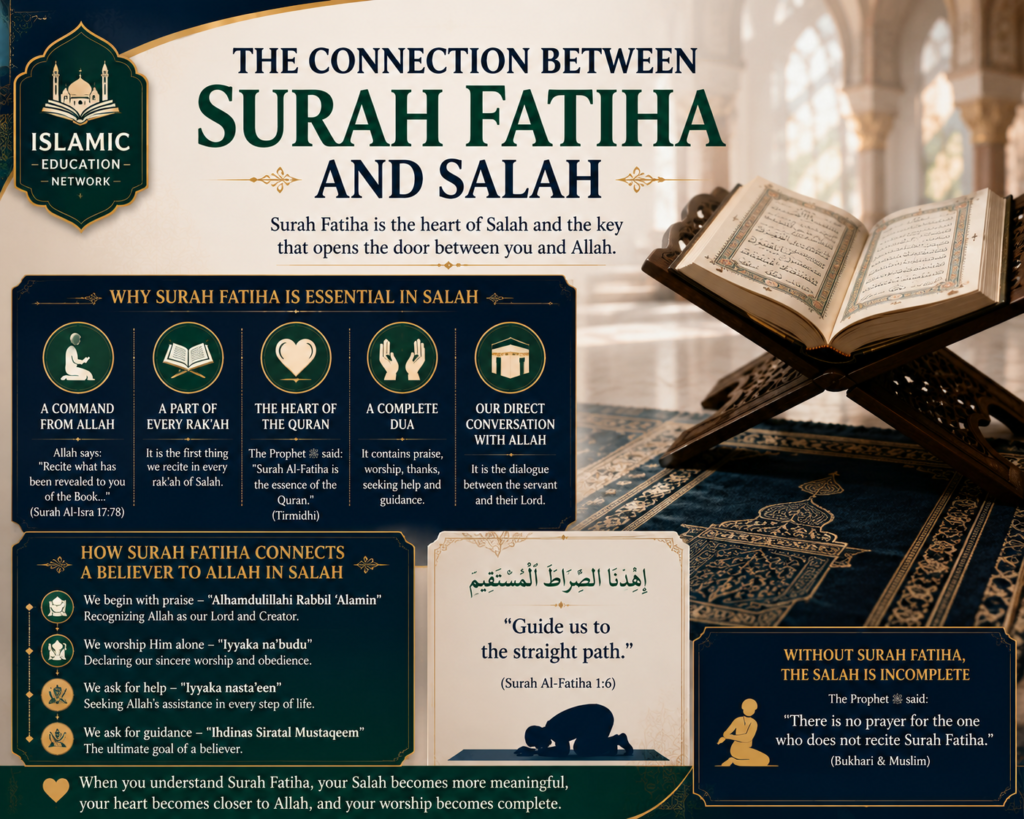
Surah Al-Fatiha occupies a unique position in Salah.
Why It Is Recited in Every Rak’ah
The Prophet Muhammad ﷺ emphasized the importance of Surah Al-Fatiha in prayer.
Because it contains the essence of faith, worship, and guidance, Muslims recite it repeatedly throughout the day.
Every recitation renews a believer’s commitment to Allah and refreshes their request for guidance.
The Dialogue Between Allah and His Servant
An authentic Hadith Qudsi describes Allah responding to the recitation of Surah Al-Fatiha verse by verse.
When the servant says:
“All praise is for Allah, Lord of the worlds,”
Allah says:
“My servant has praised Me.”
This narration demonstrates that Surah Al-Fatiha is not merely a recitation. It is a conversation between the believer and Allah.
This is one of the strongest reasons scholars consider it a complete dua.
Spiritual Benefits of Surah Al-Fatiha
Surah Al-Fatiha offers numerous spiritual benefits.
Strengthens Faith
Regular recitation reinforces core Islamic beliefs every day.
Builds Reliance Upon Allah
The verse “You alone we ask for help” reminds believers to depend upon Allah before anyone else.
Increases Gratitude
Beginning with praise develops a thankful mindset.
Encourages Consistent Guidance
The repeated request for guidance helps Muslims remain conscious of their spiritual direction.
Deepens Concentration in Salah
Understanding the meanings of Surah Al-Fatiha can significantly improve focus and sincerity during prayer.
Importance of Surah Fatiha in Islam
Surah Al-Fatiha is important because it summarizes the entire message of Islam.
Its themes include:
- Tawheed
- Worship
- Mercy
- Accountability
- Guidance
- Obedience
For this reason, many scholars describe it as a summary of the Quran itself.
Every major message found throughout the Quran can be traced back to principles introduced in Surah Al-Fatiha.
Common Misconceptions About Surah Al-Fatiha
Misconception 1: It Is Only a Chapter of the Quran
While it is a Surah, it is also a powerful supplication and prayer.
Misconception 2: Guidance Refers Only to Non-Muslims
Muslims also need guidance every day.
The request for guidance includes remaining firm upon truth and increasing in righteousness.
Misconception 3: Recitation Alone Is Enough
Understanding and reflecting upon the meanings of Surah Al-Fatiha helps believers gain greater spiritual benefit.
Misconception 4: Dua Means Only Asking for Material Things
Surah Al-Fatiha shows that the greatest dua is asking for guidance and closeness to Allah.
Practical Lessons Muslims Can Apply Daily
Surah Al-Fatiha teaches several practical lessons.
Begin Every Dua with Praise
Before making requests, praise Allah and acknowledge His blessings.
Depend Upon Allah First
Seek help from Allah before turning to worldly solutions.
Ask for Guidance Regularly
Even knowledgeable believers require guidance every day.
Balance Hope and Accountability
Remember both Allah’s mercy and the Day of Judgment.
Focus on Spiritual Success
The Surah teaches that guidance is more valuable than worldly gains.
Surah Fatiha at a Glance
| Theme | Lesson |
| Praise | Thank Allah |
| Mercy | Have hope in Allah |
| Judgment | Stay accountable |
| Worship | Devote yourself to Allah |
| Dependence | Seek Allah’s help |
| Guidance | Ask for the Straight Path |
| Righteousness | Follow the path of the blessed |
Key Takeaways
- Surah Al-Fatiha is both a chapter of the Quran and a complete dua.
- It combines praise, worship, reliance, and supplication.
- The central request is guidance to the Straight Path.
- It teaches the proper etiquette of making dua.
- It is recited in every rak’ah because it summarizes the essence of Islam.
- Understanding its meanings can greatly improve the quality of Salah.
- The Surah remains one of the most powerful and comprehensive prayers in Islam.
Frequently Asked Questions
Is Surah Fatiha a dua or a surah?
It is both. Surah Al-Fatiha is a chapter of the Quran, and its contents form a complete supplication that includes praise, worship, and a request for guidance.
Why is Surah Fatiha recited in every prayer?
It summarizes the core teachings of Islam and renews a believer’s connection with Allah through praise, worship, and supplication.
What is the main dua in Surah Fatiha?
The central supplication is:
“Ihdinas Siratal Mustaqeem”
“Guide us to the Straight Path.”
Why is Surah Fatiha called Umm al-Kitab?
Because it contains the essential themes of the Quran and serves as a summary of its message.
What are the spiritual benefits of Surah Fatiha?
Its benefits include strengthening faith, increasing gratitude, encouraging reliance upon Allah, improving concentration in Salah, and helping believers seek guidance consistently.
Is Surah Fatiha the best dua for guidance?
It is among the greatest Quranic supplications because it directly asks Allah for guidance, which is the foundation of success in both this life and the Hereafter.
Conclusion
Surah Al-Fatiha is far more than the opening chapter of the Quran. It is a complete dua that teaches Muslims how to approach Allah with humility, gratitude, worship, and sincere supplication. Through its seven concise verses, it summarizes the essence of faith and the relationship between a believer and their Creator.
Every time a Muslim recites Surah Al-Fatiha in Salah, they praise Allah, acknowledge His mercy and authority, declare their devotion, and ask for the greatest blessing of all—guidance to the Straight Path. Understanding these meanings can transform a routine recitation into a deeply meaningful conversation with Allah and strengthen one’s connection to the Quran and daily worship.
For structured learning, beginners can follow:
To continue your Islamic learning journey, you may also like our guides on [Bible vs Quran Accuracy: Comparing Accuracy & Reliability], [What Is the Meaning of the Word Quran? Meaning Explained], and [How to Make Istighfar Within the Salah Correctly: Islamic Guide]. Exploring related topics can help you build a stronger understanding of Islam, the Quran, and everyday Islamic practices.