
Quick Answer
Most Islamic scholars agree that the Quran contains 14 or 15 Sajdah verses, depending on the scholarly opinion followed. These special verses are known as Ayat al-Sajdah, and when a Muslim recites or hears one of them, it is recommended or required (depending on the school of thought) to perform Sajdah Tilawah (the prostration of recitation). The Hanafi school generally counts 14 Sajdahs, while many Shafi’i and Hanbali scholars count 15 Sajdahs by including an additional Sajdah in Surah Al-Hajj.
Featured Snippet Answer
There are 14 or 15 Sajdahs in the Quran, according to different scholarly opinions. The Hanafi Madhhab counts 14 Sajdah verses, while many Shafi’i and Hanbali scholars count 15. These verses are called Ayat al-Sajdah and encourage believers to perform Sajdah Tilawah when reciting or hearing them during Quran recitation.
Introduction
Many Muslims encounter a small Sajdah symbol while reciting the Quran and wonder: How many Sajdahs are in the Quran, and what should I do when I reach one?
Understanding Sajdah Tilawah is an important part of Quran recitation. It helps Muslims respond to Allah’s commands with humility and submission. Whether you are a beginner learning to read the Quran or someone seeking a deeper understanding of Islamic worship, knowing the number of Sajdahs in the Quran and their rulings can strengthen your connection with Allah.
In this guide, we will explain the total number of Sajdahs, where they appear, the differences among scholars, and how to perform Sajdah Tilawah correctly.
What Is Sajdah Tilawah?
Sajdah Tilawah is a special prostration performed after reciting or hearing specific verses of the Quran known as Ayat al-Sajdah (Verses of Prostration).
The word Sajdah means prostration, while Tilawah means recitation. Together, Sajdah Tilawah refers to the prostration associated with Quran recitation.
These verses mention the obedience of believers, angels, and creation to Allah, encouraging Muslims to express humility through prostration.
Meaning of Sajdah in Islam
Sajdah is one of the greatest acts of worship in Islam. During prostration, a Muslim places the forehead on the ground in complete submission to Allah.
The Prophet Muhammad ﷺ taught that a servant is closest to Allah while in prostration.
Why Does the Quran Contain Sajdah Verses?
The Sajdah verses remind believers that:
- Allah alone deserves worship.
- True believers submit to Allah’s commands.
- Arrogance prevents people from obeying Allah.
- Humility brings a person closer to their Creator.
How Many Sajdahs Are in the Quran?
The answer depends on which scholarly opinion is followed.
Majority Opinion
Most scholars agree that there are either:
- 14 Sajdahs in the Quran
- 15 Sajdahs in the Quran
The difference comes from one verse in Surah Al-Hajj.
Why Do Some Scholars Count 14 and Others 15?
The scholarly difference centers on Surah Al-Hajj.
| School of Thought | Number of Sajdahs |
| Hanafi | 14 |
| Shafi’i | 15 |
| Hanbali | 15 |
| Maliki | Varies in detail |
Many Shafi’i and Hanbali scholars count two Sajdahs in Surah Al-Hajj, while the Hanafi school counts only one, resulting in a total of 14 Sajdahs.
This difference is based on scholarly interpretation and authentic Islamic jurisprudence, not disagreement about the Quran itself.
Complete List of Sajdah Verses in the Quran
The following table shows the commonly recognized locations of the Sajdah verses.
| Surah | Ayah |
| Al-A’raf | 206 |
| Ar-Ra’d | 15 |
| An-Nahl | 50 |
| Al-Isra | 109 |
| Maryam | 58 |
| Al-Hajj | 18 |
| Al-Hajj | 77* |
| Al-Furqan | 60 |
| An-Naml | 26 |
| As-Sajdah | 15 |
| Sad | 24 |
| Fussilat | 38 |
| An-Najm | 62 |
| Al-Inshiqaq | 21 |
| Al-‘Alaq | 19 |
*The second Sajdah in Surah Al-Hajj is the point of difference among scholars.
Which Surahs Contain Sajdah Verses?
The Sajdah verses are spread throughout the Quran and appear in both Makki and Madani Surahs.
Some of the most commonly known include:
Surah As-Sajdah
One of the most famous Surahs associated with prostration and submission to Allah.
Surah An-Najm
The Prophet Muhammad ﷺ reportedly performed Sajdah after reciting this Surah.
Surah Al-‘Alaq
The final Sajdah verse in the Quran appears in this Surah.
Surah Al-Hajj
The only Surah associated with the scholarly discussion regarding whether there are one or two Sajdahs.
Is Sajdah Tilawah Mandatory?
Scholars differ regarding the ruling.
Hanafi View
The Hanafi school generally considers Sajdah Tilawah wajib (necessary) when the Sajdah verse is recited or heard.
Shafi’i View
The Shafi’i school generally regards Sajdah Tilawah as a highly recommended Sunnah rather than obligatory.
Hanbali View
The Hanbali school also considers it a recommended act of worship.
Maliki View
The Maliki school has detailed rulings but generally treats Sajdah Tilawah as a recommended practice.
Despite differences, all schools agree that Sajdah Tilawah is an important act of devotion and humility.
How to Perform Sajdah Tilawah Correctly
Outside Salah
The simplest method is:
- Face the Qiblah if possible.
- Say “Allahu Akbar.”
- Go into one prostration.
- Glorify Allah during the Sajdah.
- Rise from prostration.
Many scholars do not require a full prayer for Sajdah Tilawah.
Inside Salah
When reciting a Sajdah verse during Salah:
- Recite the verse.
- Move into Sajdah.
- Continue the prayer according to the normal method.
Specific details may vary slightly among schools of thought.
What Should You Say During Sajdah Tilawah?
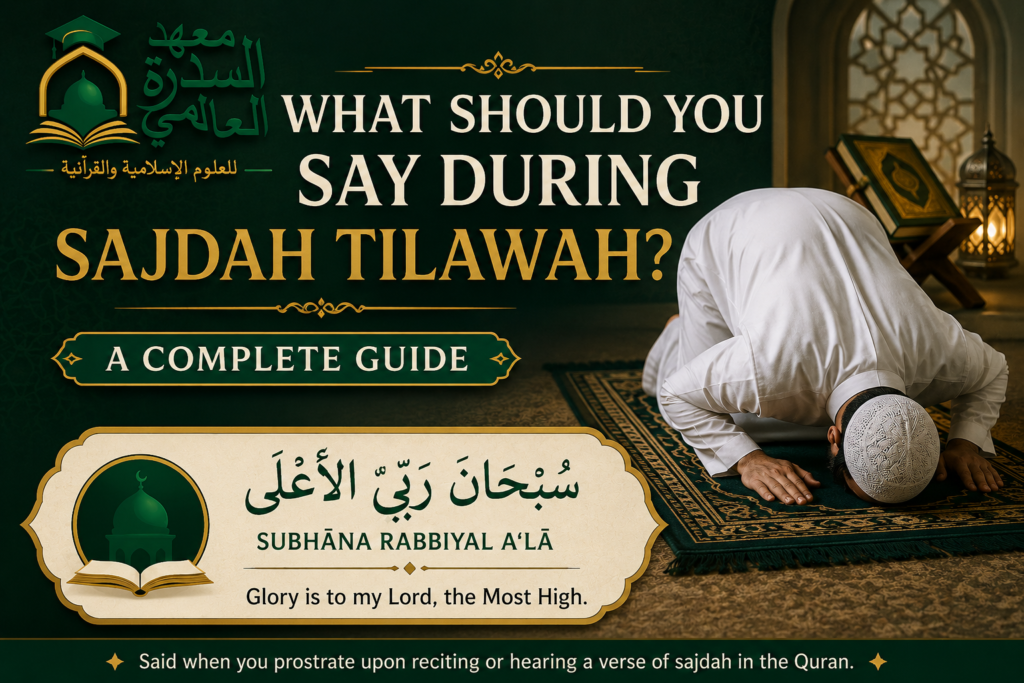
Many Muslims recite the same glorification used in regular Sajdah:
“Subhana Rabbiyal A’la”
“Glory be to my Lord, the Most High.”
Some authentic supplications have also been reported from the Prophet Muhammad ﷺ for Sajdah Tilawah.
The purpose is to praise Allah and express humility.
Rules of Sajdah Tilawah
Is Wudu Required?
Scholars differ.
Many scholars recommend performing Sajdah Tilawah in a state of purity, while some jurists discuss circumstances where the ruling may differ.
For practical purposes, it is best to perform Sajdah while having wudu whenever possible.
What If I Am Reading From a Phone?
The ruling of Sajdah Tilawah remains the same whether the Quran is read from:
- A printed Mushaf
- A Quran application
- A digital screen
The Sajdah verse does not change because of the format being used.
What If I Hear a Recitation?
Many scholars state that if a person intentionally listens to a Sajdah verse, performing Sajdah Tilawah is recommended or required according to their school of thought.
Can Women Perform Sajdah Tilawah?
Yes. Women may perform Sajdah Tilawah just as men do, while observing the general Islamic guidelines related to worship.
Sajdah Tilawah vs Regular Salah
Many people confuse Sajdah Tilawah with prayer.
The two acts are different.
| Feature | Sajdah Tilawah | Regular Salah |
| Number of Prostrations | One | Multiple |
| Rakahs | None | Required |
| Full Prayer Structure | No | Yes |
| Quran Recitation Required | No | Yes |
| Trigger | Sajdah Verse | Prayer Time |
Understanding this distinction helps avoid common mistakes.
Benefits of Sajdah Tilawah
Strengthens Humility
The act reminds believers that true honor comes from submitting to Allah.
Deepens Quran Reflection
Rather than merely reading the words, a Muslim physically responds to Allah’s message.
Increases Spiritual Connection
Sajdah is among the closest moments a believer experiences with Allah.
Revives a Sunnah Practice
Performing Sajdah Tilawah helps Muslims follow a practice taught by the Prophet Muhammad ﷺ.
Common Misconceptions About Sajdah in the Quran
Misconception 1: There Is Only One Accepted Number
Scholars have valid differences regarding whether there are 14 or 15 Sajdahs.
Misconception 2: Missing Sajdah Invalidates Quran Recitation
A person who forgets Sajdah Tilawah has not invalidated their Quran recitation.
Misconception 3: Sajdah Tilawah Is the Same as Salah
Sajdah Tilawah is a separate act of worship and not a complete prayer.
Misconception 4: Sajdah Applies Only When Reading From a Physical Quran
The ruling applies regardless of whether the Quran is read from a book or digital device.
Practical Tips for Learning Sajdah Verses
Mark the Sajdah Locations
Many printed Qurans already contain a Sajdah symbol in the margin.
Learn the List Gradually
Memorizing all Sajdah locations becomes easier when learned one Surah at a time.
Study Quran Tafsir
Understanding why the Sajdah verse appears increases appreciation and reflection.
For deeper understanding of Quranic meanings, students may benefit from an Online Quran Tafseer Course.
Improve Your Quran Recitation
Correct recitation helps you recognize Sajdah verses accurately. An Online Tajweed Course can help learners improve pronunciation and fluency.
Frequently Asked Questions
How many Sajdah Tilawah verses are in the Quran?
Depending on the scholarly opinion, there are either 14 or 15 Sajdah verses in the Quran.
Which Surah contains two Sajdahs?
Surah Al-Hajj is the Surah associated with two Sajdah verses according to many scholars.
Is Sajdah Tilawah compulsory?
The Hanafi school generally considers it wajib, while other major schools generally regard it as a recommended Sunnah.
Can Sajdah Tilawah be delayed?
Scholars have discussed this issue in detail. Performing it soon after recitation is generally preferred.
Can I perform Sajdah Tilawah while reading from a phone?
Yes. The ruling is connected to the verse itself, not the device used for recitation.
What if I forget to perform Sajdah?
Forgetting does not invalidate your Quran recitation. You may perform it later according to scholarly guidance.
Can children perform Sajdah Tilawah?
Yes. Teaching children Sajdah Tilawah is a good way to help them appreciate Quran recitation and Islamic worship.
Key Takeaways
- The Quran contains 14 or 15 Sajdah verses, depending on the scholarly opinion followed.
- These verses are called Ayat al-Sajdah.
- The Hanafi school commonly counts 14 Sajdahs.
- Many Shafi’i and Hanbali scholars count 15.
- Sajdah Tilawah is a special prostration connected to Quran recitation.
- It demonstrates humility, obedience, and reverence for Allah.
- Scholars differ on some rulings, but all agree on its spiritual importance.
Conclusion
The question “How many Sajdahs are in the Quran?” has a straightforward answer: scholars count either 14 or 15 Sajdahs, depending on how they interpret the verses of Surah Al-Hajj. More important than the number itself is understanding the purpose behind these verses.
Sajdah Tilawah is a beautiful expression of submission to Allah. Each Sajdah verse invites believers to move beyond reading and actively respond to the words of the Quran with humility and worship.
As you continue your Quran journey, learning the locations, rulings, and wisdom of Sajdah Tilawah can help transform Quran recitation into a deeper and more meaningful act of devotion.
For structured learning, beginners can follow:
To continue your Islamic learning journey, you may also like our guides on [Why Surah Fatiha Is a Complete Dua in Islam: Full Explanation], [Bible vs Quran Accuracy: Comparing Accuracy & Reliability], and [What Is the Meaning of the Word Quran? Meaning Explained]. Exploring related topics can help you build a stronger understanding of Islam, the Quran, and everyday Islamic practices.