
Introduction
Every Muslim believes that the Akhirah (Hereafter) is a reality. After death, every person will stand before Allah on the Day of Judgment to answer for their beliefs and deeds. Those who earn Allah’s pleasure will enter Jannah (Paradise), while those who deserve punishment may enter Jahannam (Hell) according to Allah’s perfect justice.
One question that many Muslims ask is: What are the seven layers of Hell in Islam? Are they mentioned in the Qur’an? Who enters each layer? Are all punishments the same? And can a Muslim enter Hell?
These are important questions because understanding Jahannam is not meant to create despair—it is meant to encourage sincere faith, repentance, and righteous living. At the same time, Islam teaches that Allah is both perfectly Just and Most Merciful, so discussions about Hell should always be balanced with the hope of His forgiveness.
This guide explains the topic using the Qur’an, authentic Hadith, and the understanding of recognized Islamic scholars while distinguishing between what is explicitly stated in the primary sources and what comes from scholarly interpretation.
Quick Answer
The Qur’an clearly states that Hell (Jahannam) has seven gates (Qur’an 15:43–44). Many classical scholars also discussed seven names or levels associated with Hell based on different Qur’anic terms, although the Qur’an does not explicitly present a single list called “the seven layers of Hell.”
According to mainstream Islamic scholarship:
- Jahannam has seven gates.
- Punishments differ according to people’s deeds and disbelief.
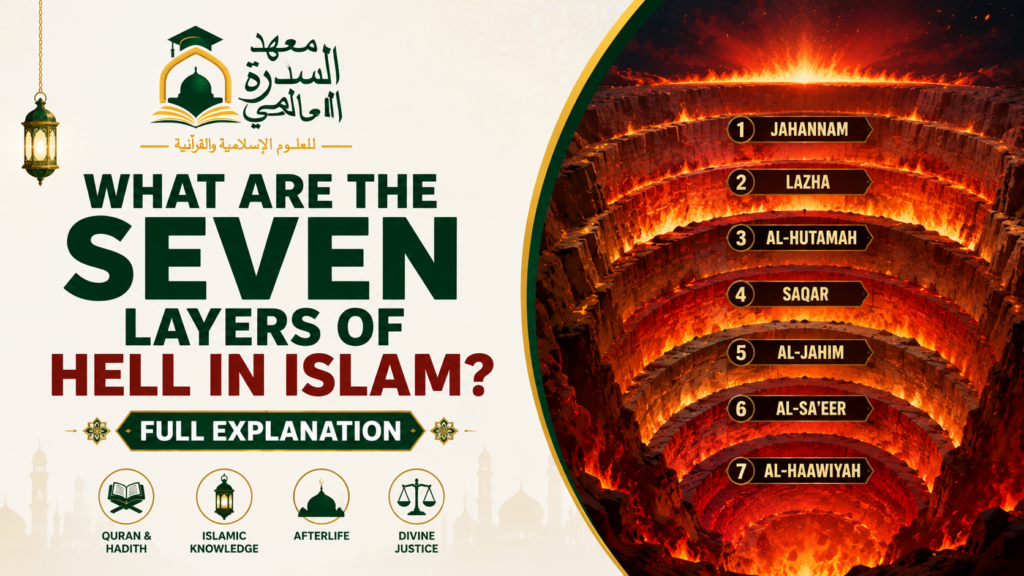
- Some scholars describe seven levels using Qur’anic names such as Jahannam, Lazaa, Hutamah, Saqar, Sa’eer, Jahim, and Hawiyah.
- The most severe punishment is for those who knowingly rejected faith and persisted in disbelief.
- Sinful believers may be punished temporarily if Allah wills, but sincere repentance can erase sins before death.
Featured Snippet Answer
The Qur’an states that Hell has seven gates (Qur’an 15:44). While many Islamic scholars discuss seven names or levels of Hell based on Qur’anic terminology, the Qur’an does not provide one definitive list of seven layers. Punishment in Jahannam varies according to a person’s beliefs, actions, and Allah’s perfect justice.
What Is Jahannam in Islam?
Jahannam is the Arabic name for Hell—the place of punishment prepared by Allah for those who reject Him, persist in disbelief, or commit grave sins without repentance, according to His judgment.
It is one of the central beliefs of Islamic creed (Aqidah) that both Jannah (Paradise) and Jahannam (Hell) are real creations of Allah.
The Qur’an describes Jahannam using powerful language to remind people of the consequences of disbelief, oppression, arrogance, hypocrisy, and persistent sin.
However, these descriptions are not meant to remove hope. Throughout the Qur’an, warnings about Hell are accompanied by reminders of Allah’s mercy and invitations to repent.
Key Characteristics of Jahannam
- A real place in the Hereafter.
- Created by Allah.
- Prepared for those who deserve punishment.
- Punishments vary according to deeds.
- Allah alone decides who is punished and for how long.
- His justice is always perfect, and His mercy is greater than anyone can fully comprehend.
Takeaway
Learning about Jahannam should strengthen faith, increase sincere repentance, and encourage obedience to Allah rather than create hopelessness.
Does the Qur’an Mention Seven Layers of Hell?
This is one of the most misunderstood aspects of the topic.
What the Qur’an Clearly Says
Allah says:
“Indeed, Hell is the promised place for them all. It has seven gates; for every gate is a portion of them designated.”
(Qur’an 15:43–44)
This verse explicitly mentions seven gates of Hell.
What the Verse Does Not Say
The verse does not explicitly state that Hell has “seven layers” or provide seven named levels in one place.
Instead, the Qur’an uses several different names when describing Hell, including:
- Jahannam
- Jahim
- Saqar
- Sa’eer
- Lazaa
- Hutamah
- Hawiyah
Because of these different names, some classical scholars discussed whether they describe separate levels or different descriptions of Hell.
Therefore, it is more accurate to say:
- The Qur’an clearly confirms seven gates.
- The commonly mentioned seven layers are based on scholarly interpretation rather than a single explicit Qur’anic list.
This distinction is important because Islamic teachings should always distinguish between what is directly revealed and what scholars infer from the texts.
Takeaway
When teaching this topic, it is best to avoid stating that the Qur’an explicitly lists seven layers. Instead, explain the scholarly views with honesty and evidence.
Seven Gates vs. Seven Layers: What Is the Difference?
Many people use these terms interchangeably, but they are not exactly the same.
| Seven Gates | Seven Layers |
| Explicitly mentioned in Qur’an (15:44). | Commonly discussed in classical scholarship. |
| Seven entrances assigned to different groups. | Often described as levels of punishment. |
| Clear Qur’anic evidence. | Interpretation based on Qur’anic terminology and tafsir. |
| Accepted by all Muslims because it is directly mentioned in the Qur’an. | Details may vary among scholars. |
Understanding this distinction helps avoid common misconceptions while remaining faithful to authentic Islamic sources.
Takeaway
The safest and most accurate wording is to say that the Qur’an confirms seven gates, while many scholars also discuss seven levels or layers based on Qur’anic descriptions of Hell.
The Commonly Mentioned Seven Layers (or Names) of Hell
Although the Qur’an does not present one complete list titled “the seven layers of Hell,” many classical Islamic scholars have discussed seven well-known names associated with Jahannam. These names appear in different Qur’anic passages and are often explained in books of tafsir.
The commonly cited names are:
| Common Name | Mentioned in the Qur’an | General Meaning |
| Jahannam | Yes | The general name for Hell. |
| Lazaa | Yes | A blazing flame that strips away the skin. |
| Hutamah | Yes | The crushing Fire that destroys completely. |
| Saqar | Yes | A fierce Fire described in Surah Al-Muddaththir. |
| Sa’eer | Yes | A blazing Fire prepared for those who reject Allah. |
| Jahim | Yes | An intensely burning Fire. |
| Hawiyah | Yes | A deep abyss described in Surah Al-Qari’ah. |
It is important to remember that these names are all found in the Qur’an. However, whether each one represents a separate “layer” or different descriptions of Hell is an issue on which scholars have expressed different views.
1. Jahannam
Jahannam is the most common Qur’anic name for Hell.
It appears many times throughout the Qur’an as the general destination for those whom Allah judges deserving of punishment.
In many verses, Jahannam serves as the overall name for Hell rather than one specific level.
Its repeated mention reminds believers that accountability after death is real and that every action has consequences.
Takeaway
Jahannam is best understood as the primary Qur’anic name for Hell.
2. Lazaa
Allah says:
“No! Indeed, it is the Flame (Lazaa), stripping away the scalp…”
(Qur’an 70:15–16)
The word Lazaa emphasizes the intense, blazing nature of the Fire.
The Qur’an uses vivid language here to warn against arrogance, greed, and turning away from Allah’s guidance.
The purpose of these descriptions is to awaken the heart—not simply to describe physical punishment.
3. Hutamah
Allah says:
“No! He will surely be thrown into the Hutamah. And what can make you know what the Hutamah is? It is the kindled Fire of Allah.”
(Qur’an 104:4–6)
Hutamah literally conveys the meaning of something that crushes or shatters completely.
In Surah Al-Humazah, this punishment is mentioned in connection with people who mocked others, spread slander, hoarded wealth, and believed their possessions would make them immortal.
The Qur’an highlights that worldly status and wealth cannot protect a person from Allah’s justice.
Lesson
A believer should guard both the tongue and the heart. Mockery, arrogance, and pride are serious sins that can lead to severe consequences if a person dies without repentance.
4. Saqar
Allah says:
“I will drive him into Saqar. And what can make you know what Saqar is? It lets nothing remain and leaves nothing untouched.”
(Qur’an 74:26–28)
Saqar is one of the most vividly described names of Hell in the Qur’an.
The surrounding verses mention people who rejected Allah’s revelations despite recognizing the truth.
The description emphasizes the completeness and severity of divine punishment.
Lesson
Rejecting guidance after knowingly recognizing it is far more serious than making mistakes out of ignorance.
5. Sa’eer
The Qur’an frequently mentions Sa’eer, meaning a blazing or fiercely burning Fire.
For example:
“Indeed, We have prepared for the disbelievers the Blaze (Sa’eer).”
(Qur’an 67:5)
The term stresses the intense nature of Hellfire and serves as a warning against persistent disbelief and rebellion against Allah.
Lesson
Islam teaches that guidance is a blessing. A believer should continuously ask Allah for steadfastness rather than becoming overconfident.
6. Jahim
Another Qur’anic name is Jahim, which refers to an intensely burning Fire.
Allah says:
“Indeed, the wicked will surely be in Jahim.”
(Qur’an 82:14)
The Qur’an often contrasts Jahim with the reward awaiting the righteous in Paradise.
This contrast reminds believers that every action has consequences and that Allah’s justice is perfect.
Lesson
Every act of obedience, no matter how small, has value in the sight of Allah.
7. Hawiyah
Allah says:
“Then his refuge will be Hawiyah. And what will make you know what it is? It is a scorching Fire.”
(Qur’an 101:9–11)
Hawiyah literally carries the meaning of a deep abyss or pit.
The verses appear after discussing people whose good deeds are light on the Day of Judgment.
The Qur’an teaches that success in the Hereafter depends upon sincere faith combined with righteous actions.
Lesson
A Muslim should strive to increase good deeds while sincerely repenting for shortcomings.
Summary Table of the Commonly Mentioned Names
| Name | Qur’anic Reference | General Description |
| Jahannam | Many verses | General name for Hell |
| Lazaa | 70:15–16 | Blazing flame |
| Hutamah | 104:4–9 | Crushing Fire |
| Saqar | 74:26–30 | Fierce consuming Fire |
| Sa’eer | 67:5 and others | Blazing Fire |
| Jahim | 82:14 and others | Intense Fire |
| Hawiyah | 101:9–11 | Deep abyss of Fire |
Important Note: These Qur’anic names are authentic. However, scholars differ on whether they represent separate levels, descriptive names, or different aspects of Jahannam. It is best not to present one interpretation as if it were explicitly stated in the Qur’an.
Who Will Enter Hell According to Islam?
Only Allah knows the final destination of every individual.
Islam strongly discourages declaring that a specific person is destined for Hell unless this has been explicitly stated in the Qur’an or authentic Sunnah.
Instead, the Qur’an describes categories of people whose actions may lead to punishment.
These include:
1. Those Who Reject Allah After the Truth Becomes Clear
Persistent disbelief (kufr) is repeatedly mentioned as a cause of punishment.
Allah says:
“Indeed, those who disbelieve and deny Our signs—they are the companions of the Fire.”
(See Qur’an 5:10 and similar verses.)
2. The Hypocrites (Nifaq)
The Qur’an gives a particularly severe warning regarding deliberate hypocrisy.
Allah says:
“Indeed, the hypocrites will be in the lowest depths of the Fire.”
(Qur’an 4:145)
This verse refers to those who outwardly claimed faith while secretly working against Islam.
3. Those Who Associate Partners with Allah (Shirk)
Allah warns against dying without repenting from shirk.
“Indeed, Allah does not forgive association with Him, but He forgives what is less than that for whom He wills.”
(Qur’an 4:48)
This verse emphasizes the seriousness of shirk while also highlighting Allah’s vast mercy regarding other sins.
4. Those Who Persist in Major Sins Without Repentance
The Qur’an warns against:
- Murder
- Oppression
- Theft
- Consuming usury (riba)
- Adultery
- False testimony
- Backbiting and slander
- Breaking trusts
However, warnings do not mean that every individual who commits these sins will certainly remain in Hell forever.
Allah alone judges every case with perfect justice.
Can Muslims Enter Hell?
This is one of the most frequently asked questions.
The short answer is:
Yes, according to mainstream Sunni belief, some sinful Muslims may enter Hell temporarily if Allah wills.
However, this requires careful explanation.
Believers Are Different from Disbelievers
A Muslim who sincerely believes in Allah and dies upon Tawhid is fundamentally different from someone who knowingly rejects faith.
A believer may still commit major sins.
If such a person dies without repentance:
- Allah may forgive them entirely.
- Allah may punish them temporarily.
- Allah may accept intercession for them.
- Allah may admit them directly into Paradise through His mercy.
All of these outcomes depend entirely on Allah’s wisdom and justice.
Authentic Hadith About Intercession
Numerous authentic narrations in Sahih al-Bukhari and Sahih Muslim describe that, after Allah grants permission for intercession, some believers who were punished in Hell will eventually be brought out and admitted into Paradise.
These narrations demonstrate two essential principles:
- Allah’s justice is perfect.
- Allah’s mercy is beyond human imagination.
Is Hell Eternal?
The answer depends on whom we are discussing.
| Group | Mainstream Sunni Understanding |
| Persistent disbelievers who die upon disbelief | Eternal punishment |
| Sinful believers | May be forgiven or punished temporarily before entering Paradise, if Allah wills |
This distinction is one of the central teachings of Sunni Aqidah.
Allah’s Justice and Mercy
One of the greatest mistakes people make is focusing only on Allah’s punishment while forgetting His mercy.
The Qur’an repeatedly combines both themes.
Allah warns about Hell because He wants people to turn back to Him before it is too late.
Every warning in the Qur’an is ultimately an invitation to repentance.
Allah says:
“Say, ‘O My servants who have transgressed against themselves, do not despair of the mercy of Allah. Indeed, Allah forgives all sins. Indeed, He is the Most Forgiving, the Most Merciful.'”
(Qur’an 39:53)
This verse is among the strongest reminders that no sinner should lose hope while they are still alive.
Common Misconceptions
Misconception 1
The Qur’an explicitly lists seven layers of Hell.
Correction:
No. The Qur’an explicitly mentions seven gates, while the commonly discussed seven levels come from scholarly interpretation of various Qur’anic names.
Misconception 2
Every Muslim who commits a major sin will definitely enter Hell.
Correction:
No.
Allah may forgive a believer, accept their repentance, or punish them temporarily according to His wisdom.
Misconception 3
There is no hope after committing major sins.
Correction:
As long as a person is alive, sincere repentance (Tawbah) remains open.
Allah’s mercy is greater than every sin for those who return to Him sincerely.
Key Takeaway
The purpose of learning about Jahannam is not to create despair, but to strengthen faith, encourage repentance, increase righteous deeds, and deepen awareness of Allah’s perfect justice and boundless mercy.
How Can a Muslim Avoid Hell According to Islam?
The Qur’an does not teach Muslims to live in constant fear alone. Instead, it encourages a balance between hope in Allah’s mercy and fear of His punishment. This balance motivates believers to obey Allah, avoid sin, and repent sincerely whenever they fall short.
The following are among the greatest means of seeking protection from Jahannam.
1. Believe in Allah with Sincere Tawhid
The foundation of salvation is believing in Allah alone without associating partners with Him.
A Muslim should strive to strengthen faith through:
- Learning the Qur’an.
- Understanding the pillars of faith.
- Avoiding shirk in all its forms.
- Trusting Allah in every situation.
Takeaway
Correct belief is the foundation upon which all good deeds are built.
2. Perform the Obligatory Acts of Worship
The five daily prayers, fasting in Ramadan, paying Zakah (when applicable), and performing Hajj (if able) are pillars of Islam that strengthen a believer’s relationship with Allah.
The Prophet ﷺ emphasized that prayer is one of the greatest protections for a believer.
Takeaway
Consistency in obligatory worship is more beloved to Allah than occasional acts of devotion.
3. Repent Sincerely (Tawbah)
Every human being sins.
What distinguishes a believer is not perfection but sincere repentance.
True Tawbah includes:
- Feeling genuine remorse.
- Stopping the sin.
- Resolving not to return to it.
- Restoring the rights of others if they were wronged.
Allah loves those who continually repent.
Takeaway
No sin is too great if a person sincerely turns back to Allah before death.
4. Increase Good Deeds
The Qur’an teaches that good deeds erase many sins.
Examples include:
- Daily prayers.
- Charity.
- Kindness to parents.
- Helping others.
- Reading the Qur’an.
- Remembering Allah (Dhikr).
- Seeking beneficial knowledge.
Small deeds performed consistently can have tremendous weight on the Day of Judgment.
5. Make Dua for Protection from Hell
The Prophet ﷺ regularly sought Allah’s protection from the Fire.
Among the beautiful supplications found in the Qur’an is:
“Our Lord, grant us good in this world and good in the Hereafter, and protect us from the punishment of the Fire.”
(Qur’an 2:201)
Making this dua regularly reminds believers to remain mindful of the Hereafter.
Practical Lessons Every Muslim Can Learn
Studying Jahannam is not merely about learning names or descriptions. It should inspire positive change.
Practical Applications
- Remember that every action matters.
- Never underestimate a small sin.
- Never lose hope in Allah’s mercy.
- Seek forgiveness every day.
- Treat people with kindness and justice.
- Increase acts of worship gradually and consistently.
- Prepare for the Hereafter while fulfilling responsibilities in this world.
Takeaway
The greatest benefit of learning about Hell is developing a stronger relationship with Allah and living a life of sincere obedience.
Key Differences at a Glance
| Topic | Authentic Islamic Teaching |
| Does Hell exist? | Yes. It is a real creation of Allah. |
| Does the Qur’an mention seven gates? | Yes (Qur’an 15:43–44). |
| Does the Qur’an explicitly list seven layers? | No. This is a scholarly interpretation of various Qur’anic names. |
| Can punishments differ? | Yes. Punishment varies according to Allah’s justice and a person’s deeds. |
| Can sinful Muslims enter Hell? | According to mainstream Sunni belief, some may be punished temporarily if Allah wills. |
| Is repentance accepted? | Yes, until death. Allah’s mercy remains open to those who sincerely repent. |
Common Misconceptions
Misconception: Jahannam and Naar are two different places.
Reality:
“Naar” literally means “Fire” and is often used in the Qur’an as a general term for Hellfire, while “Jahannam” is the primary proper name for Hell. They are not separate destinations.
Misconception: Every mention of Jahim, Saqar, or Hawiyah refers to a separate physical level.
Reality:
These names all appear in the Qur’an, but scholars have differed over whether they describe distinct levels, different names, or different aspects of Hell. The Qur’an itself does not settle this question explicitly.
Misconception: Fear of Hell should lead a Muslim to despair.
Reality:
Islam teaches a balance between fear and hope. Allah repeatedly invites sinners to repent and promises forgiveness for those who return to Him sincerely.
Frequently Asked Questions (FAQ)
1. What are the seven layers of Hell in Islam?
Many classical scholars mention seven names associated with Hell—Jahannam, Lazaa, Hutamah, Saqar, Sa’eer, Jahim, and Hawiyah. However, the Qur’an does not explicitly present them as one fixed list of seven layers.
2. Does the Qur’an mention seven layers of Hell?
No. The Qur’an explicitly mentions seven gates of Hell in Surah Al-Hijr (15:43–44). The idea of seven layers comes from scholarly interpretation of various Qur’anic descriptions.
3. What is the difference between Jahannam and Naar?
Jahannam is the primary name for Hell, while Naar means “Fire” and is frequently used as a descriptive term for Hellfire in the Qur’an.
4. Who will enter Hell according to Islam?
The Qur’an warns that those who die upon disbelief, hypocrisy, or other serious sins without repentance may face punishment. The final judgment belongs to Allah alone.
5. Can Muslims enter Hell?
According to mainstream Sunni belief, some sinful believers may be punished temporarily if Allah wills. Ultimately, Allah decides each person’s fate with perfect justice and mercy.
6. Is Hell eternal in Islam?
For those who die upon persistent disbelief, mainstream Sunni belief holds that punishment is eternal. Sinful believers, however, may be forgiven or punished temporarily before entering Paradise if Allah wills.
7. Are punishments the same for everyone?
No. The Qur’an teaches that punishment differs according to each person’s beliefs, intentions, and deeds. Allah’s judgment is perfectly just.
8. What is the safest way to avoid Hell?
Strengthen faith, perform obligatory acts of worship, avoid major sins, repent sincerely, and seek Allah’s mercy through righteous deeds and sincere supplication.
9. Why does the Qur’an describe Hell in such detail?
These descriptions are meant to warn people, encourage repentance, and remind them that actions in this life have consequences in the Hereafter.
10. Can repentance erase major sins?
Yes. The Qur’an teaches that Allah forgives those who sincerely repent before death. His mercy is vast, and no one should despair of it.
11. What is the purpose of learning about Jahannam?
Learning about Hell strengthens faith, increases accountability, encourages repentance, and reminds believers to strive for Allah’s pleasure and Paradise.
12. What should Muslims remember most about Hell?
Alongside Allah’s justice, Muslims should remember His immense mercy. Every warning in the Qur’an is also an invitation to return to Him with sincere repentance.
Key Takeaways
- The Qur’an clearly states that Hell has seven gates.
- The commonly mentioned “seven layers” are based on scholarly interpretation of Qur’anic names, not a single explicit Qur’anic list.
- Jahannam is real and is part of the Islamic belief in the Hereafter.
- Punishment in Hell differs according to Allah’s perfect justice.
- Mainstream Sunni belief distinguishes between the fate of persistent disbelievers and sinful believers.
- Allah’s mercy is always greater than despair, and sincere repentance remains open until death.
- Studying Jahannam should inspire greater faith, obedience, and hope in Allah rather than fear alone.
Conclusion
Belief in Jahannam is an essential part of the Islamic belief in the Hereafter. The Qur’an presents Hell as a real place of accountability while also emphasizing Allah’s unmatched mercy and willingness to forgive those who sincerely repent.
When discussing the seven layers of Hell in Islam, it is important to distinguish between what the Qur’an explicitly states and what scholars have inferred from its various descriptions. The Qur’an clearly mentions seven gates, while the well-known list of seven names is part of classical scholarly discussion rather than a direct Qur’anic list.
For every believer, the greatest lesson is not simply to learn the names associated with Hell, but to prepare for the Day of Judgment through sincere faith, righteous deeds, and continuous repentance. By seeking knowledge, following the guidance of the Qur’an and the authentic Sunnah, and placing our trust in Allah’s justice and mercy, we hope to be among those whom Allah admits into Jannah by His grace.
“Our Lord, grant us good in this world and good in the Hereafter and protect us from the punishment of the Fire.” (Qur’an 2:201)
Continue Your Quran Islamic Learning
To strengthen your understanding of Salah and Quran recitation, you may also find these topics helpful:
Related Articles
Caliphate of Umar ibn al-Khattab (RA): Complete History
Dreams in Islam and the Unseen: Meaning, Types & Explained
What Are Jinn in Islam? Meaning, Creation, Types & Quranic Facts
Difference Between Eid al-Fitr and Eid al-Adha Explained
Sunnahs of Eid al-Adha: Complete Authentic Guide (2026)
Recommended Courses
By combining authentic knowledge with regular practice, you can continue building a stronger connection with Allah and perform your daily prayers with confidence, understanding, and devotion.