
Introduction
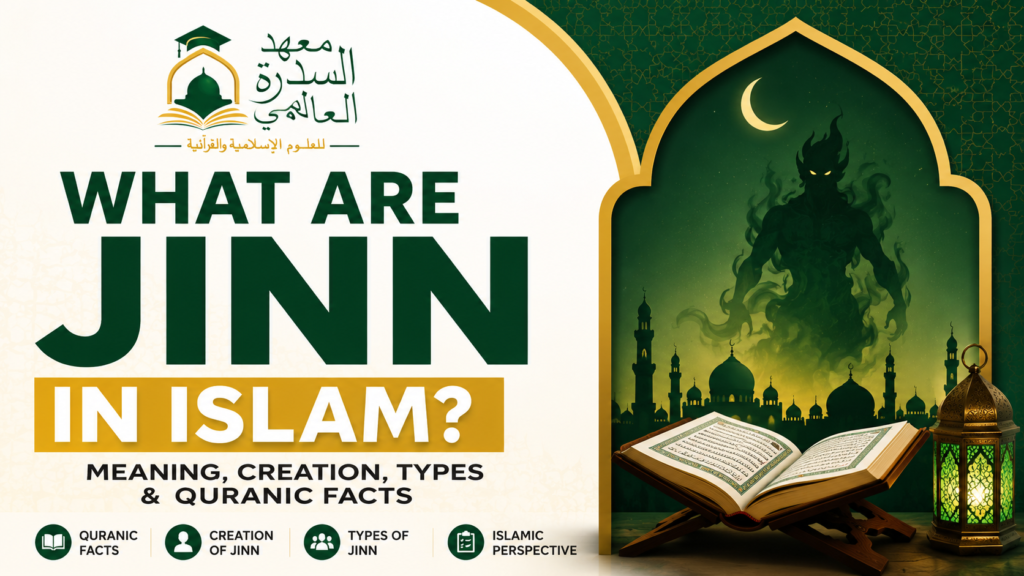
Many people have heard stories about jinn through movies, folklore, or social media. Some believe they are ghosts, demons, or supernatural creatures that exist only in myths. Islam, however, presents a clear and balanced understanding of jinn based on the Quran and the authentic Sunnah. Rather than encouraging fear or superstition, Islam teaches Muslims to believe in jinn as one of Allah’s real creations while avoiding exaggerated or unsupported claims.
Belief in jinn is part of believing in the unseen (Al-Ghayb), one of the characteristics of true believers mentioned in the Quran. Like humans and angels, jinn were created by Allah for a specific purpose. They have intelligence, free will, and accountability. Some obey Allah and become righteous believers, while others reject His guidance and become disbelievers.
This guide explains who the jinn are, how they were created, why Allah created them, whether they have free will, and what every Muslim should know according to authentic Islamic teachings.
Quick Answer
Jinn are one of Allah’s creations mentioned throughout the Quran. Allah created them from smokeless fire before creating humans from clay. Unlike angels, jinn have free will, meaning they can choose to believe or disbelieve, obey or disobey Allah. Some jinn are righteous Muslims, while others are disbelievers and devils (shayatin). Although humans generally cannot see them, jinn are real and are part of the unseen world. Muslims believe in their existence because Allah and His Messenger ﷺ informed us about them.
Key Takeaway:
Jinn are neither myths nor imaginary beings. They are a real creation of Allah with responsibilities similar to humans.
Featured Snippet
What are jinn in Islam?
Jinn are invisible creatures created by Allah from smokeless fire. They possess free will, worship Allah, and are accountable for their deeds just like humans. Some jinn are believers, while others reject faith. Their existence is confirmed in the Quran and authentic Hadith, making belief in them part of Islamic faith.
What Are Jinn?
The word jinn refers to a hidden or unseen creation of Allah. They live in a world that normally remains invisible to humans. Although we cannot usually see them, they are real beings with thoughts, emotions, and responsibilities.
Islam teaches that Allah created three major intelligent creations:
| Creation | Created From | Free Will |
| Angels | Light | No |
| Jinn | Smokeless fire | Yes |
| Humans | Clay | Yes |
Unlike angels, who always obey Allah, both humans and jinn have the freedom to choose between obedience and disobedience. Because of this choice, they will both be judged on the Day of Judgment.
The Quran repeatedly mentions jinn, including an entire chapter named Surah Al-Jinn, showing that their existence is an established part of Islamic belief.
Key Takeaway:
Jinn are intelligent, accountable beings created by Allah and are not comparable to ghosts or fictional monsters.
What Does the Word “Jinn” Mean?
The Arabic word jinn (الجن) comes from the root ج ن ن (j-n-n), which carries the meaning of to hide, conceal, or cover.
This linguistic meaning helps explain why they are called jinn—they are hidden from ordinary human sight.
The same Arabic root appears in several other words:
- Jannah – a garden whose trees cover the ground.
- Janin – an unborn child hidden in the womb.
- Majnun – someone whose mind is considered hidden or disturbed.
This does not mean jinn are imaginary. Rather, it describes their unseen nature.
The Quran teaches that humans generally cannot see jinn, although Allah has given them the ability to see us under normal circumstances.
Key Takeaway:
The name “jinn” reflects their hidden nature, not that they are mythical or fictional.
How Were Jinn Created?
Allah clearly tells us how jinn were created.
In Surah Al-Hijr (15:27), Allah says that He created the jinn before mankind from the fire of a scorching wind.
Similarly, Surah Ar-Rahman (55:15) states that Allah created the jinn from a smokeless flame of fire.
These verses establish an important difference between Allah’s creations:
- Humans were created from clay.
- Angels were created from light (as explained in authentic Hadith).
- Jinn were created from smokeless fire.
Although they were created from fire, this does not mean they are constantly made of visible flames. Just as humans are created from clay but are not lumps of clay today, jinn exist in a form that Allah has given them.
Islam does not describe every detail of their physical appearance because such knowledge belongs to the unseen.
Key Takeaway:
Allah created jinn from smokeless fire before creating humans, but their exact physical nature remains part of the unseen.
Why Did Allah Create Jinn?
Many people wonder whether jinn were created simply to test or frighten humans. The Quran gives a much deeper answer.
Allah says:
“I did not create jinn and mankind except that they should worship Me.”
(Surah Adh-Dhariyat 51:56)
This verse shows that both humans and jinn share the same primary purpose:
- To worship Allah alone.
- To obey His commands.
- To avoid associating partners with Him.
- To prepare for the Hereafter.
Just as prophets were sent to humans, Allah also conveyed guidance to the jinn. The Quran mentions that groups of jinn listened attentively to the recitation of the Prophet Muhammad ﷺ, believed in the message, and returned to their people to invite them to Islam.
This demonstrates that jinn, like humans, are morally responsible for their choices.
Key Takeaway:
The purpose of creating jinn is the same as the purpose of creating humans—to worship Allah sincerely and live according to His guidance.
Do Jinn Have Free Will?
One of the most important differences between angels and jinn is free will.
Allah has given jinn the ability to choose between belief and disbelief. They can obey Allah, repent from sins, and perform righteous deeds, or they can reject faith and commit wrongdoing.
The Quran records the words of believing jinn in Surah Al-Jinn, where they declare their belief after hearing the Quran. Other verses mention that among the jinn are both righteous and unrighteous individuals.
This means:
- Some jinn are Muslims.
- Some are non-Muslims.
- Some are obedient.
- Some are rebellious.
- Some invite others to goodness.
- Others spread corruption.
Like humans, every jinn will stand before Allah on the Day of Judgment and be rewarded or punished according to their deeds.
Understanding this helps Muslims avoid the common misconception that all jinn are evil. Islam teaches that jinn, like humans, are individuals with different beliefs and choices.
Key Takeaway:
Jinn possess free will and are accountable before Allah. Not every jinn is evil, just as not every human is righteous.
Recap: In Part 1, we learned that jinn are a real creation of Allah, created from smokeless fire, given free will, and created to worship Allah. In this section, we’ll answer some of the most common questions about jinn and compare them with shaytan and angels according to authentic Islamic teachings.
Are All Jinn Evil?
One of the biggest misconceptions about jinn is that every jinn is evil. This belief is not supported by the Quran.
Islam teaches that jinn, like humans, have free will. As a result, they are not all the same. Some are righteous believers who worship Allah, while others reject His guidance and spread corruption.
In Surah Al-Jinn, a group of jinn listened to the Quran recited by Prophet Muhammad ﷺ. They believed in Allah and accepted Islam, then returned to their own people to call them toward faith.
The Quran also mentions that among the jinn are:
- Believing jinn
- Disbelieving jinn
- Righteous jinn
- Wrongdoers
- Those who submit to Allah
- Those who choose rebellion
This balanced view prevents Muslims from assuming that every unexplained event is caused by evil jinn.
Key Takeaway
Not every jinn is evil. Just as humans differ in faith and character, jinn also include both believers and disbelievers.
Muslim and Non-Muslim Jinn
Since jinn have free will, they can choose whether or not to believe in Allah.
Muslim Jinn
Believing jinn:
- Worship Allah.
- Follow His commands.
- Believe in the prophets.
- Accept the Quran.
- Will be rewarded in the Hereafter.
Non-Muslim Jinn
Disbelieving jinn:
- Reject Allah’s guidance.
- Follow falsehood.
- May encourage humans toward sin.
- Will be held accountable on the Day of Judgment.
This demonstrates Allah’s perfect justice. Both humans and jinn are responsible for the choices they make.
Key Takeaway
The jinn community includes believers and disbelievers, just like the human community.
What Types of Jinn Are Mentioned in Islam?
The Quran does not provide a detailed classification of every type of jinn. Instead, it focuses on their beliefs, actions, and accountability.
Islamic sources generally describe jinn in broad categories:
1. Believing Jinn
These jinn obey Allah and strive to live according to His guidance.
Characteristics include:
- Faith in Allah
- Worship
- Obedience
- Righteous conduct
2. Disbelieving Jinn
These jinn reject Allah’s commands.
Some may mislead humans through whispers and temptation, similar to the role of the devils (shayatin).
3. Shayatin (Devils)
The word shaytan describes those who are rebellious against Allah.
Not every jinn is a shaytan.
However, every shaytan from among the jinn is rebellious.
This distinction is important because many people mistakenly use the words interchangeably.
Key Takeaway
“Jinn” refers to the entire creation, while “shaytan” refers to the rebellious among them.
Where Do Jinn Live?
The Quran and authentic Sunnah do not provide a complete map of where jinn live. However, Islamic teachings indicate that they inhabit the earth alongside humans while remaining in a world generally hidden from our sight.
Authentic narrations suggest that jinn may be found in places such as:
- Deserts
- Ruins
- Remote areas
- Mountains
- Certain unclean places
However, this does not mean every abandoned building or dark place contains jinn.
Islam discourages speculation without evidence.
Muslims should avoid spreading stories based on fear or superstition.
Key Takeaway
Jinn live on the earth, but their exact locations are part of the unseen. Muslims should avoid making claims without authentic evidence.
Can Jinn See Humans?
The Quran indicates that jinn are generally able to see humans while humans cannot normally see them.
Allah says in Surah Al-A’raf (7:27) that Satan and his tribe see people from where humans cannot see them.
This verse teaches that:
- Jinn have abilities different from humans.
- Their unseen nature is part of Allah’s creation.
- Humans should rely on Allah for protection rather than fear.
Key Takeaway
Jinn may see humans under normal circumstances, but humans generally cannot see jinn.
Can Humans See Jinn?
Under ordinary circumstances, humans cannot see jinn.
Their hidden nature is one of the reasons they are called “jinn.”
Islam does not encourage Muslims to seek encounters with jinn or attempt to communicate with them.
Claims of regularly seeing or speaking with jinn should be approached with caution and should not become the basis of Islamic belief.
Our religion is built upon authentic revelation—not personal experiences or sensational stories.
Key Takeaway
Muslims believe in jinn because Allah informed us about them, not because we can normally see them.
What Powers Do Jinn Have?
The Quran mentions that Allah has given jinn certain abilities beyond those of humans.
However, these abilities are limited.
Jinn cannot do whatever they wish, nor do they possess independent power.
Everything happens only by Allah’s permission.
Some abilities mentioned in authentic Islamic sources include:
- Moving quickly
- Traveling over long distances
- Whispering evil suggestions (waswasah)
- Taking on different forms (according to authentic narrations)
At the same time, they have important limitations:
- They do not know the unseen independently.
- They cannot escape Allah’s decree.
- They will die like humans.
- They will be judged by Allah.
Many exaggerated stories about supernatural powers have no authentic basis in Islam.
Key Takeaway
Jinn possess abilities beyond humans, but they remain Allah’s creation and cannot act independently of His will.
Difference Between Jinn and Shaytan
Understanding this distinction removes one of the most common misconceptions.
| Jinn | Shaytan |
| A complete creation of Allah | A rebellious jinn (or one who acts rebelliously) |
| Can be believers or disbelievers | Always rebellious against Allah |
| Have free will | Use free will to disobey Allah |
| Some are righteous | Encourage evil and sin |
| Will be judged by Allah | Will also be judged by Allah |
Simple Explanation
Every shaytan is from the rebellious among the jinn, but not every jinn is a shaytan.
Key Takeaway
The words jinn and shaytan are not synonyms. One describes the creation; the other describes rebellion.
Difference Between Jinn and Angels
Many beginners confuse angels with jinn, but they are entirely different creations.
| Angels | Jinn |
| Created from light | Created from smokeless fire |
| Always obey Allah | Have free will |
| Never sin | Can obey or disobey |
| Do not rebel | Some rebel |
| Carry out Allah’s commands | Accountable for their choices |
| Do not eat or marry according to Islamic teachings | Have communities and descendants |
Key Takeaway
Angels never disobey Allah, while jinn have the freedom to choose obedience or disobedience.
Who Was Iblis?
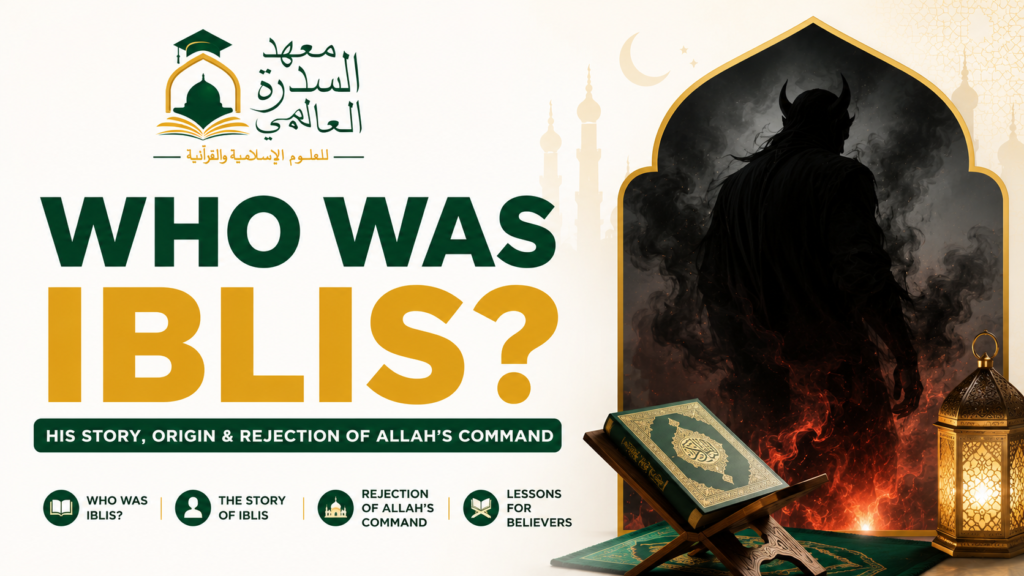
One of the most frequently asked questions is whether Iblis was an angel.
The Quran gives a clear answer.
When Allah commanded the angels to prostrate to Adam (AS), Iblis refused out of arrogance.
The Quran explains that Iblis was one of the jinn, not one of the angels.
His refusal was the result of pride and disobedience.
Because angels do not disobey Allah, Iblis could not have been an angel.
After rejecting Allah’s command, Iblis became the leader of those who seek to mislead humanity until the Day of Judgment.
His goal is to tempt people away from faith through whispers, deception, and sinful desires.
However, his influence is limited.
He cannot force anyone to commit sin. Every human remains responsible for his or her own choices.
Key Takeaway
Iblis was a jinn who became rebellious through pride and disobedience. He is not an angel.
What Does Surah Al-Jinn Teach?
One of the strongest proofs for the existence of jinn is Surah Al-Jinn (Chapter 72). This chapter records the response of a group of jinn after they listened to the Quran being recited by Prophet Muhammad ﷺ.
When they heard the Quran, they recognized that it was the truth and immediately believed in Allah. They returned to their people and invited them to faith.
Surah Al-Jinn teaches several important lessons:
- Jinn can hear and understand the Quran.
- Some jinn sincerely accept Islam.
- Jinn are accountable for their actions.
- Like humans, they will be rewarded or punished in the Hereafter.
- The Quran is guidance for all morally responsible beings.
This chapter reminds Muslims that guidance comes from Allah alone and that sincere hearts—whether human or jinn—can recognize the truth.
Key Takeaway
Surah Al-Jinn emphasizes that jinn are responsible servants of Allah who can choose faith, worship Him, and invite others to His guidance.
Common Myths About Jinn vs. Authentic Islamic Teachings
Many beliefs about jinn come from folklore, movies, and cultural traditions rather than authentic Islamic sources. It is important to separate myths from what the Quran and Sunnah actually teach.
| Common Myth | Authentic Islamic Teaching |
| Every jinn is evil. | No. Some jinn are believers and righteous. |
| Jinn know the unseen. | Only Allah has complete knowledge of the unseen. |
| Every strange sound is caused by jinn. | Islam does not support such assumptions without evidence. |
| Jinn can control everything. | Jinn have limited abilities and remain under Allah’s authority. |
| Muslims should constantly fear jinn. | Muslims should fear Allah alone and rely on Him for protection. |
| Movies accurately portray jinn. | Entertainment often exaggerates or fabricates stories about jinn. |
Key Takeaway
Islam encourages knowledge based on revelation, not superstition or fear.
Can Jinn Harm Humans?
This is one of the most searched questions on the internet.
The balanced Islamic answer is:
Yes, harm from jinn is possible by Allah’s permission, but Muslims should neither deny authentic evidence nor exaggerate the issue.
Islam teaches that:
- Allah alone has absolute power.
- No creation can harm or benefit anyone except by Allah’s permission.
- Many problems people attribute to jinn may have natural, medical, or psychological causes.
- Muslims should avoid assuming that every illness, nightmare, or difficulty is caused by jinn.
The Quran teaches believers to place their trust in Allah while taking appropriate religious and practical means.
A Balanced Approach
Avoid two extremes:
❌ Denying the existence or abilities of jinn altogether.
❌ Blaming every unexplained event on jinn.
The middle path taught in Islam is to believe what Allah and His Messenger ﷺ informed us, without adding speculation.
Key Takeaway
Muslims acknowledge the reality of jinn but avoid fear, superstition, and unsupported claims.
Can Jinn Possess Humans?
Islamic scholars have discussed this subject based on Quranic verses and authentic narrations. The mainstream position among many classical scholars is that possession can occur by Allah’s permission, although it is not something that should be assumed whenever unusual behavior is observed.
Modern medical and psychological conditions should never be dismissed without proper evaluation. Islam encourages seeking appropriate medical treatment while also turning to Allah through prayer and authentic spiritual practices.
The safest approach is:
- Do not jump to conclusions.
- Avoid unqualified individuals claiming supernatural knowledge.
- Seek authentic Islamic guidance.
- Seek professional medical help when needed.
- Trust Allah in every situation.
Key Takeaway
Islam teaches balance, wisdom, and reliance on authentic evidence rather than sensational claims.
How Can Muslims Protect Themselves from Harmful Jinn?
Islam provides simple and authentic ways to seek Allah’s protection.
Protection comes from Allah—not from charms, amulets, or superstitious practices.
1. Recite Ayat al-Kursi
Authentic narrations mention the virtue of reciting Ayat al-Kursi, especially before sleeping.
2. Read Surah Al-Ikhlas, Al-Falaq, and An-Nas
The Prophet ﷺ regularly recited these chapters for protection.
3. Maintain Morning and Evening Adhkar
Daily remembrance of Allah strengthens a believer’s relationship with Him and includes authentic supplications seeking His protection.
4. Say “Bismillah”
The Prophet ﷺ taught Muslims to mention Allah’s name before:
- Entering the home
- Eating
- Drinking
- Beginning important actions
5. Read Surah Al-Baqarah
Authentic hadith mention the virtues of reciting Surah Al-Baqarah in the home.
6. Strengthen Tawakkul (Trust in Allah)
A believer’s greatest protection is sincere faith, regular worship, and complete reliance upon Allah.
Practices to Avoid
Islam discourages seeking protection through:
- Amulets (unless there is scholarly discussion on permissible written Quranic verses; many scholars discourage this)
- Fortune tellers
- Magicians
- Superstitions
- Calling upon jinn
- Attempting to communicate with unseen beings
True protection is found through worship, remembrance, and obedience to Allah.
Key Takeaway
The strongest shield against harmful jinn is sincere faith, authentic remembrance, and following the guidance of the Quran and Sunnah.
Practical Lessons Every Muslim Can Learn
Understanding jinn should increase faith—not fear.
Some important lessons include:
- Believe in the unseen because Allah informed us about it.
- Avoid myths and exaggerated stories.
- Learn Islam from authentic sources.
- Remember that every creation is under Allah’s control.
- Focus on worship rather than curiosity about the unseen.
- Maintain daily adhkar and Quran recitation.
- Trust Allah during times of fear or uncertainty.
The purpose of learning about jinn is not to become fascinated by the unseen but to strengthen our belief in Allah and prepare for the Hereafter.
Key Takeaways
- Jinn are a real creation of Allah.
- They were created from smokeless fire.
- They possess free will.
- Some are believers while others are disbelievers.
- Iblis was one of the jinn, not an angel.
- Jinn are different from shaytan.
- Islam rejects myths and superstition.
- Allah alone controls all creation.
- Muslims protect themselves through authentic Quranic recitation, remembrance, and trust in Allah.
Conclusion
Belief in jinn is part of the Islamic belief in the unseen. The Quran and authentic Sunnah provide a balanced understanding that neither exaggerates their powers nor denies their existence. Like humans, jinn are servants of Allah who were created to worship Him and will be judged according to their deeds.
Rather than fearing jinn because of stories or cultural myths, Muslims should focus on what Allah has revealed. Learning authentic Islamic teachings helps replace uncertainty with knowledge and fear with trust in Allah.
The best protection is not superstition but sincere worship, regular remembrance of Allah, recitation of the Quran, and following the guidance of Prophet Muhammad ﷺ. When a Muslim strengthens faith and reliance upon Allah, they gain confidence, peace of mind, and a clearer understanding of the unseen world as taught in Islam.
Continue Your Quran Islamic Learning
To strengthen your understanding of Salah and Quran recitation, you may also find these topics helpful:
Related Articles
Difference Between Eid al-Fitr and Eid al-Adha Explained
Sunnahs of Eid al-Adha: Complete Authentic Guide (2026)
What Is the Connection Between Hajj and Eid al-Adha?
Who Compiled the Quran Into a Book? Complete History
Can You Chew Gum While Fasting? Islamic Ruling Explained
Recommended Courses
By combining authentic knowledge with regular practice, you can continue building a stronger connection with Allah and perform your daily prayers with confidence, understanding, and devotion.