
Introduction
Every Surah in the Holy Quran has a unique purpose, but Surah Al-Fatiha holds a special place in Islam. It is the opening chapter of the Quran, the foundation of every unit of Salah, and one of the most frequently recited passages in a Muslim’s daily life.
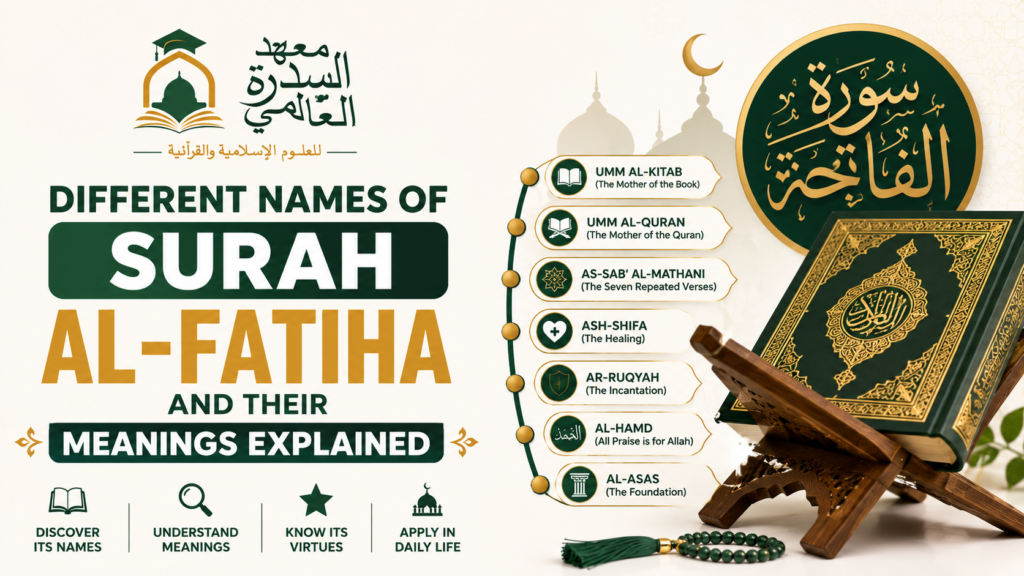
What makes Surah Al-Fatiha even more remarkable is that it is known by many different names. Each name highlights a unique quality, virtue, or role of this blessed Surah. Some names come directly from the Quran or authentic Hadith, while others were given by classical Islamic scholars to describe its importance and meanings.
Understanding these names helps Muslims appreciate why Surah Al-Fatiha is regarded as one of the greatest chapters of the Quran. Rather than being different Surahs, these titles all refer to the same chapter, with each name emphasizing a different aspect of its significance in worship, guidance, healing, and faith.
In this guide, you’ll learn the authentic names of Surah Al-Fatiha, what each one means, why it was given that title, and what Muslims can learn from every name.
Quick Answer
Surah Al-Fatiha has several well-known names in Islamic tradition, including Al-Fatiha, Umm Al-Kitab, Umm Al-Quran, As-Sab’ Al-Mathani, Al-Hamd, Ash-Shifa, Ar-Ruqyah, Al-Asas, Al-Kafiyah, and Al-Wafiyah.
Each name reflects a unique characteristic of the Surah. Some emphasize its role as the opening of the Quran, others highlight its importance in Salah, while some refer to its spiritual healing, comprehensive guidance, and central place in Islamic worship.
What are the different names of Surah Al-Fatiha?
Surah Al-Fatiha is known by several names in the Quran, authentic Hadith, and classical Islamic scholarship. The most well-known include Al-Fatiha, Umm Al-Kitab, Umm Al-Quran, As-Sab’ Al-Mathani, Al-Hamd, Ash-Shifa, Ar-Ruqyah, Al-Asas, Al-Kafiyah, and Al-Wafiyah. Each title highlights a different virtue, meaning, or role of this blessed chapter.
What Is Surah Al-Fatiha?
Surah Al-Fatiha is the first chapter of the Holy Quran and consists of seven verses. It was revealed in Makkah, making it a Makki Surah according to the majority of scholars.
It serves as the introduction to the Quran and summarizes many of the central themes of Islam, including:
- Belief in Allah (SWT)
- His mercy and lordship
- Worship and sincerity
- Seeking guidance
- Following the straight path
- Avoiding misguidance
Every Muslim recites Surah Al-Fatiha in every unit (Rak’ah) of Salah, making it the most frequently recited chapter of the Quran.
Key Takeaway: Surah Al-Fatiha is both the opening chapter of the Quran and the foundation of every Muslim’s daily prayer.
Why Does Surah Al-Fatiha Have So Many Names?
One of the beautiful features of the Arabic language is that something honorable is often known by multiple names. In Islamic tradition, many respected people, places, and acts of worship have more than one title.
Surah Al-Fatiha is no exception.
Scholars explain that each name describes a specific quality of the Surah rather than referring to a different chapter. Its numerous names reflect its comprehensive role in a Muslim’s life—as a prayer, a source of guidance, a means of healing, and the essence of the Quran’s message.
The more virtues a thing possesses, the more descriptive names it may have. This is why Surah Al-Fatiha has been honored with multiple titles throughout Islamic history.
Key Takeaway: Every name of Surah Al-Fatiha highlights a unique aspect of its greatness rather than representing a separate Surah.
Different Names of Surah Al-Fatiha and Their Meanings
| Name | Literal Meaning | Why It Is Called This |
| Al-Fatiha | The Opening | It opens the Holy Quran and begins every prayer. |
| Umm Al-Kitab | Mother of the Book | It summarizes the main teachings of the Quran. |
| Umm Al-Quran | Mother of the Quran | It contains the core message of the Quran. |
| As-Sab’ Al-Mathani | The Seven Oft-Repeated Verses | It consists of seven verses recited repeatedly in Salah. |
| Al-Hamd | The Praise | It begins with praising Allah: Alhamdu lillahi Rabbil-‘Alamin. |
| Ash-Shifa | The Healing | It is recited for spiritual healing through Allah’s permission. |
| Ar-Ruqyah | The Spiritual Cure | Authentic Hadith mention its use in Ruqyah. |
| Al-Asas | The Foundation | It forms the foundation of Islamic worship and prayer. |
| Al-Kafiyah | The Sufficient | It is indispensable in Salah and cannot be replaced by another Surah. |
| Al-Wafiyah | The Complete | It should be recited in full during prayer. |
Which Names Are Mentioned in the Quran or Authentic Hadith?
Not every commonly used name has the same level of textual evidence. Some are explicitly mentioned in the Quran or authentic Hadith, while others became well known through classical scholars because they accurately describe the Surah.
| Name | Quran | Hadith | Scholarly Usage |
| Al-Fatiha | ✔ | ✔ | ✔ |
| Umm Al-Kitab | ✔ | ✔ | ✔ |
| Umm Al-Quran | — | ✔ | ✔ |
| As-Sab’ Al-Mathani | ✔ | ✔ | ✔ |
| Ash-Shifa | — | Supported through authentic reports regarding its healing role | ✔ |
| Ar-Ruqyah | — | ✔ | ✔ |
| Al-Hamd | — | ✔ | ✔ |
| Al-Asas | — | Scholarly title | ✔ |
| Al-Kafiyah | — | Scholarly title | ✔ |
| Al-Wafiyah | — | Scholarly title | ✔ |
Note: Some names are descriptive titles used by respected scholars rather than formal names explicitly mentioned in the Quran.
Why These Names Matter
Learning these names is more than memorizing terminology.
Each title teaches an important lesson:
- Al-Fatiha reminds us that every good beginning starts with Allah.
- Umm Al-Kitab shows that the Surah summarizes the Quran’s message.
- As-Sab’ Al-Mathani highlights its central place in every Salah.
- Ash-Shifa teaches us that true healing comes from Allah.
- Ar-Ruqyah reminds us of the importance of Quranic supplications.
- Al-Asas emphasizes that faith is built upon sincere worship.
- Al-Hamd begins with gratitude before asking Allah for guidance.
Together, these names reveal why Surah Al-Fatiha is often described by scholars as the heart of a Muslim’s daily worship.
Detailed Explanation of Each Name
The names of Surah Al-Fatiha are not merely honorary titles. Every name reflects one of its unique qualities, virtues, or roles in the life of a believer. Understanding these names deepens our appreciation of this remarkable Surah and helps us recite it with greater reflection during Salah.
In the next section, we’ll explain each authentic name individually, including:
- its Arabic meaning,
- why it was given,
- supporting Quran or Hadith evidence where applicable,
- and the practical lesson Muslims can learn from it.
Detailed Explanation of the Different Names of Surah Al-Fatiha
Each name of Surah Al-Fatiha highlights a unique aspect of its greatness. Some names are found in the Quran or authentic Hadith, while others were used by classical scholars because they accurately describe the Surah’s role in Islam.
1. Al-Fātiḥah (الفاتحة) — The Opening
Meaning: The Opening
This is the most well-known and universally accepted name of the Surah. The Arabic word “Fātiḥah” comes from the root f-t-h (فتح), meaning to open.
It is called Al-Fātiḥah because:
- It is the opening chapter of the Holy Quran.
- Every written copy of the Quran begins with it.
- It opens every Rak’ah of Salah.
- It serves as the gateway to understanding the message of the Quran.
Although the Quran itself does not explicitly call it “Al-Fātiḥah,” this name is well established in authentic Hadith and has been accepted by Muslim scholars throughout history.
Practical Lesson
Just as every prayer begins with Al-Fātiḥah, every believer should begin important matters by remembering Allah and seeking His guidance.
Takeaway: Al-Fātiḥah teaches us that every meaningful beginning should start with the remembrance of Allah.
2. Umm Al-Kitāb (أم الكتاب) — The Mother of the Book
Meaning: The Mother of the Book
One of the most honored names of Surah Al-Fātiḥah is Umm Al-Kitāb.
In Arabic, the word “Umm” (Mother) often refers to the origin, foundation, or essence of something—not merely motherhood in the biological sense.
Surah Al-Fātiḥah is called Umm Al-Kitāb because it contains the fundamental themes of the Quran:
- Tawḥīd (belief in the Oneness of Allah)
- Worship
- Mercy
- Guidance
- Accountability
- Supplication
- The Straight Path
Many scholars explain that the rest of the Quran expands upon the principles introduced in Al-Fātiḥah.
Why This Name Is Significant
When Muslims understand Surah Al-Fātiḥah, they gain a framework for understanding the entire Quran.
Takeaway: Umm Al-Kitāb reminds us that the essential teachings of the Quran begin with Surah Al-Fātiḥah.
3. Umm Al-Qur’an (أم القرآن) — The Mother of the Quran
Meaning: The Mother of the Quran
This title is closely related to Umm Al-Kitāb, but it specifically emphasizes that Al-Fātiḥah contains the central message of the Quran.
The Surah introduces every major theme found throughout the Quran, including:
- Allah’s Lordship
- His Mercy
- Worship
- Seeking Help
- Guidance
- The Hereafter
- The Straight Path
The Prophet ﷺ referred to Al-Fātiḥah by this name in authentic narrations, highlighting its unique status among all chapters of the Quran.
Practical Lesson
Whenever you recite Al-Fātiḥah, remember that you are reciting a summary of the Quran’s central message.
Takeaway: Umm Al-Qur’an teaches that the Quran’s guidance begins with sincere worship and seeking Allah’s direction.
4. As-Sab’ Al-Mathānī (السبع المثاني) — The Seven Oft-Repeated Verses
Meaning: The Seven Oft-Repeated Verses
This is one of the names mentioned directly in the Quran.
Allah says:
“And We have certainly given you seven of the oft-repeated verses and the Great Quran.”
(Surah Al-Hijr 15:87)
The majority of classical scholars explain that the phrase “Seven Oft-Repeated Verses” refers to Surah Al-Fātiḥah.
It receives this name because:
- It contains seven verses.
- It is repeated in every Rak’ah of Salah.
- Muslims recite it many times every day.
No other Surah is recited as consistently in daily worship.
Practical Lesson
Repetition in Islam is not meaningless repetition. Every recitation is an opportunity to renew sincerity, gratitude, and reliance on Allah.
Takeaway: Every repetition of Al-Fātiḥah is a renewed conversation with Allah.
5. Al-Ḥamd (الحمد) — The Praise
Meaning: The Praise
This name comes from the opening words of the Surah:
“All praise belongs to Allah, Lord of all the worlds.”
Because the Surah begins with praise, scholars commonly refer to it as Al-Ḥamd.
Unlike ordinary praise directed toward people, Al-Ḥamd signifies complete and perfect praise reserved exclusively for Allah.
This opening verse teaches Muslims an important principle:
Before asking Allah for anything, begin by praising Him.
Practical Lesson
Gratitude opens the heart and strengthens faith. Starting our prayers with praise reminds us of Allah’s countless blessings before we present our needs.
Takeaway: Al-Ḥamd teaches believers to begin every supplication with gratitude.
6. Ash-Shifā’ (الشفاء) — The Healing
Meaning: The Healing
Among the beautiful names of Surah Al-Fātiḥah is Ash-Shifā’, meaning the Healing.
This title reflects the Surah’s role as a means of spiritual healing by Allah’s permission.
Authentic Hadith describe companions of the Prophet ﷺ reciting Surah Al-Fātiḥah as Ruqyah for a man who had been bitten by a poisonous creature. By Allah’s will, he recovered.
Because of this authentic incident, scholars recognized Al-Fātiḥah as one of the greatest chapters for seeking healing from Allah.
It is important to understand that:
- Healing comes from Allah alone.
- The Quran is a means of healing.
- Surah Al-Fātiḥah is not a magical formula.
- Muslims place their trust in Allah while using the Quran as a source of spiritual benefit.
Practical Lesson
When facing illness, anxiety, or hardship, believers turn to Allah sincerely while reciting His words with faith.
Takeaway: Ash-Shifā’ reminds us that ultimate healing belongs to Allah, and the Quran is among His greatest blessings.
7. Ar-Ruqyah (الرقية) — The Spiritual Cure
Meaning: The Spiritual Cure
This title is closely connected to Ash-Shifā’.
The Prophet ﷺ approved the use of Surah Al-Fātiḥah in Ruqyah, making it one of the most authentic Quranic supplications for seeking Allah’s protection and healing.
Islamic Ruqyah is:
- Recitation of the Quran.
- Authentic supplications.
- Trust in Allah.
- Free from superstition and forbidden practices.
Because Al-Fātiḥah was used successfully as Ruqyah during the Prophet’s lifetime, scholars referred to it as Ar-Ruqyah.
Practical Lesson
Muslims seek protection through Allah’s words rather than relying on superstitions, charms, or unlawful practices.
Takeaway: Ar-Ruqyah teaches complete reliance upon Allah for protection and well-being.
8. Al-Asās (الأساس) — The Foundation
Meaning: The Foundation
This title was commonly used by scholars to describe Surah Al-Fātiḥah because it lays the foundation of Islamic belief and worship.
Within just seven verses, it teaches:
- Who Allah is.
- Why we worship Him.
- How we ask Him for guidance.
- The importance of following the straight path.
- The reality of accountability.
These themes form the basis of a Muslim’s relationship with Allah.
Practical Lesson
A strong faith begins with understanding these foundational principles.
Takeaway: Al-Asās reminds us that every aspect of Islamic life is built upon sincere worship and guidance from Allah.
9. Al-Kāfiyah (الكافية) — The Sufficient
Meaning: The Sufficient
Some scholars described Surah Al-Fātiḥah as Al-Kāfiyah because it is sufficient in Salah in a way that no other Surah is.
While Muslims often recite another Surah after Al-Fātiḥah, the prayer itself cannot be valid without Al-Fātiḥah according to the well-known authentic Hadith:
“There is no prayer for the one who does not recite the Opening of the Book.”
This demonstrates its unique and irreplaceable role in worship.
Practical Lesson
Surah Al-Fātiḥah is not simply recommended—it is an essential part of every obligatory prayer.
Takeaway: Al-Kāfiyah highlights the indispensable place of Al-Fātiḥah in Salah.
10. Al-Wāfiyah (الوافية) — The Complete
Meaning: The Complete
Another scholarly title is Al-Wāfiyah, meaning the Complete.
Scholars explained that Al-Fātiḥah should be recited in its entirety during Salah and is not meant to be divided or partially omitted.
Its complete message forms a perfect balance of:
- Praise
- Worship
- Reliance
- Supplication
- Guidance
Practical Lesson
Every verse contributes to the Surah’s complete message. Reciting it attentively strengthens concentration and devotion in prayer.
Takeaway: Al-Wāfiyah reminds us that every verse of Surah Al-Fātiḥah carries essential meaning.
Summary Table of the Names of Surah Al-Fātiḥah
| Name | Meaning | Main Significance |
| Al-Fātiḥah | The Opening | Opens the Quran and every Salah |
| Umm Al-Kitāb | Mother of the Book | Foundation of the Quran’s teachings |
| Umm Al-Qur’an | Mother of the Quran | Summary of the Quran’s message |
| As-Sab’ Al-Mathānī | Seven Oft-Repeated Verses | Recited in every Rak’ah |
| Al-Ḥamd | The Praise | Begins with praising Allah |
| Ash-Shifā’ | The Healing | Means of healing by Allah’s permission |
| Ar-Ruqyah | The Spiritual Cure | Used in authentic Ruqyah |
| Al-Asās | The Foundation | Foundation of Islamic belief and worship |
| Al-Kāfiyah | The Sufficient | Essential for Salah |
| Al-Wāfiyah | The Complete | Complete and perfect chapter for prayer |
The Importance of Surah Al-Fatiha in Salah
Surah Al-Fatiha is the heart of every Muslim’s daily prayer. It is recited in every Rak’ah (unit) of Salah, making it the most frequently recited chapter of the Holy Quran.
The Prophet Muhammad ﷺ emphasized its essential role in prayer by saying:
“There is no prayer for the one who does not recite the Opening of the Book (Surah Al-Fatiha).”
(Sahih al-Bukhari and Sahih Muslim)
This authentic Hadith highlights the unique status of Surah Al-Fatiha. While Muslims often recite another Surah after it, no other chapter can replace Al-Fatiha in Salah.
Why Is It Essential in Prayer?
Surah Al-Fatiha contains everything a believer needs to express in worship:
- Praise for Allah.
- Recognition of His mercy.
- Acknowledgment of the Day of Judgment.
- Complete devotion in worship.
- Reliance upon Allah alone.
- A sincere request for guidance.
Every time Muslims recite Al-Fatiha, they renew their commitment to worship Allah sincerely and seek His guidance on the Straight Path.
Key Takeaway: Every Rak’ah begins with Surah Al-Fatiha because it summarizes the believer’s relationship with Allah.
Virtues of Surah Al-Fatiha
Surah Al-Fatiha is one of the greatest chapters of the Quran. Numerous authentic narrations highlight its special virtues.
1. The Greatest Surah in the Quran
The Prophet ﷺ informed one of his companions that Surah Al-Fatiha is the greatest Surah in the Quran before teaching him its verses.
This demonstrates its unmatched importance among all chapters of the Quran.
2. A Gift Unique to This Ummah
Allah honored Prophet Muhammad ﷺ and his Ummah with As-Sab’ Al-Mathani (The Seven Oft-Repeated Verses).
It is a unique gift that accompanies Muslims in every prayer throughout their lives.
3. A Means of Seeking Healing
Authentic Hadith record that the Companions recited Surah Al-Fatiha as Ruqyah, and Allah granted healing to a man who had been bitten by a poisonous creature.
This teaches Muslims that:
- Healing comes from Allah.
- The Quran is a source of spiritual benefit.
- Ruqyah should follow authentic Islamic teachings.
4. A Complete Supplication
Unlike many Surahs that focus on a particular topic, Al-Fatiha combines:
- Praise
- Worship
- Hope
- Reliance
- Guidance
- Supplication
This comprehensive nature explains why scholars described it as Umm Al-Kitab and Umm Al-Quran.
5. The Most Frequently Recited Chapter
Most Muslims recite Surah Al-Fatiha at least 17 times each day in the five obligatory prayers. Those who perform Sunnah and voluntary prayers recite it even more often.
Its constant repetition helps strengthen faith and keeps the believer connected to Allah throughout the day.
Key Takeaway: The virtues of Surah Al-Fatiha extend beyond prayer—it is a source of guidance, remembrance, and spiritual growth.
Lessons Muslims Can Learn from the Names of Surah Al-Fatiha
Every title of Surah Al-Fatiha teaches a valuable lesson.
| Name | Life Lesson |
| Al-Fatiha | Begin every important matter with Allah’s remembrance. |
| Umm Al-Kitab | Build your understanding of Islam on the Quran’s core teachings. |
| Umm Al-Quran | Reflect on the Quran’s central message in daily life. |
| As-Sab’ Al-Mathani | Consistency in worship strengthens faith. |
| Al-Hamd | Start every supplication with gratitude. |
| Ash-Shifa | Turn to Allah during illness and hardship. |
| Ar-Ruqyah | Seek protection through authentic Quranic supplications. |
| Al-Asas | Build a strong foundation in belief and worship. |
| Al-Kafiyah | Never neglect Surah Al-Fatiha in Salah. |
| Al-Wafiyah | Give every verse the attention it deserves. |
Common Misconceptions
Misconception 1: Every name is mentioned directly in the Quran.
Reality: Only some names are explicitly found in the Quran or authentic Hadith. Others are descriptive titles used by respected scholars to explain the Surah’s qualities.
Misconception 2: Different names refer to different Surahs.
Reality: All of these names refer to the same Surah. Each title highlights a different virtue or characteristic.
Misconception 3: Surah Al-Fatiha heals by itself.
Reality: Healing comes only from Allah. Surah Al-Fatiha is a means through which believers seek Allah’s healing, as supported by authentic Hadith.
Misconception 4: Knowing the names is enough.
Reality: Understanding the meanings and acting upon the lessons of Surah Al-Fatiha is far more beneficial than simply memorizing its titles.
Key Takeaway: Authentic knowledge helps Muslims appreciate the true significance of Surah Al-Fatiha while avoiding misunderstandings.
Tips for Reflecting on Surah Al-Fatiha
To deepen your connection with this remarkable Surah:
- Learn the meaning of each verse.
- Understand why each name was given.
- Recite it slowly and thoughtfully during Salah.
- Read a reliable Tafsir to appreciate its message.
- Memorize authentic Hadith about its virtues.
- Teach its meanings to your family and children.
- Apply its lessons of gratitude, worship, and reliance on Allah in daily life.
Frequently Asked Questions (FAQs)
What are the different names of Surah Al-Fatiha?
The best-known names include Al-Fatiha, Umm Al-Kitab, Umm Al-Quran, As-Sab’ Al-Mathani, Al-Hamd, Ash-Shifa, Ar-Ruqyah, Al-Asas, Al-Kafiyah, and Al-Wafiyah. Each name highlights a unique aspect of the Surah’s importance.
Why does Surah Al-Fatiha have many names?
Scholars explain that its many names reflect its numerous virtues and central role in Islam. Each title describes a different characteristic, such as guidance, praise, healing, or its place in prayer.
Why is Surah Al-Fatiha called Umm Al-Kitab?
It is called Umm Al-Kitab (Mother of the Book) because it summarizes the essential themes of the Quran, including belief in Allah, worship, guidance, and supplication.
Why is Surah Al-Fatiha called Umm Al-Quran?
This title emphasizes that the Surah contains the core message of the Quran and serves as an introduction to its teachings.
What does As-Sab’ Al-Mathani mean?
As-Sab’ Al-Mathani means “The Seven Oft-Repeated Verses.” It refers to the seven verses of Surah Al-Fatiha, which Muslims recite repeatedly in every Rak’ah of Salah.
Why is Surah Al-Fatiha called Ash-Shifa?
It is called Ash-Shifa (The Healing) because authentic Hadith show that it was used as a means of seeking healing through Allah’s permission. The healing itself comes from Allah alone.
Is Surah Al-Fatiha the greatest Surah in the Quran?
Yes. Authentic Hadith describe Surah Al-Fatiha as the greatest Surah in the Quran due to its comprehensive message and unique role in worship.
Why is Surah Al-Fatiha important in Salah?
Surah Al-Fatiha is an essential part of every Rak’ah. The Prophet ﷺ taught that prayer is incomplete without reciting the Opening of the Book.
How many times do Muslims recite Surah Al-Fatiha each day?
A Muslim recites it at least 17 times daily in the five obligatory prayers. Additional Sunnah and voluntary prayers increase this number.
What is the main message of Surah Al-Fatiha?
The Surah teaches believers to praise Allah, worship Him alone, seek His help, and ask for guidance to the Straight Path while remaining mindful of accountability in the Hereafter.
Key Takeaways
- Surah Al-Fatiha is the opening chapter of the Holy Quran.
- It is known by several authentic names, each highlighting a different virtue.
- Umm Al-Kitab and Umm Al-Quran emphasize its comprehensive message.
- As-Sab’ Al-Mathani refers to its seven repeatedly recited verses.
- Ash-Shifa and Ar-Ruqyah reflect its role in seeking healing through Allah’s permission.
- Surah Al-Fatiha is indispensable in Salah.
- Understanding its names deepens appreciation for its message and strengthens one’s connection with the Quran.
Conclusion
Surah Al-Fatiha is far more than the opening chapter of the Holy Quran. It is the foundation of every prayer, a summary of the Quran’s central message, and a constant reminder of a believer’s relationship with Allah.
Its many names—such as Al-Fatiha, Umm Al-Kitab, Umm Al-Quran, As-Sab’ Al-Mathani, Ash-Shifa, and Ar-Ruqyah—are not simply different titles. Each one reveals a distinct dimension of its greatness, whether as the opening of the Quran, the essence of divine guidance, a source of praise, or a means of seeking Allah’s healing and mercy.
By understanding the meanings behind these names, Muslims can recite Surah Al-Fatiha with greater reflection, sincerity, and gratitude. Rather than repeating familiar words, we begin to appreciate the profound wisdom contained within its seven verses and carry its lessons into our daily lives.
Whether you are just beginning your journey of Quranic learning or seeking to deepen your understanding, reflecting on the names of Surah Al-Fatiha is a meaningful step toward strengthening your connection with the Book of Allah and improving the quality of your worship.
Continue Your Quran Islamic Learning
To strengthen your understanding of Salah and Quran recitation, you may also find these topics helpful:
Related Articles
Word-by-Word Translation and Tafsir of Surah Al-Fatiha Explained
What Is Surah Al-Fatiha? Meaning, Translation & Importance
Why Surah Fatiha Is Called Ummul Quran:The Mother of the Quran
Spiritual Meaning of Surah Fatiha: Verse-by-Verse Explanation
Why Surah Fatiha Is a Complete Dua in Islam: Full Explanation
Recommended Courses
By combining authentic knowledge with regular practice, you can continue building a stronger connection with Allah and perform your daily prayers with confidence, understanding, and devotion.