
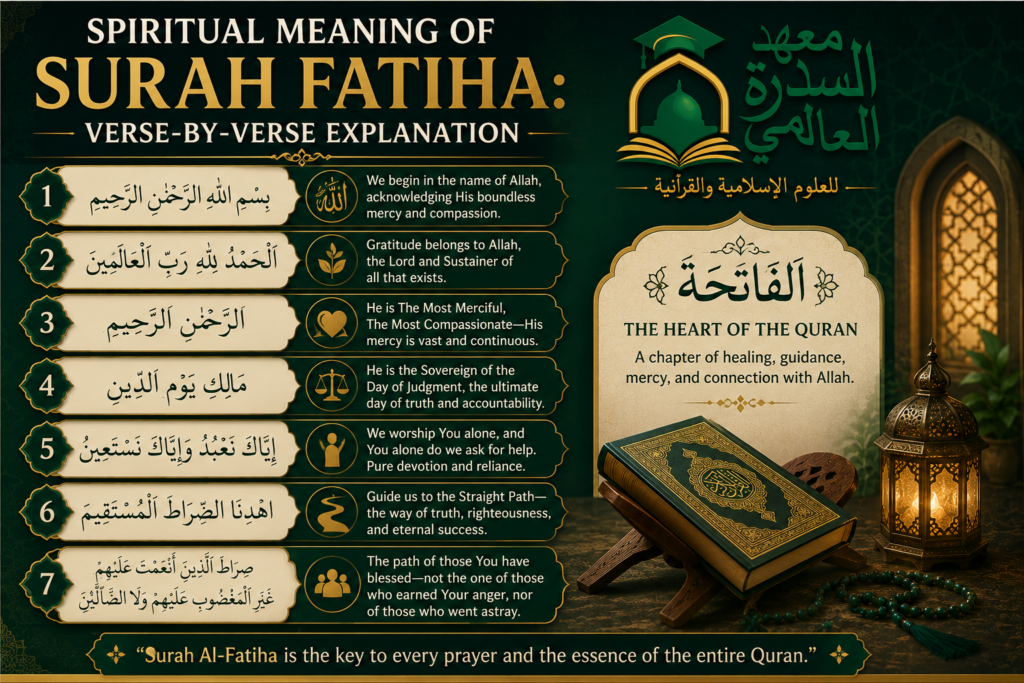
Surah Al-Fatiha is the most frequently recited chapter of the Quran. Every Muslim recites it multiple times each day in Salah, yet many people do not fully reflect on its profound spiritual message. This remarkable surah is more than an opening chapter—it is a complete guide to faith, worship, gratitude, dependence on Allah, and the pursuit of guidance.
Understanding the spiritual meaning of Surah Fatiha can transform the way we pray, strengthen our relationship with Allah, and help us live according to the values taught in Islam.
Quick Answer
The spiritual meaning of Surah Fatiha is a complete summary of a believer’s relationship with Allah. It teaches praise, gratitude, mercy, accountability, worship, reliance upon Allah, and the constant need for guidance. Each verse contains lessons that strengthen faith, improve Salah, and help Muslims remain on the Straight Path (Sirat al-Mustaqim).
Featured Snippet Answer
Surah Fatiha is the opening chapter of the Quran and a powerful supplication that teaches Muslims to praise Allah, recognize His mercy, acknowledge His authority over the Day of Judgment, worship Him alone, seek His help, and ask for guidance. Its spiritual meaning centers on faith, dependence on Allah, and living according to divine guidance.
What Is the Spiritual Meaning of Surah Fatiha?
The spiritual meaning of Surah Fatiha lies in its role as a conversation between a believer and Allah. It begins with praise, continues with recognition of Allah’s mercy and authority, then moves into worship, dependence, and a sincere request for guidance.
In only seven verses, Surah Fatiha summarizes the essential teachings of Islam:
- Who Allah is
- Who we are as His servants
- Why we worship Him
- What guidance we need
- How to remain steadfast in faith
Because of this comprehensive message, Surah Fatiha is often called Umm al-Kitab (The Mother of the Book).
Why Surah Fatiha Is So Important in Islam
Surah Al-Fatiha occupies a unique position in the Quran and in the life of every Muslim.
It is:
- The first chapter of the Quran
- An essential part of every unit (rak’ah) of Salah
- A powerful Dua
- A summary of the Quran’s central themes
- A source of spiritual reflection and guidance
The Prophet Muhammad ﷺ emphasized its importance and taught that no prayer is complete without its recitation.
Why It Is Called the Mother of the Quran
Surah Fatiha is called Umm al-Kitab because it contains the foundations of the Quran’s message.
The Quran teaches:
- Tawheed (Oneness of Allah)
- Worship
- Guidance
- Accountability
- Mercy
- The Hereafter
All of these themes are found within Surah Fatiha.
Just as a seed contains the blueprint of an entire tree, Surah Fatiha contains the essence of the Quran’s guidance.
Surah Fatiha and Daily Salah
Muslims recite Surah Fatiha in every rak’ah of Salah.
This repetition reminds believers daily to:
- Praise Allah
- Depend on Him alone
- Seek His guidance
- Reflect on the Hereafter
- Renew their commitment to faith
Every prayer becomes an opportunity to reconnect with Allah through the message of Surah Fatiha.
Overview of Surah Fatiha at a Glance
| Verse | Main Meaning | Spiritual Lesson |
| Bismillah | Begin with Allah | Depend on Allah in all matters |
| Alhamdulillah Rabbil Alamin | Praise belongs to Allah | Gratitude |
| Ar-Rahman Ar-Raheem | Allah’s Mercy | Hope and compassion |
| Maliki Yawmid-Deen | Master of Judgment Day | Accountability |
| Iyyaka Na’budu Wa Iyyaka Nasta’een | Worship and reliance | Sincerity |
| Ihdinas Siratal Mustaqeem | Seek guidance | Humility |
| Siratal Ladhina An’amta Alaihim | Path of the blessed | Following righteousness |
| Ghairil Maghdubi Alaihim Wa Lad-Dallin | Avoid error | Spiritual awareness |
Spiritual Meaning of Surah Fatiha Verse by Verse
Bismillahir Rahmanir Rahim
In the Name of Allah, the Most Compassionate, the Most Merciful
Every meaningful action in Islam begins with the name of Allah.
Spiritually, this verse teaches believers that success comes from Allah and that every action should be connected to Him.
Beginning with Bismillah reminds us:
- Allah is the source of all blessings.
- We should seek His help before every task.
- His mercy surrounds our lives.
Spiritual Reflection
A believer who starts every action with remembrance of Allah develops a stronger awareness of His presence throughout the day.
Alhamdulillahi Rabbil Alamin
All Praise Is Due to Allah, Lord of All Worlds
This verse teaches gratitude and recognition of Allah’s countless blessings.
The word Rabb refers to the One who creates, sustains, nurtures, and guides His creation.
Spiritual Lesson
True faith begins with gratitude.
When a believer recognizes that every blessing comes from Allah, arrogance decreases and thankfulness increases.
Practical Application
Instead of focusing only on difficulties, Surah Fatiha teaches us to recognize Allah’s favors and praise Him in all circumstances.
Ar-Rahman Ar-Raheem
The Most Compassionate, the Most Merciful
Allah repeats His attributes of mercy to remind believers that His mercy is vast and continuous.
Spiritual Lesson
No matter how many mistakes a person makes, Allah’s mercy remains open for those who sincerely repent.
This verse nurtures:
- Hope
- Optimism
- Trust in Allah
Practical Application
Believers should never despair of Allah’s mercy and should also show mercy to others.
Maliki Yawmid-Deen
Master of the Day of Judgment
This verse reminds us that every person will stand before Allah and answer for their deeds.
Spiritual Lesson
Faith is not only about hope; it also includes accountability.
Remembering the Day of Judgment helps believers:
- Avoid sins
- Improve character
- Increase sincerity
Practical Application
Before making decisions, ask yourself:
“Would I be pleased to present this action before Allah on the Day of Judgment?”
This reflection encourages better choices.
Iyyaka Na’budu Wa Iyyaka Nasta’een
You Alone We Worship and You Alone We Ask for Help
This is one of the most powerful verses in the Quran.
It combines:
- Worship (Ibadah)
- Dependence (Tawakkul)
A believer declares complete devotion to Allah while acknowledging total need for His assistance.
Spiritual Lesson
No one is completely self-sufficient.
Every success, achievement, and blessing comes through Allah’s help.
Practical Application
Whether facing exams, work challenges, family issues, or personal struggles, believers should turn to Allah before turning elsewhere.
Ihdinas Siratal Mustaqeem
Guide Us to the Straight Path
This verse contains one of the most important Duas in Islam.
Even believers who already follow Islam continue asking Allah for guidance.
Why?
Because guidance is needed every day.
Spiritual Lesson
True guidance is not a one-time event.
A Muslim needs guidance:
- In beliefs
- In worship
- In character
- In daily decisions
Practical Application
This verse teaches humility because no one can remain guided without Allah’s help.
Siratal Ladhina An’amta Alaihim
The Path of Those Upon Whom You Have Bestowed Favor
Believers ask Allah to place them among those who received His blessings.
These include:
- Prophets
- Truthful believers
- Martyrs
- The righteous
Spiritual Lesson
Faith grows through following good examples.
Islam encourages believers to learn from those who lived according to divine guidance.
Practical Application
Choose role models whose lives bring you closer to Allah rather than further from Him.
Ghairil Maghdubi Alaihim Wa Lad-Dallin
Not the Path of Those Who Earned Anger Nor Those Who Went Astray
The final verse teaches believers to avoid paths that lead away from Allah.
Spiritual Lesson
Knowledge alone is not enough.
Action alone is not enough.
A believer needs both correct knowledge and righteous action.
Practical Application
Regular learning, reflection, and sincere worship help protect Muslims from spiritual deviation.
The Relationship Between Allah and the Believer in Surah Fatiha
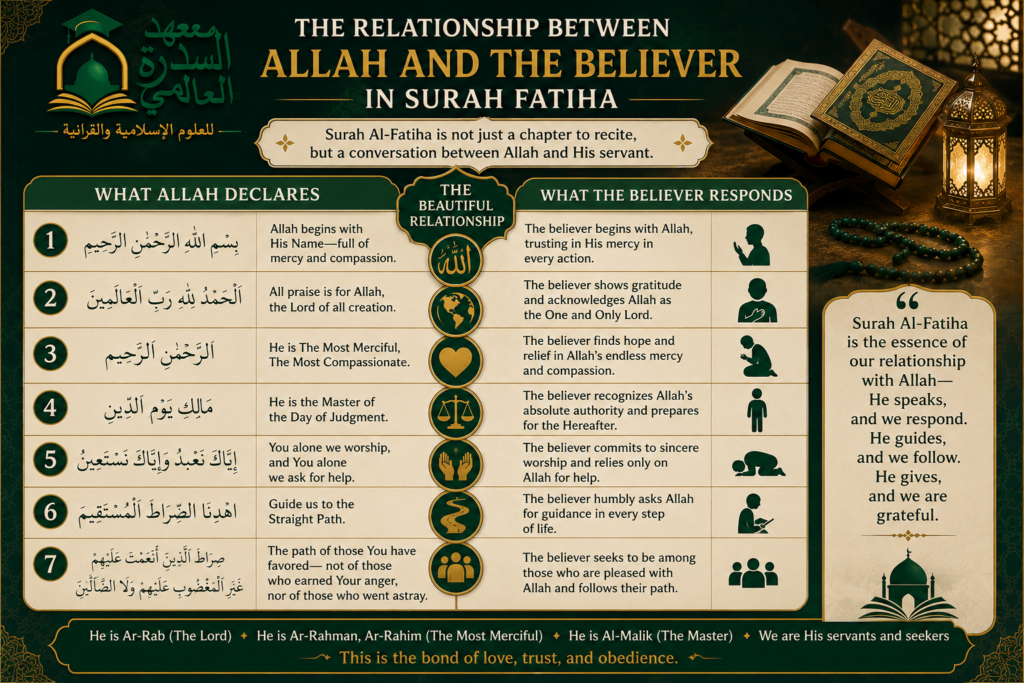
Surah Fatiha beautifully illustrates the relationship between the Creator and His servant.
The believer:
- Praises Allah
- Recognizes His mercy
- Acknowledges His authority
- Worships Him alone
- Seeks His help
- Requests His guidance
Allah, in turn, provides:
- Mercy
- Guidance
- Forgiveness
- Blessings
- Protection
This relationship forms the foundation of Islamic spirituality.
Spiritual Lessons We Learn From Surah Fatiha
Gratitude
The surah begins with praise, teaching believers to appreciate Allah’s blessings.
Hope
Allah’s mercy is mentioned repeatedly, encouraging optimism and repentance.
Accountability
Remembering the Day of Judgment motivates responsible behavior.
Worship
Life gains purpose when worship becomes centered on Allah alone.
Reliance Upon Allah
True strength comes from trusting Allah rather than relying solely on personal abilities.
Seeking Guidance
Believers continuously seek guidance because spiritual growth never ends.
How Surah Fatiha Strengthens Faith and Improves Salah
Many Muslims struggle with concentration during prayer.
Understanding the meaning of Surah Fatiha can significantly improve focus.
Instead of reciting words mechanically, believers begin to feel the message behind every verse.
When praying, remember:
- You are praising Allah.
- You are acknowledging His mercy.
- You are preparing for accountability.
- You are renewing your worship.
- You are asking for guidance.
This understanding creates a deeper spiritual connection and greater humility during Salah.
Practical Ways to Reflect on Surah Fatiha Daily
Read the Translation Regularly
Understanding the meaning helps strengthen reflection during prayer.
Study Basic Tafsir
Learning the explanation of each verse reveals deeper spiritual lessons.
Reflect During Salah
Pause mentally on the meaning of each verse while reciting it.
Apply Its Teachings
Practice:
- Gratitude
- Mercy
- Worship
- Trust in Allah
- Seeking guidance
Make It a Daily Dua
Remember that Surah Fatiha is not merely recitation; it is also a sincere request for divine guidance.
Common Misconceptions About Surah Fatiha
Surah Fatiha Is Only a Translation Exercise
False.
Its purpose goes far beyond understanding words. It teaches spiritual transformation and personal growth.
Surah Fatiha Is Only for Salah
False.
While central to prayer, its lessons apply to every aspect of life.
Understanding Surah Fatiha Is Not Necessary
False.
Understanding its meanings can greatly enhance sincerity, concentration, and spiritual development.
Key Takeaways From Surah Fatiha
- Surah Fatiha summarizes the core message of Islam.
- It teaches praise, mercy, accountability, worship, and guidance.
- Every verse contains spiritual lessons for daily life.
- It strengthens faith and improves concentration in Salah.
- It serves as both a chapter of the Quran and a powerful Dua.
- Understanding its meaning deepens one’s connection with Allah.
Frequently Asked Questions
What is the spiritual meaning of Surah Fatiha?
The spiritual meaning of Surah Fatiha is the believer’s journey of praising Allah, recognizing His mercy, worshipping Him alone, relying upon Him, and seeking guidance on the Straight Path.
Why is Surah Fatiha called the Mother of the Quran?
It is called Umm al-Kitab because it contains the essential themes of the Quran, including faith, worship, guidance, mercy, and accountability.
Is Surah Fatiha a Dua?
Yes. While it is a chapter of the Quran, it also contains a direct supplication asking Allah for guidance.
Why is Surah Fatiha recited in every Salah?
Its message is central to Islamic worship and serves as a daily renewal of faith, dependence on Allah, and commitment to divine guidance.
What does Surah Fatiha teach us?
It teaches gratitude, hope, worship, reliance upon Allah, accountability, and the importance of following the Straight Path.
How does Surah Fatiha strengthen faith in Allah?
By reminding believers of Allah’s mercy, power, guidance, and authority, it increases trust, sincerity, and spiritual awareness.
What is the most important lesson in Surah Fatiha?
One of the greatest lessons is that true success comes through worshipping Allah alone and continually seeking His guidance.
Conclusion
The spiritual meaning of Surah Fatiha extends far beyond its seven verses. It is a complete roadmap for a believer’s life, teaching gratitude, mercy, worship, dependence upon Allah, and the pursuit of guidance. Every time Muslims recite Surah Fatiha in Salah, they renew their covenant with Allah and reaffirm their commitment to follow the Straight Path.
By studying, reflecting upon, and applying the lessons of Surah Fatiha, believers can strengthen their faith, improve their worship, and develop a deeper spiritual connection with Allah. This is why Surah Al-Fatiha remains one of the most powerful and transformative chapters in the entire Quran.
For structured learning, beginners can follow:
To continue your Islamic learning journey, you may also like our guides on [How Many Sajdahs Are in the Quran? Complete Guide (2026)], [Why Surah Fatiha Is a Complete Dua in Islam: Full Explanation], and [Bible vs Quran Accuracy: Comparing Accuracy & Reliability]. Exploring related topics can help you build a stronger understanding of Islam, the Quran, and everyday Islamic practices.