
Introduction
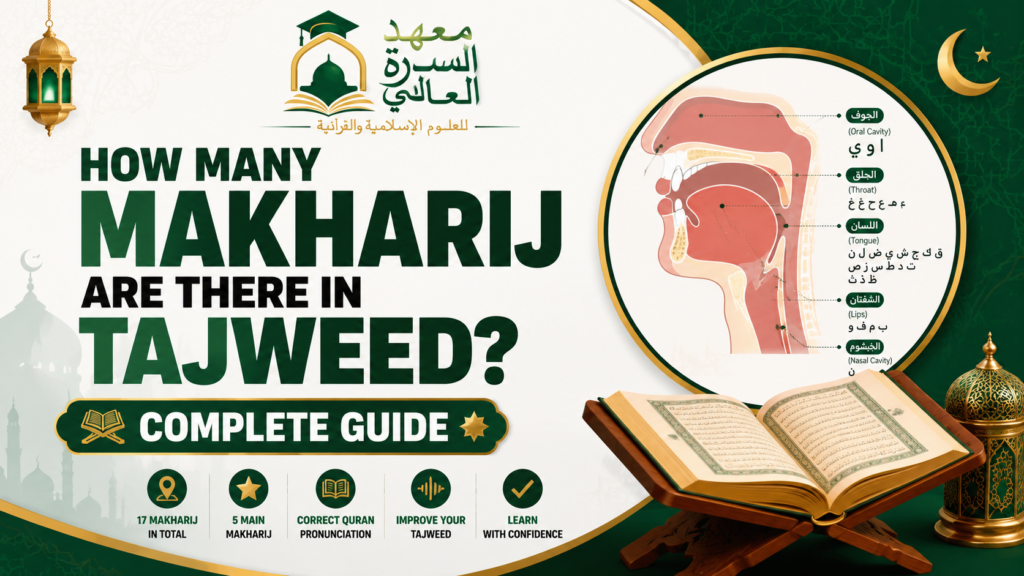
If you’ve recently started learning Tajweed, you’ve probably come across two different answers to the same question: Are there 5 Makharij or 17 Makharij? This often confuses beginners and makes the topic seem more complicated than it really is.
The good news is that both answers are correct, depending on how the articulation points are being classified. In the widely taught system of Tajweed, there are five main articulation regions (Makharij), which are further divided into seventeen detailed articulation points. Understanding this relationship makes it much easier to pronounce Arabic letters correctly and recite the Quran with confidence.
In this guide, you’ll learn what Makharij are, why both numbers are used, how the five major regions are organized, and why mastering them is one of the most important steps in learning Tajweed.
Quick Answer
There are five main Makharij (major articulation regions) in Tajweed. These five regions are further divided into seventeen detailed articulation points according to the widely taught classification used by Tajweed scholars. Every Arabic letter has a specific Makhraj, or place of articulation, which helps ensure correct Quranic pronunciation.
Key Facts
| Question | Answer |
| How many main Makharij are there? | 5 |
| How many detailed Makharij are there? | 17 |
| What is a Makhraj? | The place where an Arabic letter is pronounced |
| Why are Makharij important? | They help preserve correct Quran pronunciation |
Key Takeaway: There is no contradiction between five and seventeen Makharij. The five are the major regions, while the seventeen are the detailed articulation points within those regions.
What Is a Makhraj in Tajweed?
A Makhraj (plural: Makharij) is the exact place from which an Arabic letter is pronounced. In Tajweed, every letter has its own point of articulation. Pronouncing a letter from the wrong place can change its sound and, in some cases, even alter the meaning of a word.
For example, some Arabic letters may sound similar to beginners, but they originate from different parts of the mouth or throat. Learning their correct Makharij helps distinguish these letters clearly.
Think of a Makhraj as the “birthplace” of a letter. Just as every person has a specific hometown, every Arabic letter has a specific point from which it should be pronounced.
Learning Makharij allows you to:
- Pronounce Arabic letters accurately.
- Improve your Quran recitation.
- Avoid confusing similar sounds.
- Build a strong foundation for learning Tajweed.
- Recite the Quran with greater confidence and clarity.
Key Takeaway: A Makhraj is the precise point of articulation for an Arabic letter, making it one of the foundations of correct Tajweed.
Why Do Some Books Mention 5 Makharij While Others Mention 17?
This is one of the most common questions among students of Tajweed.
The confusion comes from the way articulation points are classified.
The Five Main Makharij
The five Makharij refer to the major regions from which Arabic letters are pronounced:
- Oral cavity
- Throat
- Tongue
- Lips
- Nasal cavity
These broad regions make it easier for beginners to understand where sounds originate.
The Seventeen Detailed Makharij
Each of the five major regions contains one or more specific articulation points. When these individual points are counted separately, the total becomes seventeen in the widely taught classification.
This means:
- 5 = Major articulation regions
- 17 = Detailed articulation points within those regions
Both descriptions refer to the same pronunciation system. One is broad, while the other is more detailed.
Why This Matters
As you progress in Tajweed, you’ll move from recognizing the five major regions to mastering the individual articulation points for each Arabic letter. Understanding both classifications helps you appreciate how precise Quranic pronunciation is.
Key Takeaway: Five and seventeen are not competing numbers—they describe the same system at different levels of detail.
The Five Main Makharij Explained
The Arabic letters originate from five primary articulation regions. Each region contains one or more detailed points where specific letters are pronounced.
| Main Makhraj | Arabic Name | Primary Function |
| Oral Cavity | Al-Jawf | Produces elongated vowel sounds |
| Throat | Al-Halq | Produces throat letters |
| Tongue | Al-Lisan | Produces most Arabic letters |
| Lips | Ash-Shafatan | Produces lip letters |
| Nasal Cavity | Al-Khayshum | Produces the nasal sound (Ghunnah) |
Let’s look at each one.
1. Al-Jawf (The Oral Cavity)
Al-Jawf refers to the open space inside the mouth and throat. It is associated with the long vowel sounds used in Quran recitation.
Rather than relying on a specific contact point between the tongue and mouth, these sounds flow naturally through the oral cavity.
When learning Tajweed, students are taught to maintain the correct length and clarity of these vowel sounds without forcing them.
Tips for Practice
- Keep the mouth relaxed.
- Avoid shortening long vowels.
- Listen carefully to a qualified reciter and imitate the duration of each sound.
2. Al-Halq (The Throat)
The throat is responsible for several Arabic letters that many beginners find challenging because similar sounds may not exist in their native language.
The throat is commonly divided into three sections:
- Upper throat
- Middle throat
- Lower throat
Each section produces different letters.
Many learners initially struggle to distinguish these sounds, but consistent listening and guided practice usually lead to noticeable improvement.
Practice Tips
- Do not force throat sounds.
- Practice slowly.
- Compare similar letters one at a time.
- Use a mirror and listen to experienced reciters.
3. Al-Lisan (The Tongue)
The tongue is the largest and most important articulation region in Tajweed.
Most Arabic letters originate from different parts of the tongue interacting with areas such as the upper teeth or the roof of the mouth.
Because so many letters are pronounced here, students spend significant time learning the precise tongue placement for each group of letters.
Small differences in tongue position can produce completely different sounds, which is why careful practice is essential.
Tips
- Learn one tongue-letter group at a time.
- Practice slowly before increasing speed.
- Repeat difficult sounds until they become natural.
4. Ash-Shafatan (The Lips)
Some Arabic letters are produced primarily through the movement of the lips.
Correct lip positioning helps distinguish these sounds clearly and prevents common pronunciation mistakes.
Students should pay attention to:
- Lip closure
- Lip rounding
- Gentle airflow
- Relaxed movement
Watching experienced Quran teachers pronounce these letters can be especially helpful.
5. Al-Khayshum (The Nasal Cavity)
The nasal cavity is associated with the Ghunnah, the characteristic nasal resonance used in specific Tajweed rules.
Unlike the other Makharij, the nasal cavity is not used to produce independent letters. Instead, it contributes a nasal quality to certain sounds during recitation.
Learning to control this resonance helps improve fluency and accuracy while avoiding exaggerated or insufficient nasalization.
Beginner Tip
Practice Ghunnah under the guidance of a qualified teacher, as beginners often overemphasize or shorten the nasal sound.
Summary of the Five Main Makharij
| Main Region | Purpose |
| Al-Jawf | Long vowel sounds |
| Al-Halq | Throat letters |
| Al-Lisan | Most Arabic letters |
| Ash-Shafatan | Lip letters |
| Al-Khayshum | Nasal resonance (Ghunnah) |
Key Takeaways So Far
- Every Arabic letter has a specific point of articulation.
- There are five major articulation regions.
- These five regions contain seventeen detailed articulation points.
- Learning Makharij improves Quran pronunciation and forms the foundation of Tajweed.
- Beginners should master the major regions before focusing on the finer details.
The Seventeen Detailed Articulation Points
Now that you understand the five main Makharij, it’s time to look at the seventeen detailed articulation points. These are the specific locations from which the Arabic letters are pronounced according to the widely taught classification in Tajweed.
Think of it this way:
- Five Makharij are like the main regions of a country.
- Seventeen Makharij are the individual cities within those regions.
Learning these detailed points helps you pronounce every Arabic letter from its correct place.
Overview of the Seventeen Makharij
| Main Region | Detailed Articulation Points |
| Al-Jawf (Oral Cavity) | 1 |
| Al-Halq (Throat) | 3 |
| Al-Lisan (Tongue) | 10 |
| Ash-Shafatan (Lips) | 2 |
| Al-Khayshum (Nasal Cavity) | 1 |
| Total | 17 |
1. Al-Jawf (Oral Cavity)
Number of Articulation Points
1
This region produces the long vowel sounds (Madd letters).
These sounds flow through the open space of the mouth without a fixed contact point.
Examples include the long forms of:
- ا
- و
- ي
Common Beginner Mistakes
- Shortening long vowels.
- Stretching them too much.
- Mixing long and short vowel sounds.
Practice Tip
Listen carefully to a qualified reciter and match both the sound and the length of each vowel.
Key Takeaway: Long vowels should sound smooth and natural without being rushed or exaggerated.
2. Al-Halq (The Throat)
The throat contains three detailed articulation points.
A. Lowest Part of the Throat
Letters are produced from the deepest area of the throat.
Examples:
- ء
- هـ
B. Middle of the Throat
Examples:
- ع
- ح
These letters are often difficult for beginners because similar sounds may not exist in many other languages.
C. Upper Part of the Throat
Examples:
- غ
- خ
These letters originate closer to the mouth than the previous throat sounds.
Practice Tips
- Avoid forcing the throat.
- Practice slowly.
- Compare one pair of letters at a time.
- Record your recitation and compare it with a qualified teacher.
Key Takeaway: Small differences within the throat create different Arabic letters.
3. Al-Lisan (The Tongue)
The tongue contains ten articulation points, making it the largest and most detailed region.
Most Arabic letters originate here.
Rather than memorizing all ten immediately, beginners should understand that different parts of the tongue interact with:
- the roof of the mouth,
- the gums,
- and the upper teeth.
This creates different sounds.
Examples of tongue letters include:
- ق
- ك
- ج
- ش
- ي (non-vowel)
- ض
- ل
- ن
- ر
- ط
- د
- ت
- ص
- س
- ز
Why the Tongue Is So Important
Because the majority of Arabic letters come from the tongue, even slight positioning errors can change the sound.
Practice Tips
- Learn one group at a time.
- Do not rush.
- Focus on precision before speed.
- Repeat difficult sounds daily.
Key Takeaway: Mastering tongue placement is one of the biggest steps toward fluent Quran recitation.
4. Ash-Shafatan (The Lips)
The lips contain two articulation points.
Some letters are produced when:
- both lips meet,
- or the lower lip touches the upper front teeth.
Examples include:
- ف
- ب
- م
- و (non-vowel)
Common Errors
- Weak lip closure.
- Over-rounding the lips.
- Confusing similar sounds.
Practice Tips
Watch your lip movement in a mirror while reciting.
Key Takeaway: Clear lip movement helps distinguish several important Arabic letters.
5. Al-Khayshum (The Nasal Cavity)
The nasal cavity contains one articulation point.
It produces the nasal resonance known as Ghunnah.
Unlike the other Makharij, it is not the origin of independent Arabic letters. Instead, it adds a nasal quality during specific Tajweed rules.
Practice Tips
- Avoid exaggerating the nasal sound.
- Keep it smooth and controlled.
- Practice under qualified supervision whenever possible.
Key Takeaway: Ghunnah should sound natural rather than forced.
Summary Table of the Seventeen Makharij
| Main Region | Detailed Points | Main Function |
| Al-Jawf | 1 | Long vowel sounds |
| Al-Halq | 3 | Throat letters |
| Al-Lisan | 10 | Most Arabic letters |
| Ash-Shafatan | 2 | Lip letters |
| Al-Khayshum | 1 | Nasal resonance |
| Total | 17 | Complete articulation system |
Makharij vs. Sifaat: What Is the Difference?
Many beginners confuse Makharij and Sifaat, but they describe two different aspects of pronunciation.
| Makharij | Sifaat |
| Place where a letter is pronounced | Characteristics or qualities of the letter |
| Answers “Where?” | Answers “How?” |
| Focuses on articulation point | Focuses on pronunciation characteristics |
| Determines letter origin | Determines how the letter sounds |
Simple Example
Imagine driving a car.
- Makharij tell you where the journey begins.
- Sifaat describe how you drive.
Both are necessary for correct Quran recitation.
Key Takeaway: Makharij identify the letter’s origin, while Sifaat describe its pronunciation characteristics.
Why Are Makharij So Important in Quran Recitation?
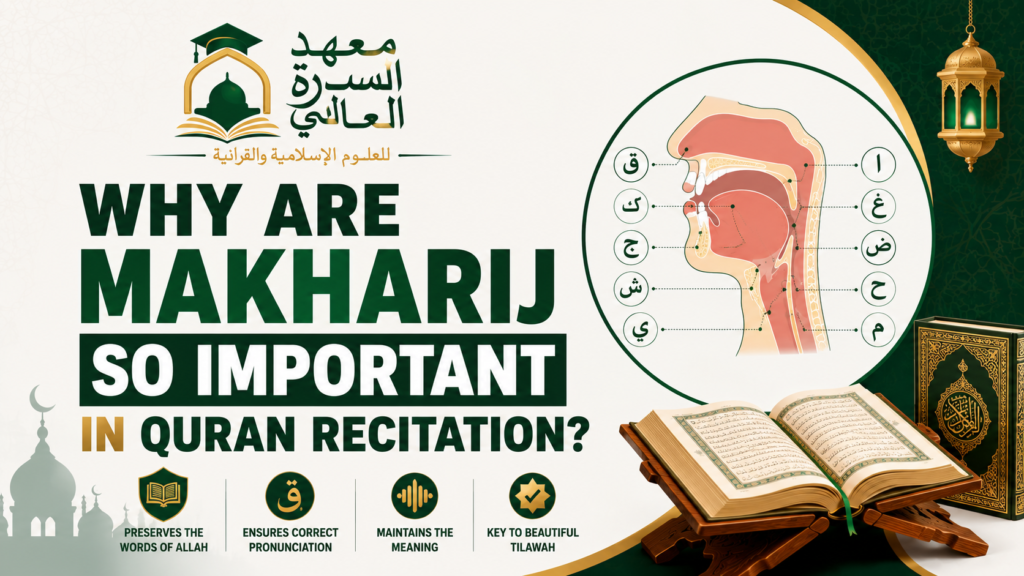
Correct Makharij are one of the foundations of Tajweed.
Every Arabic letter has its own unique sound. If a letter is pronounced from the wrong place, it may resemble another letter and change the intended pronunciation.
Learning Makharij helps you:
- Pronounce every Arabic letter accurately.
- Distinguish similar sounds.
- Improve fluency.
- Read the Quran with greater confidence.
- Build a solid foundation before studying advanced Tajweed rules.
For beginners, mastering Makharij often leads to noticeable improvements in clarity and confidence.
Key Takeaway: Correct Makharij preserve the distinct sound of every Arabic letter and support accurate Quran recitation.
Common Pronunciation Mistakes Beginners Make
Learning Makharij takes patience. Nearly every beginner makes mistakes at first, and that is a normal part of the learning process.
Here are some of the most common errors.
| Mistake | Why It Happens | How to Improve |
| Mixing similar letters | Similar sounds | Practice minimal pairs individually |
| Shortening long vowels | Lack of timing | Count vowel length while practicing |
| Weak tongue placement | New mouth movements | Slow repetition with feedback |
| Incorrect throat sounds | Unfamiliar pronunciation | Listen and imitate qualified reciters |
| Overusing Ghunnah | Trying too hard | Keep the nasal sound natural |
Practical Tips to Avoid Mistakes
1. Practice Slowly
Accuracy comes before speed.
2. Listen More Than You Speak
Regular listening trains your ear to recognize correct pronunciation.
3. Use a Mirror
Watching your lips and tongue movement helps identify mistakes.
4. Record Yourself
Comparing your recitation with a qualified teacher can reveal differences you may not notice while speaking.
5. Practice Daily
Even 10–15 minutes of focused practice each day can lead to steady improvement.
Section Summary
By understanding the seventeen detailed articulation points, you gain a clearer picture of how every Arabic letter is pronounced. Combined with knowledge of the five main Makharij, this forms the foundation of correct Tajweed and prepares you for more advanced pronunciation rules.
How to Improve Your Makharij
Learning Makharij is not about memorizing tables alone. It is a practical skill that develops through regular listening, careful observation, and consistent practice. Even experienced students continue refining their pronunciation over time.
If you’re just beginning, don’t try to master all seventeen articulation points in one sitting. Instead, focus on steady progress.
1. Learn the Arabic Alphabet Correctly
A strong foundation begins with learning each Arabic letter from its correct articulation point.
If you are new to Quran reading, studying Noorani Qaida before advanced Tajweed lessons can make learning Makharij much easier.
2. Learn One Group at a Time
Avoid trying to memorize every articulation point at once.
A simple learning sequence is:
- Learn the five main Makharij.
- Study one articulation region each week.
- Practice the letters belonging to that region.
- Move to the next group only after becoming comfortable with the previous one.
This gradual approach helps build confidence and improves retention.
3. Listen to Qualified Quran Reciters
Listening is one of the fastest ways to improve pronunciation.
Pay attention to:
- Where each sound originates.
- The clarity of every letter.
- The length of long vowels.
- The natural flow of recitation.
Try repeating a short verse immediately after listening to it.
4. Practice in Front of a Mirror
A mirror helps you observe:
- Lip movement
- Mouth opening
- Tongue position (where visible)
- Jaw movement
Many beginners discover pronunciation mistakes simply by watching themselves recite.
5. Record Your Recitation
Recording yourself allows you to compare your pronunciation with that of a qualified teacher or experienced reciter.
Often, mistakes become much easier to notice when listening to a recording than while reciting.
6. Learn From a Qualified Teacher
Books and articles provide valuable knowledge, but a qualified Tajweed teacher can identify subtle pronunciation errors that are difficult to recognize on your own.
Personal feedback helps correct mistakes before they become habits.
7. Practice Consistently
Short, regular practice sessions are more effective than occasional long sessions.
Sample Daily Routine
| Activity | Time |
| Review previous letters | 5 minutes |
| Practice one articulation group | 10 minutes |
| Listen to a qualified reciter | 5 minutes |
| Read Quran with focus on Makharij | 10 minutes |
| Self-review | 5 minutes |
Total: Approximately 35 minutes per day
Even if you have less time, practicing consistently for 10–15 minutes daily is beneficial.
Key Takeaway: Consistency and correct guidance are more important than practicing for long periods without feedback.
Beginner Practice Exercises
Try these simple exercises to strengthen your Makharij.
Exercise 1: Slow Letter Practice
Recite each Arabic letter individually.
Focus on:
- Clarity
- Accuracy
- Correct articulation point
Do not worry about speed.
Exercise 2: Similar Letter Comparison
Practice pairs of letters that beginners often confuse.
For example:
- ق and ك
- ص and س
- ط and ت
- ض and د
- ظ and ذ
Listen carefully to the differences before repeating them.
Exercise 3: Read Short Words
Once individual letters become comfortable, practice short Arabic words containing those letters.
This helps connect isolated sounds to actual Quranic reading.
Exercise 4: Read Slowly
Reading slowly gives your tongue, lips, and throat enough time to produce each letter correctly.
Speed naturally improves with experience.
Exercise 5: Daily Revision
Spend a few minutes each day reviewing previously learned articulation points before learning new ones.
Regular revision helps prevent forgetting.
Common Misconceptions About Makharij
Many beginners have misunderstandings about Tajweed. Clearing these up early makes learning easier.
| Misconception | Reality |
| There are only five Makharij. | There are five major regions divided into seventeen detailed articulation points. |
| Makharij and Sifaat are the same. | Makharij identify where a letter is pronounced; Sifaat describe how it is pronounced. |
| Good pronunciation comes naturally. | Correct pronunciation requires learning and practice. |
| Memorizing the chart is enough. | Practical application is essential. |
| Adults cannot improve their Makharij. | Learners of all ages can improve through regular practice and guidance. |
Key Takeaway: Understanding the theory is important, but consistent application is what improves recitation.
Key Takeaways
Before moving on to more advanced Tajweed topics, remember these essential points:
- A Makhraj is the place where an Arabic letter is pronounced.
- The widely taught classification includes five main articulation regions.
- These five regions are divided into seventeen detailed articulation points.
- Every Arabic letter has a specific point of articulation.
- Correct Makharij help preserve accurate Quran pronunciation.
- Makharij and Sifaat are related but different concepts.
- Regular practice and qualified guidance lead to steady improvement.
Frequently Asked Questions (FAQs)
How many Makharij are there in Tajweed?
There are five main Makharij, which are divided into seventeen detailed articulation points according to the widely taught classification in Tajweed.
What is a Makhraj?
A Makhraj is the exact place from which an Arabic letter is pronounced. Every Arabic letter has its own specific articulation point.
Why are there both 5 and 17 Makharij?
The five Makharij refer to the major articulation regions, while the seventeen Makharij refer to the detailed articulation points within those regions. Both descriptions refer to the same pronunciation system at different levels of detail.
What are the five main Makharij?
The five main articulation regions are:
- Al-Jawf (Oral Cavity)
- Al-Halq (Throat)
- Al-Lisan (Tongue)
- Ash-Shafatan (Lips)
- Al-Khayshum (Nasal Cavity)
Which articulation region contains the most letters?
The tongue (Al-Lisan) contains the largest number of detailed articulation points and is responsible for producing most Arabic letters.
What is the difference between Makharij and Sifaat?
Makharij identify the place where a letter is pronounced, while Sifaat describe the qualities or characteristics of that letter during pronunciation.
Is learning Makharij necessary for beginners?
Yes. Learning Makharij early helps beginners develop correct pronunciation habits and provides a solid foundation for studying Tajweed.
Can I learn Makharij without a teacher?
You can learn the theory through books, articles, and videos, but a qualified teacher is highly recommended for correcting pronunciation and providing feedback.
How long does it take to learn Makharij?
The time varies from person to person. With regular practice and guidance, many beginners become comfortable with the basic articulation regions within a few weeks, while mastering all pronunciation details usually takes longer.
What should I study after learning Makharij?
After becoming familiar with Makharij, learners typically continue with other foundational Tajweed topics, such as:
- Sifaat al-Huruf
- Ghunnah
- Madd rules
- Qalqalah
- Noon Sakinah and Tanween
- Meem Sakinah
- Rules of stopping and starting (Waqf and Ibtida)
These topics build upon the pronunciation skills learned through Makharij.
Conclusion
Understanding how many Makharij there are in Tajweed is one of the first steps toward correct Quran recitation. While the different numbers may seem confusing at first, the explanation is straightforward: there are five main articulation regions, which are divided into seventeen detailed articulation points in the widely taught Tajweed classification.
Learning these articulation points is about more than memorizing names or tables. It is about training your tongue, lips, throat, and mouth to pronounce every Arabic letter from its proper place. This careful attention to pronunciation helps preserve the beauty and accuracy of Quran recitation.
If you’re just beginning your Tajweed journey, focus on understanding the five major regions first. Then, gradually learn the detailed articulation points through regular practice, attentive listening, and guidance from a qualified teacher. With patience and consistency, your pronunciation will become clearer, more confident, and closer to the established rules of Tajweed.
Continue Your Quran Islamic Learning
To strengthen your understanding of Salah and Quran recitation, you may also find these topics helpful:
Related Articles
What Is Tajweed in Quran? Rules, Principles & Importance
Al Halq in Tajweed: Meaning, Six Throat Letters, Makharij & Guide
What Is Makhraj in Tajweed? Complete Guide to Makharij of Arabic
Challenges in Learning Tajweed: Causes, Difficulties, and Solutions
Recommended Courses
By combining authentic knowledge with regular practice, you can continue building a stronger connection with Allah and perform your daily prayers with confidence, understanding, and devotion.